
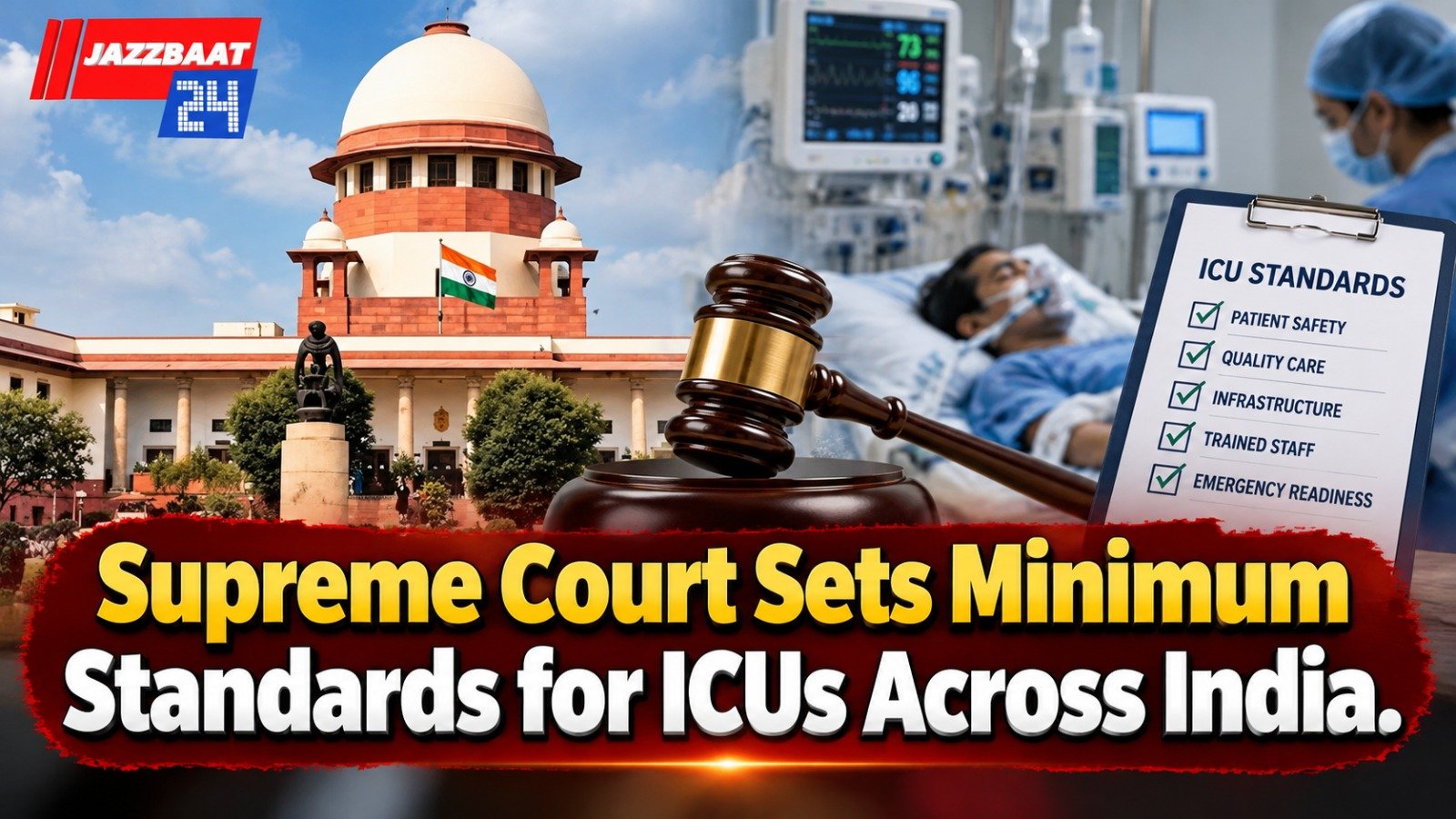
The Supreme Court has directed States and Union Territories to implement minimum standards for establishing and operating Intensive Care Units (ICUs) across the country, bringing both government and private hospitals under a common framework.
A bench of Justices Ahsanuddin Amanullah and R Mahadevan on Monday made the guidelines applicable nationwide. The framework, prepared with the involvement of medical experts and placed before the court by the Union health ministry, lays down basic requirements for ICU infrastructure, equipment, staffing and clinical services.
The guidelines divide intensive care facilities into three levels. Level 1 ICUs are intended to provide basic stabilisation and care, while Level 2 and Level 3 facilities provide increasingly specialised services for patients requiring more complex and advanced critical care. The framework is designed to ensure that hospitals identifying themselves as having ICUs meet certain minimum requirements.
Among the requirements are essential emergency equipment such as ventilators, defibrillators and ECG machines. ICU beds are also expected to have access to oxygen, suction facilities, electrical outlets and other bedside utilities, including monitoring equipment and infusion pumps. Laboratory and imaging services such as X-rays and ultrasound should also be available in close proximity to the ICU.
The court has also emphasised the importance of trained medical and nursing personnel. Earlier proceedings highlighted the need for appropriately qualified intensivists and trained nursing staff capable of managing critically ill patients around the clock. The guidelines also stress continuing training, infection-control practices and periodic audits.
Implementation will take place in phases. According to the latest directions, states and Union Territories have been given time-bound targets, with some requirements expected to be addressed within three months and the overall implementation exercise extending up to nine months. Some states have told the court that establishing Level 1 ICUs in remote and hilly regions will require additional time because of infrastructure challenges.
The framework also places importance on technology-driven critical care. Earlier Supreme Court proceedings supported the use of tele-ICU systems and a broader digital network to connect hospitals with specialist centres. Such arrangements could help smaller and remote hospitals obtain expert support when specialised critical-care doctors are not immediately available.
The issue has been under the Supreme Court's consideration for several years, with the proceedings focusing on the absence of uniform standards for ICU and critical-care services. In April, the court described the consensus document as a practical and implementable foundation for minimum ICU standards and directed that it be shared with all states and Union Territories.
The latest order marks a significant step towards creating a common baseline for critical-care facilities across India. The objective is to ensure that essential infrastructure, equipment and trained personnel are available when patients require intensive medical support, while allowing implementation to take account of differences in hospital capacity and local resources.




Reader Comments 0