
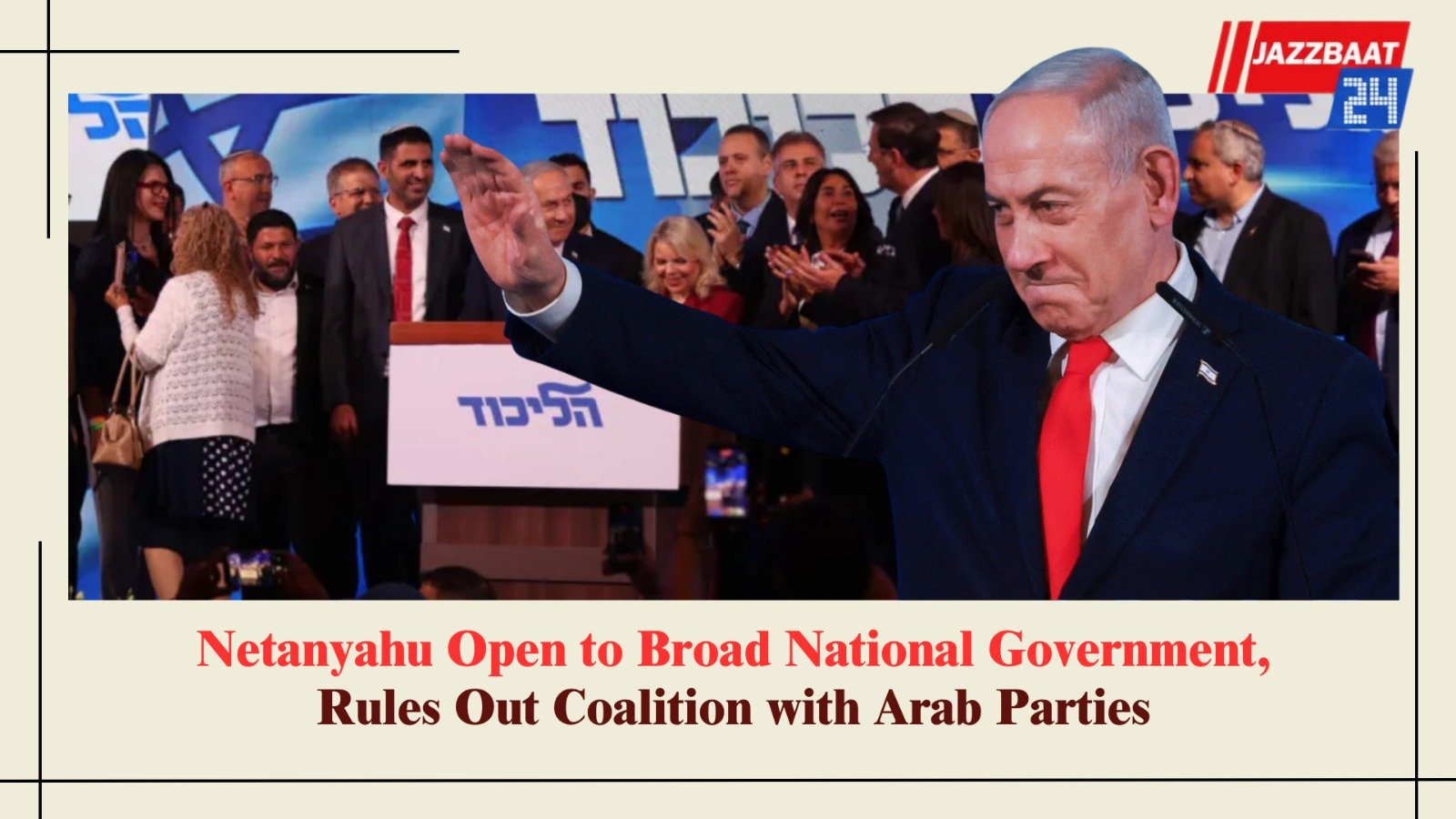
Jerusalem: Israeli Prime Minister Benjamin Netanyahu has expressed willingness to form a broad national government following the country's recent parliamentary elections, but has firmly ruled out forming an administration dependent on Arab-led political parties. His statement comes amid uncertainty over the formation of Israel's next government, as neither political bloc has secured the required majority in the 120-member Knesset.
In a statement posted on social media on Monday, Netanyahu said his Likud party had emerged as the largest political party and claimed that he had received a mandate from the Jewish electorate to lead the next government.
"The public in Israel does not want a government that depends on Ra'am and the Joint List," Netanyahu said, accusing the two Arab-led political groups of supporting terrorism and rejecting the existence of the Jewish state. These allegations reflect Netanyahu's political position and have been disputed by the parties concerned.
He added that Likud was ready to extend its support to any political party willing to join a broad national government, provided it did not support terrorism.
"We aspire to form a broad government with our partners and with any party that wishes to do so and does not support terrorism. I am open to holding discussions on the matter," he said.
Election results create political uncertainty
The October 27 parliamentary elections have produced a complicated political situation. Netanyahu's Likud party secured 27 seats, while his broader political bloc won 53 seats. The opposition bloc led by Gadi Eisenkot secured 48 seats, while Arab-led parties collectively won 19 seats.
A political alliance needs at least 61 seats to command a majority in the Knesset and form a government. The results have therefore left both sides facing challenges in securing the numbers required to govern.
Opposition backs Gadi Eisenkot
Meanwhile, opposition leaders have rallied behind Gadi Eisenkot, leader of the Yashar party, as their preferred candidate to form the next government. Opposition parties are scheduled to meet to coordinate their strategy and discuss their next steps.
Eisenkot has reportedly ruled out joining a government led by Netanyahu, even if US President Donald Trump requests him to reconsider.
Avigdor Lieberman, leader of Yisrael Beytenu, has also rejected joining a Netanyahu-led administration.
President Isaac Herzog is expected to begin consultations with political representatives on November 4 and 5 before deciding whom to invite to form the government.
The political deadlock has raised the possibility of prolonged negotiations as Israel's political parties attempt to secure the support needed to establish the next administration.


Reader Comments 0