
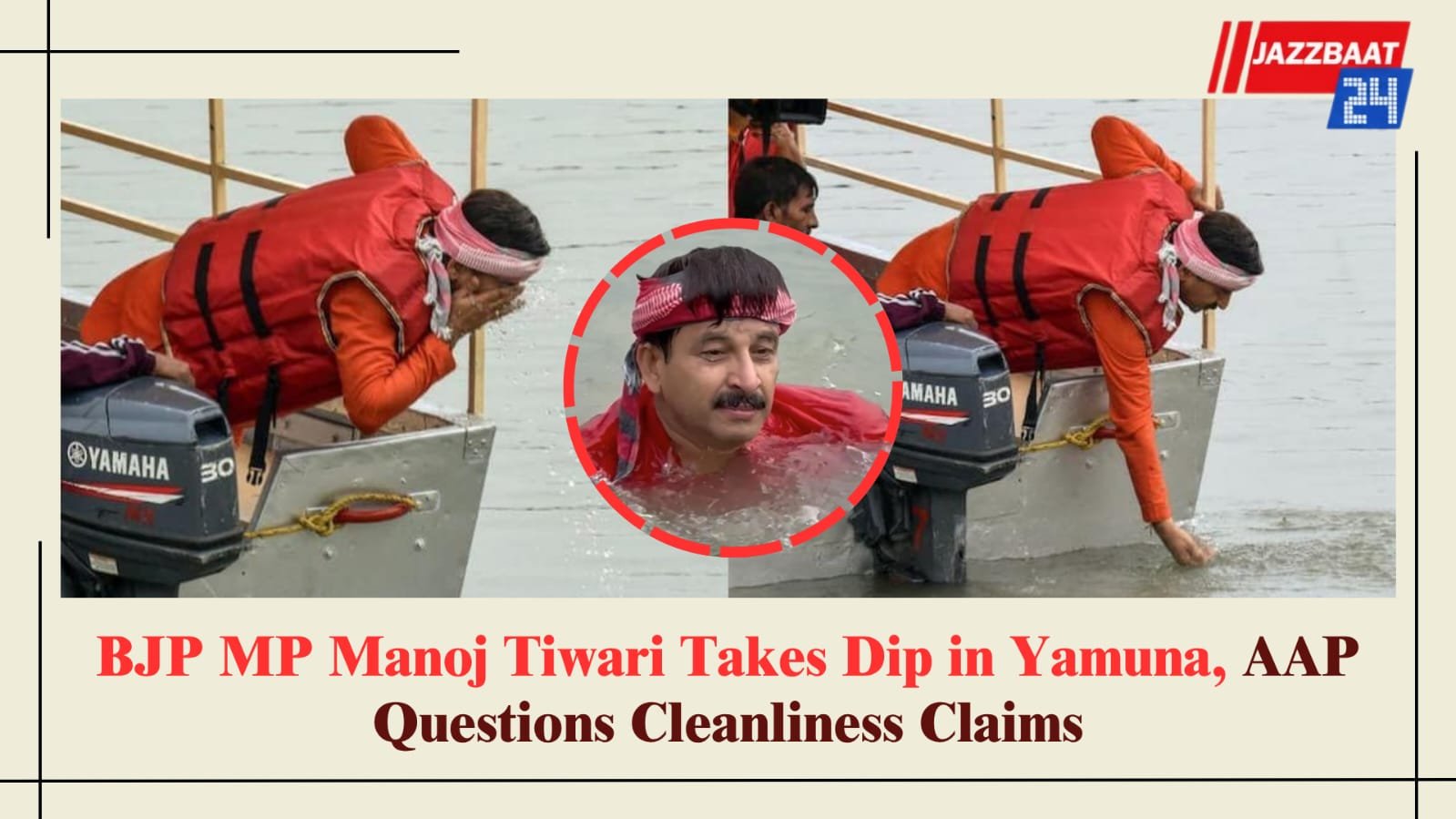
News Desk: A fresh political battle has erupted over the cleanliness of the Yamuna River ahead of Chhath Puja, after BJP MP Manoj Tiwari took a dip in the river and drank its water at Sonia Vihar Ghat in Delhi on Thursday.
Tiwari claimed that pollution levels in the Yamuna had reduced significantly over the past year due to the cleaning initiatives undertaken by the BJP-led Delhi government under Chief Minister Rekha Gupta. He also said that the river was now improving and that devotees could once again celebrate Chhath Puja in its waters.
The BJP MP, who represents North East Delhi, pointed to the presence of migratory birds as evidence of improving water quality. He argued that such birds would not visit the river if it remained heavily polluted. Tiwari also performed a ritual sip of Yamuna water, known as aachman, and challenged former Delhi Chief Minister Arvind Kejriwal and Congress leader Rahul Gandhi to take a dip in the river.
The Aam Aadmi Party (AAP), however, strongly rejected the BJP's claims. Delhi AAP president Saurabh Bharadwaj said the stretch between Palla and Wazirabad had historically been comparatively clean. He alleged that the BJP was taking credit for improvements caused by the release of additional fresh water from Haryana.
Bharadwaj also challenged Tiwari and Delhi Water Minister Parvesh Verma to drink water at Kalindi Kunj Ghat, arguing that the river becomes heavily polluted further downstream.
Meanwhile, water-quality data presents a more complicated picture. According to an analysis of Delhi Pollution Control Committee (DPCC) monitoring data by NDTV Datafy, pollution levels remain significantly above the prescribed bathing standards at several locations.
The Biochemical Oxygen Demand (BOD) level at Palla stands at 2 mg/l, which is within the prescribed bathing-water limit of 3 mg/l. However, the reading rises sharply to 30 mg/l at the ISBT Bridge and 18 mg/l at ITO.
There has been some improvement at ITO, where BOD levels dropped from 70 mg/l in July 2025 to 18 mg/l in September 2026. However, the latest reading is still six times higher than the recommended limit.
The faecal coliform count is another major concern. At the ISBT Bridge, it stands at 35,000 MPN per 100 millilitres, against the desirable bathing-water limit of 2,500.
The controversy comes as the Centre and Delhi government continue efforts to clean the river. Union Home Minister Amit Shah recently launched 43 projects worth Rs 8,941 crore, promising to clean the Delhi stretch of the Yamuna by May 2029.
For now, political claims of improvement remain at odds with the available water-quality data. While some progress has been recorded, significant pollution continues to raise questions about whether the river is safe for devotees during Chhath Puja.



Reader Comments 0