
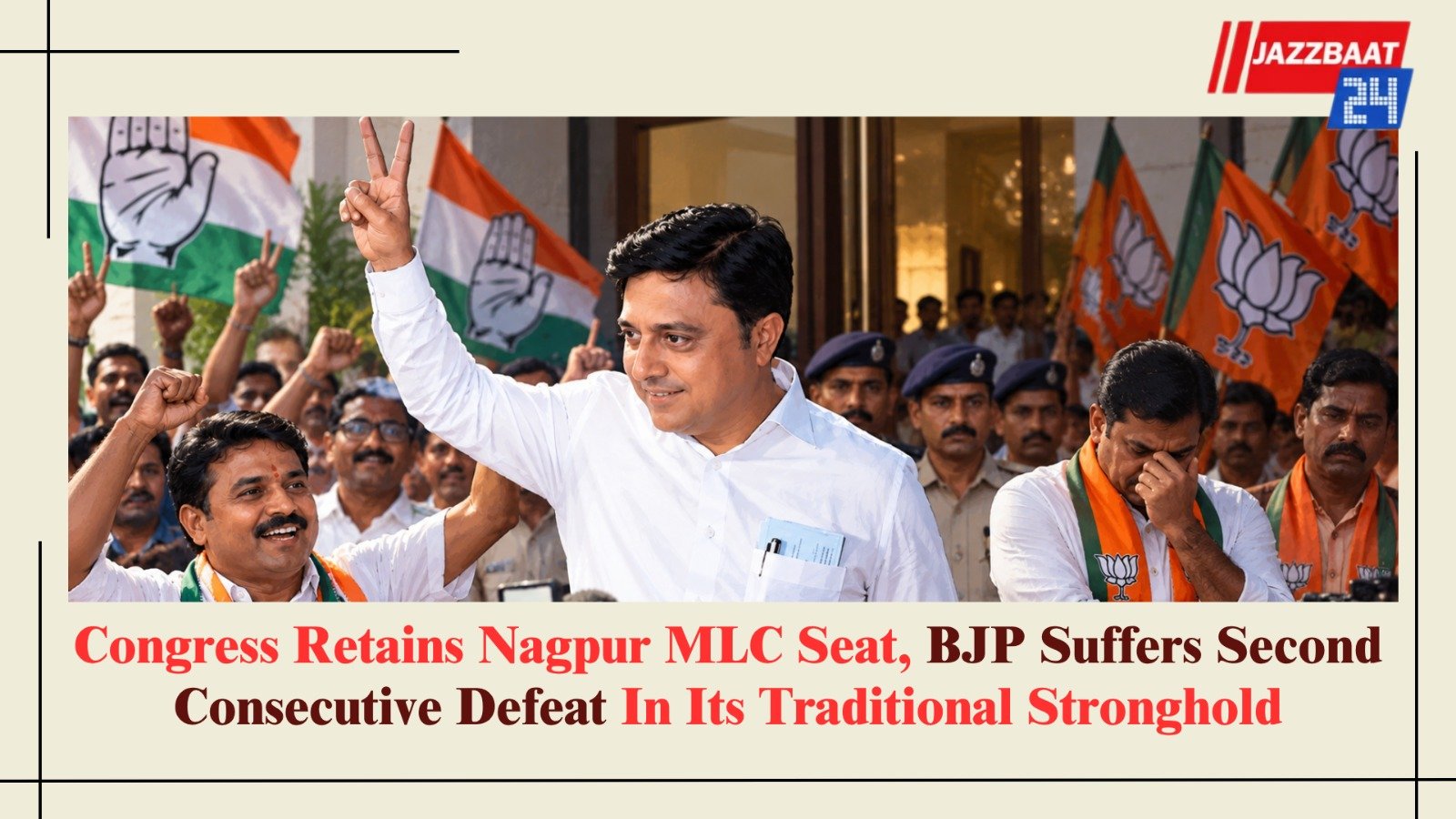
News Desk: The Congress has secured a significant victory in Maharashtra's Nagpur Division Graduates' Constituency, dealing another setback to the BJP in a seat that has traditionally been considered one of its strongest political strongholds. Congress candidate Abhijit Wanjarri defeated BJP nominee Sudhakar Kohale by 3,271 votes, retaining the seat for a second consecutive term.
The result is particularly notable because Nagpur is the home city of Maharashtra Chief Minister Devendra Fadnavis and Union Minister Nitin Gadkari. The constituency had remained associated with the BJP for nearly 56 years and was represented by Gadkari for more than two decades.
Despite an extensive campaign led by prominent BJP leaders, the party failed to regain the constituency. Several factors appear to have influenced the outcome.
1. Independent Candidate's Second-Preference Votes
One of the major factors was the performance of independent candidate Nitesh Karale, a social media influencer. He secured more than 24,000 votes, attracting support from sections of rural graduate voters, including SC and ST communities.
As neither of the main candidates secured the required quota through first-preference votes, the counting process moved to subsequent preferences. Karale's second-preference votes largely benefited Wanjarri, helping him overtake Kohale.
2. High Number Of Invalid Votes
The election witnessed an unusually high number of invalid ballots. Out of 1,65,906 votes polled, around 15,032 were declared invalid.
Reports suggested that approximately 4,000 ballot papers had incorrect preference markings against Kohale's name, affecting the BJP candidate's final tally.
3. Internal Discontent Within BJP
The selection of Sudhakar Kohale reportedly created dissatisfaction within sections of the BJP and the Rashtriya Swayamsevak Sangh (RSS).
Former MLA Anil Sole maintained a rebellious position against the official candidate, reportedly affecting coordination among local party workers and weakening organisational unity during the campaign.
4. Wanjarri's Six Years Of Groundwork
Unlike a campaign focused largely on high-profile rallies, Abhijit Wanjarri reportedly maintained regular contact with graduate voters throughout his previous six-year tenure.
His voter outreach programmes, grassroots engagement and enrolment efforts helped him maintain support across the Vidarbha region.
5. Confusion Over Preferential Voting
The large number of invalid votes also exposed a lack of awareness about the preferential voting system.
In this election, voters were required to mark numerical preferences rather than use traditional tick marks or signatures. Incorrect markings, including multiple preference numbers against the same candidate, resulted in ballot rejection.
The Nagpur result has therefore highlighted several factors, including candidate selection, internal party coordination, grassroots campaigning and voter awareness. For the BJP, the defeat means another electoral setback in a constituency that has long been central to its political influence in Maharashtra.


Reader Comments 0