
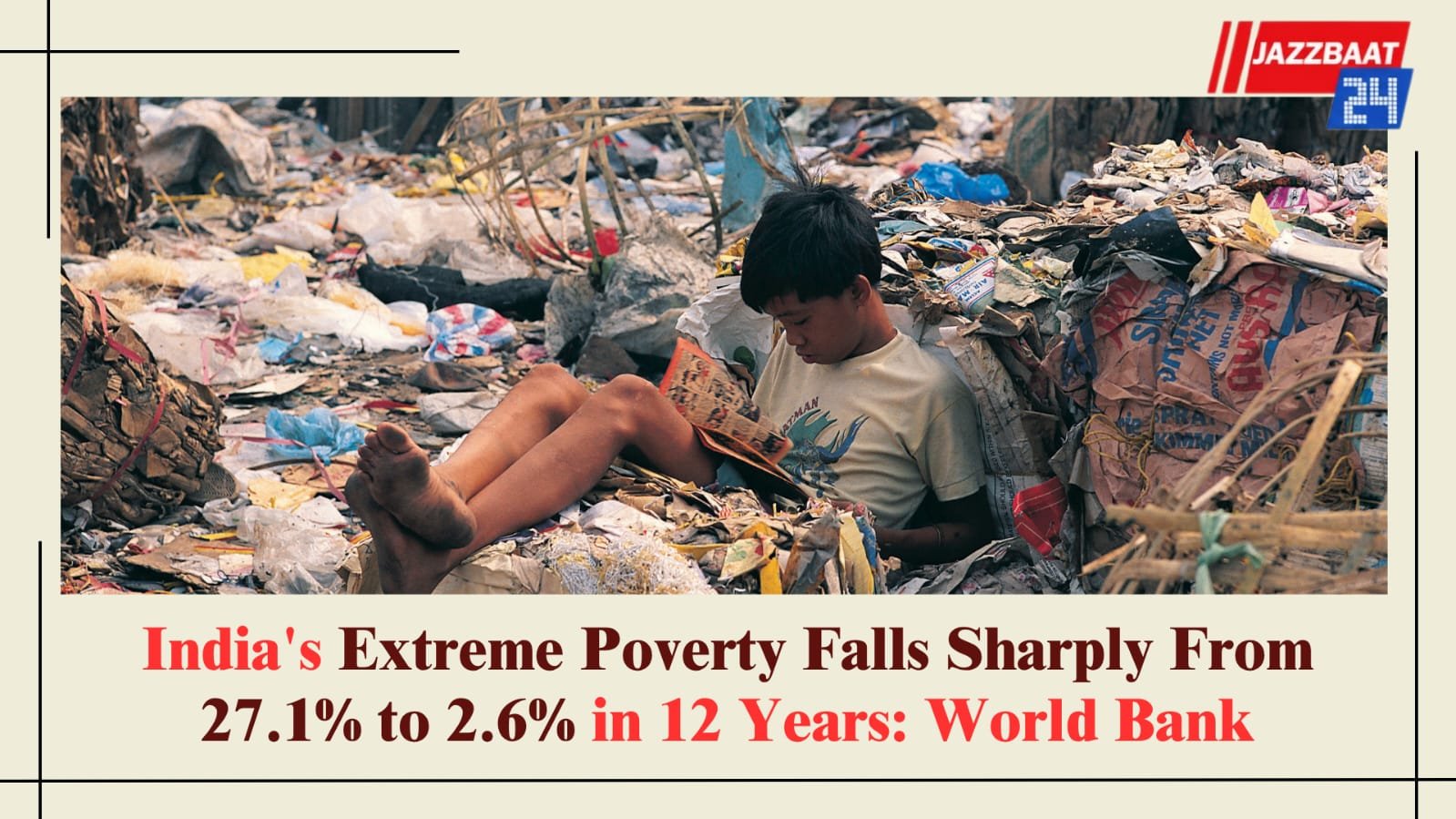
News Desk: India has made significant progress in reducing extreme poverty over the past 12 years, with the poverty rate falling from 27.1 per cent in 2011 to just 2.6 per cent in 2023, according to the World Bank's October 2026 Poverty and Equity Brief. The report estimates that around 496 million people were lifted out of extreme poverty during this period.
The findings highlight one of the fastest reductions in poverty globally. The report also shows a major decline in the proportion of people living below the lower-middle-income poverty line of $4.20 per day, measured at 2021 purchasing power parity. This figure dropped from 57.7 per cent in 2011 to 16.1 per cent in 2023.
According to the World Bank, the improvement has been driven by several factors, including strong growth in household consumption, increased employment opportunities, particularly for women, and expanded government welfare support. Food subsidies and other social transfer programmes have also played an important role in improving living conditions for millions of households.
The decline is visible in non-monetary poverty indicators as well. India's multidimensional poverty rate, measured by the Oxford Poverty and Human Development Initiative, fell from 53.8 per cent in 2005-06 to 16.4 per cent in 2019-21. The World Bank's own multidimensional poverty measure stood at 15.5 per cent in 2022-23.
The report expects poverty to decline further in the coming years, although at a slower pace. Based on its projections, the poverty rate at the $4.20-a-day threshold could decrease from 14.2 per cent in 2026 to 12.1 per cent by 2028.
However, the report also highlights several challenges that India must address. Around 57 per cent of the country's poor population is concentrated in a belt stretching from Uttar Pradesh to West Bengal. Creating more productive employment opportunities in these states will be crucial for sustaining poverty reduction.
Employment increased by approximately 134 million people between 2017 and 2023, with much of the growth coming from rural women entering paid work. However, youth unemployment remains a concern. It increased from 14.6 per cent to 15.9 per cent between the first quarters of FY26 and FY27.
The report also points out that real earnings have remained broadly unchanged, while many new jobs have been concentrated in relatively low-productivity sectors.
Despite the impressive progress, the World Bank cautions that sustained economic growth, better-paying jobs and improved employment opportunities will be essential to ensure that poverty reduction continues across India.




Reader Comments 0