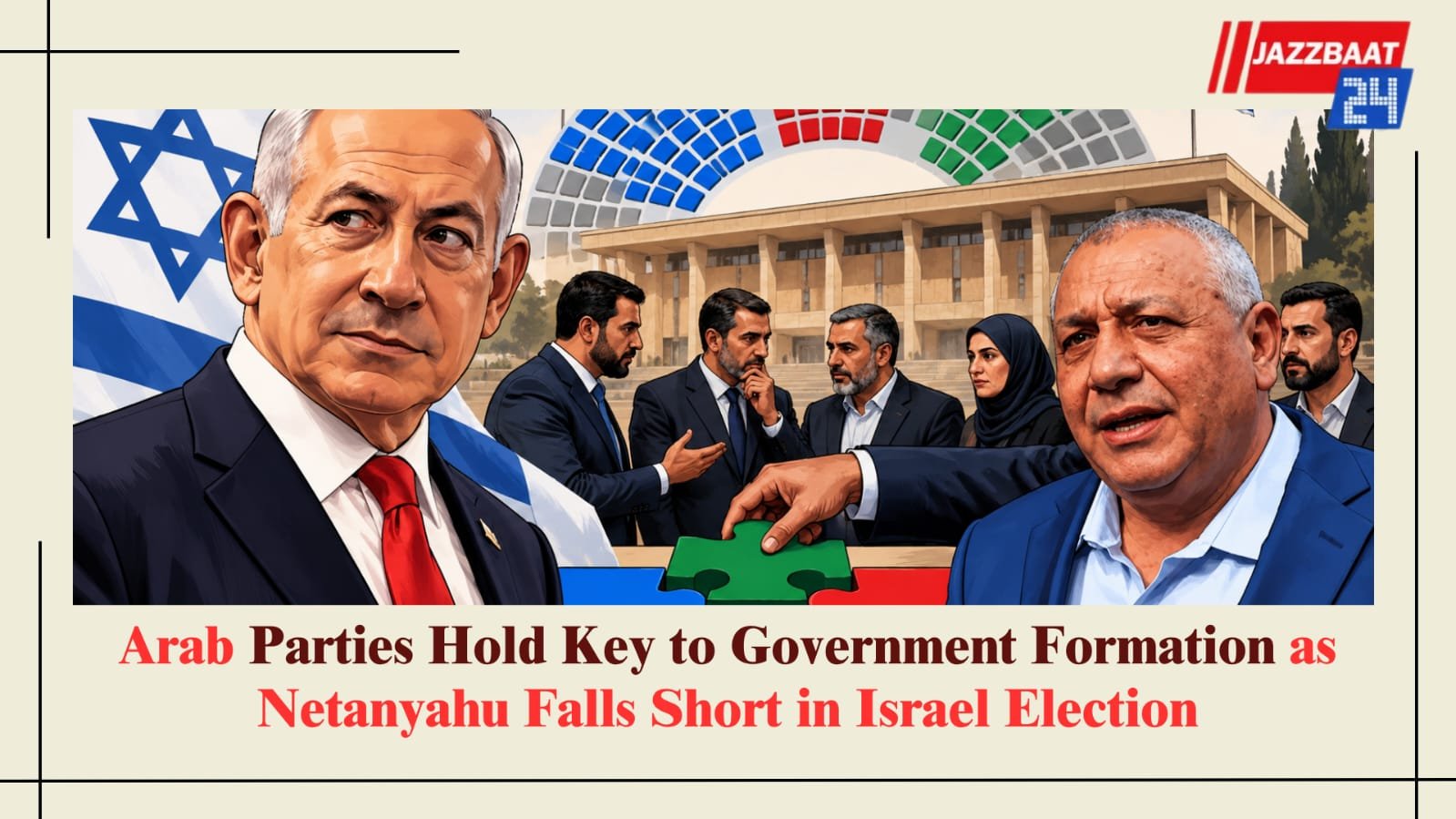
News Desk: Israel's 2026 general election has produced a complicated political situation, with Prime Minister Benjamin Netanyahu's right-wing bloc falling short of the majority needed to form the next government. The final vote count shows that Netanyahu's alliance secured 53 seats in the 120-member Knesset, while the opposition bloc won 48 seats.
With 61 seats required to form a government, neither side has secured an outright majority. This has placed Arab political parties, which collectively won 19 seats, in a crucial position. Their support could determine the next political leadership of Israel, making them potential kingmakers in the government formation process.
Netanyahu's Likud party is expected to emerge as the largest single party with 27 seats. However, the overall performance of the right-wing bloc has left the Prime Minister facing uncertainty over his political future.
The election result could have major consequences for Netanyahu. If he loses office, he may face renewed scrutiny over his long-standing corruption cases. His government could also come under pressure to face a formal investigation into the security failures surrounding the Hamas-led attack on Israel on October 7, 2023.
Meanwhile, opposition leaders are exploring possible ways to secure support from Arab-led parties. Former military chief and opposition leader Gadi Eisenkot has indicated that he is open to working with Arab political groups, subject to certain conditions.
Ahmad Tibi, a senior figure in the Arab-led Joint List, said opposition representatives had approached him to discuss replacing the Knesset Speaker. He indicated that his party could support the opposition's candidate for the position.
Even without formally joining a governing coalition, Arab parties could influence parliamentary proceedings by supporting opposition candidates for key positions and helping shape the legislative agenda.
However, the political situation remains uncertain. If neither bloc manages to gather sufficient support to form a government, Israel could face another general election early next year.
The election has also triggered political tensions over the role of Arab-led parties. Netanyahu's Likud party amplified allegations that Arab parties had influenced the results through possible foreign assistance, although no evidence was presented to substantiate the claims.
Opposition leaders accused Netanyahu of targeting the Arab population and attempting to undermine the legitimacy of the election outcome.
With no clear majority emerging from the results, the decisions of Arab political parties are now expected to play a significant role in determining Israel's next government.



Reader Comments 0