
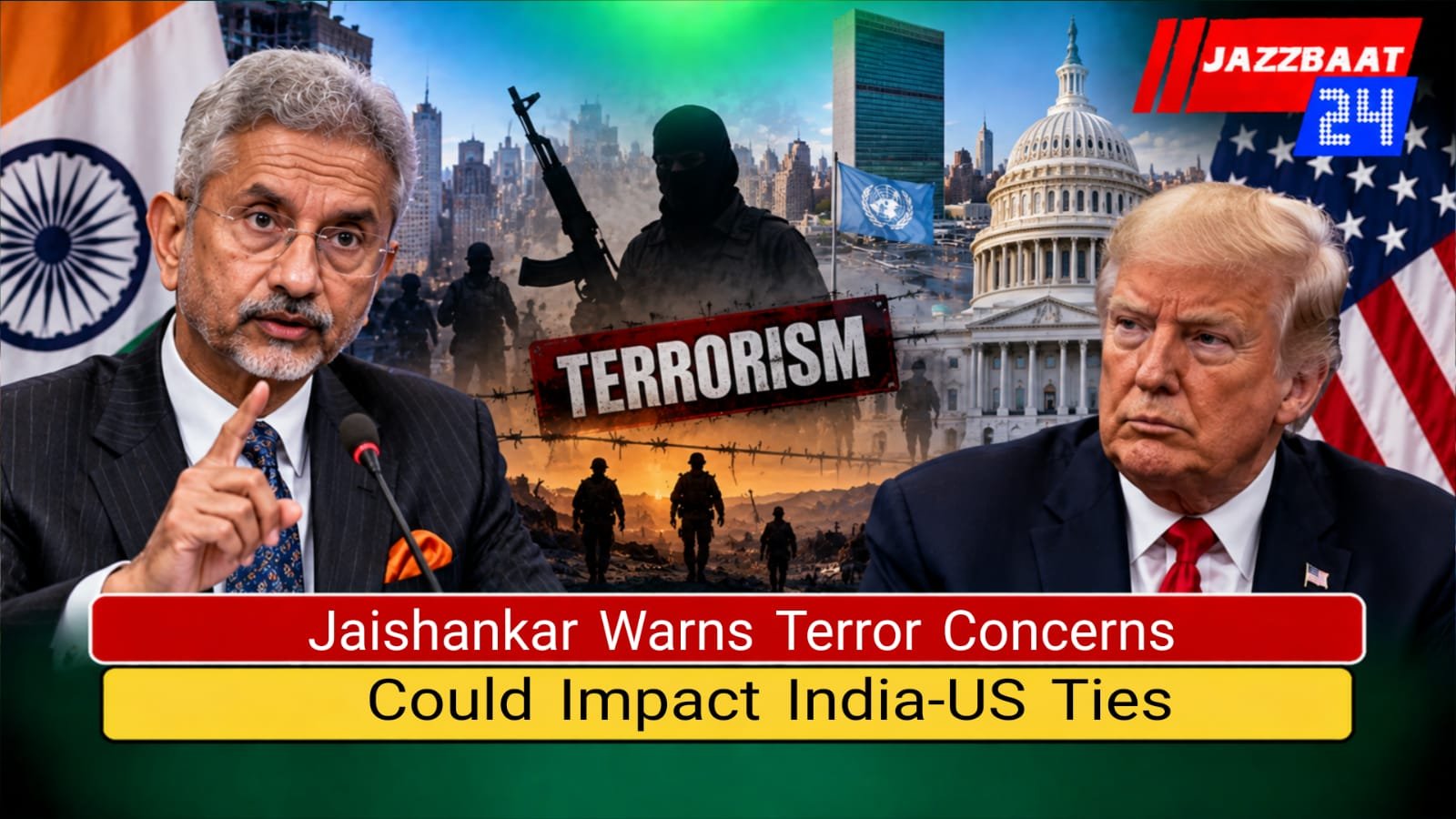
External Affairs Minister S. Jaishankar has said that India’s concerns over cross-border terrorism need to be better understood and appreciated by its international partners, including the United States. Speaking at an Asia Society event in New York on Monday, Jaishankar said that a lack of sufficient understanding of an issue that is central to India’s security could have an impact on bilateral relationships.
His comments came as India and the United States continue to work through differences over trade, tariffs and broader strategic issues. Jaishankar said the India-US relationship had experienced “bumps”, particularly because of the pace and complexity of ongoing trade negotiations, uncertainty surrounding US tariffs and differences over India’s concerns about terrorism originating from Pakistan.
Trade talks remain complicated
According to Jaishankar, negotiations on a trade agreement have been complicated by India’s economic structure. He pointed to the country’s large number of small producers, agricultural communities and factories, saying that any agreement has to take into account a wide range of domestic interests.
He indicated that there is now broadly an understanding between the two sides on the trade agreement, but questions remain over changes in the US tariff framework.
Jaishankar also referred to developments following the US move away from its earlier reciprocal tariff structure. He said a new process under Section 301 was still unfolding, adding another element of uncertainty to the trade discussions.
The two countries have maintained significant economic ties, but negotiations have been taking place against the backdrop of changes in US trade policy and continuing discussions over market access and tariffs.
Terrorism remains a major issue
For New Delhi, however, terrorism remains a particularly sensitive issue. Jaishankar said India had faced attacks originating from a neighbouring country for decades and that this has made terrorism one of its primary foreign-policy and security concerns.
He stressed that if a major concern for one partner is not fully understood or appreciated by another, it can affect the relationship between the two countries.
The minister’s remarks follow his strong statements at the 81st United Nations General Assembly in New York. During his UN address, Jaishankar said that cross-border terrorism posed a direct challenge to the international order and argued that countries responsible for supporting terrorism should be held accountable.
India’s position has also been highlighted in recent exchanges involving Pakistan. At a UN-related briefing on September 25, Jaishankar responded to a Pakistani journalist who questioned India over terrorism. The exchange came during discussions on the safety of commercial shipping and seafarers.
India stresses strategic autonomy
Jaishankar also spoke about India’s approach to international relations, describing a world that is becoming increasingly multipolar. He said countries are now maintaining relationships with several major powers simultaneously rather than relying exclusively on one strategic partner.
He argued that India’s long-standing approach of maintaining multiple international partnerships is increasingly reflected in the behaviour of other major powers as well.
The minister’s remarks come at a time when India is simultaneously engaging with the US, Russia, China, Europe and other major global players.
Jaishankar also highlighted the growing influence of public opinion and social media on diplomacy. He said foreign policy is no longer shaped only by governments, ministers and diplomats, as public opinion increasingly plays a role in international relations.
His comments underline the multiple issues currently shaping India-US ties, with trade negotiations, tariffs, terrorism and strategic autonomy all forming part of the broader bilateral conversation.

Reader Comments 0