
Subhrangsu Mukherjee, Munich, Germany, November 5: Halloween has become an increasingly familiar part of Germany’s autumn calendar, reflecting the influence of international popular culture and changing consumer habits. Once regarded primarily as an American celebration, the occasion has gained considerable popularity across German cities, including Munich, where costumes, pumpkin decorations and themed events have become established seasonal attractions.
Yet Halloween’s growing presence in Germany also highlights an intriguing cultural parallel with traditions observed thousands of kilometres away. In Bengal, Bhoot Chaturdashi, celebrated shortly before Kali Puja, has long been associated with ancestral remembrance, folklore and beliefs surrounding the supernatural.
Although the two observances emerged from different historical and religious backgrounds, both offer insights into how societies have sought to understand death, memory and the unknown.
Halloween’s European Roots and German Reinvention
Halloween’s origins are considerably more complex than its contemporary association with costumes, carved pumpkins and trick-or-treating might suggest.
The name derives from All Hallows’ Eve, the evening preceding All Saints’ Day on 1 November. Its historical development reflects a combination of Christian observances and European folk traditions, including practices commonly associated with the ancient Gaelic festival of Samhain.
Historians continue to debate the precise extent to which Samhain influenced modern Halloween customs.
Although Halloween’s historical roots lie in Europe, many of its most recognisable contemporary traditions developed in North America, where customs introduced by European immigrants gradually evolved into community celebrations.
Germany’s modern embrace of Halloween began gathering momentum during the 1990s, helped by the costume industry and commercial promotion.
An unexpected development in 1991 contributed to this transformation. As the Gulf War led to the cancellation of numerous carnival celebrations in Germany, sections of the costume industry sought alternative commercial opportunities. Halloween subsequently emerged as an attractive occasion for promoting costumes and seasonal merchandise.
Over the following decades, the festival became increasingly visible in German retail and entertainment.
Nevertheless, its expansion has occurred alongside established religious traditions.
In Bavaria, 1 November is observed as Allerheiligen, or All Saints’ Day, a public holiday traditionally associated with commemorating the deceased. Families visit cemeteries, tend graves and place flowers and candles in remembrance of relatives.
While Halloween has developed into a largely recreational occasion, All Saints’ Day continues to retain its solemn religious significance.
Munich’s Changing Halloween Traditions
By late October, Halloween decorations have become a familiar sight in parts of Munich. Pumpkins, costumes and confectionery occupy an increasingly prominent place in seasonal retail displays, while entertainment venues organise themed activities.
Children participate in neighbourhood trick-or-treating, calling out “Süßes oder Saures!”, the German equivalent of “Trick or Treat!”
For teenagers and adults, costume parties and social gatherings have become popular ways of marking the occasion.
However, Halloween is neither a traditional German public holiday nor a universally observed celebration.
Many households do not participate, and attitudes towards the festival remain varied. Some regard it as an enjoyable opportunity for social interaction, while others view its growing popularity as an example of commercialised cultural change.
Its expanding presence nevertheless illustrates how international customs can gradually become part of everyday cultural life without necessarily displacing established traditions.
Bhoot Chaturdashi: Bengal’s Encounter with the Supernatural
Across continents, Bengal observes a different tradition associated with spirits, ancestral remembrance and longstanding cultural beliefs.
Bhoot Chaturdashi takes place on the fourteenth lunar day of the waning moon, immediately preceding Kali Puja.
In 2026, the occasion falls on 7 November, approximately a week after Halloween.
One of its most recognisable customs involves lighting fourteen earthen lamps, traditionally known as choddo prodip, in different parts of the household.
The practice is commonly associated with honouring ancestors and traditional beliefs concerning protection from harmful influences.
Another distinctive custom is the preparation and consumption of choddo shaak, a combination of fourteen varieties of leafy greens.
The precise ingredients and rituals vary between regions, families and communities.
Unlike Halloween, Bhoot Chaturdashi is not generally associated with elaborate costumes, commercial entertainment or children visiting neighbouring homes for sweets.
Its observance remains more closely connected with household rituals, religious beliefs and family traditions passed down through generations.
Despite their associations with spirits and the supernatural, Halloween and Bhoot Chaturdashi developed within distinct cultural and religious settings. Their similarities are thematic rather than evidence of a common historical origin.
Ghost Stories and Cultural Memory
The supernatural has occupied an enduring place in Bengali folklore.
Characters such as the Brahmadaitya, Petni and Shakchunni have featured in traditional ghost stories for generations, often combining fear, suspense, humour and moral themes.
Such narratives have helped shape childhood memories and storytelling traditions within Bengali households.
Modern Halloween approaches similar supernatural imagery from a different perspective.
Ghosts, witches and other frightening figures have become central to costumes, decorations and entertainment, transforming themes historically associated with fear into opportunities for celebration.
For Bengali families living in Germany, these traditions need not be mutually exclusive.
Children growing up in Munich may participate in Halloween festivities while continuing to observe Bhoot Chaturdashi and Kali Puja with their families.
Such experiences reflect the cultural realities of immigrant communities, where participation in local customs can coexist with the preservation of inherited traditions.
Different Origins, a Shared Human Curiosity
Halloween and Bhoot Chaturdashi should not be regarded as equivalent festivals.
Their historical development, religious significance and customary observances remain fundamentally different.
Yet their associations with spirits, remembrance and the supernatural illustrate how different societies have developed cultural responses to questions surrounding life, death and the unknown.
For immigrant families, the coexistence of these traditions also reflects the evolving nature of cultural identity.
Participating in a local celebration need not require abandoning customs inherited from earlier generations. Instead, both can contribute to a broader understanding of cultural belonging.
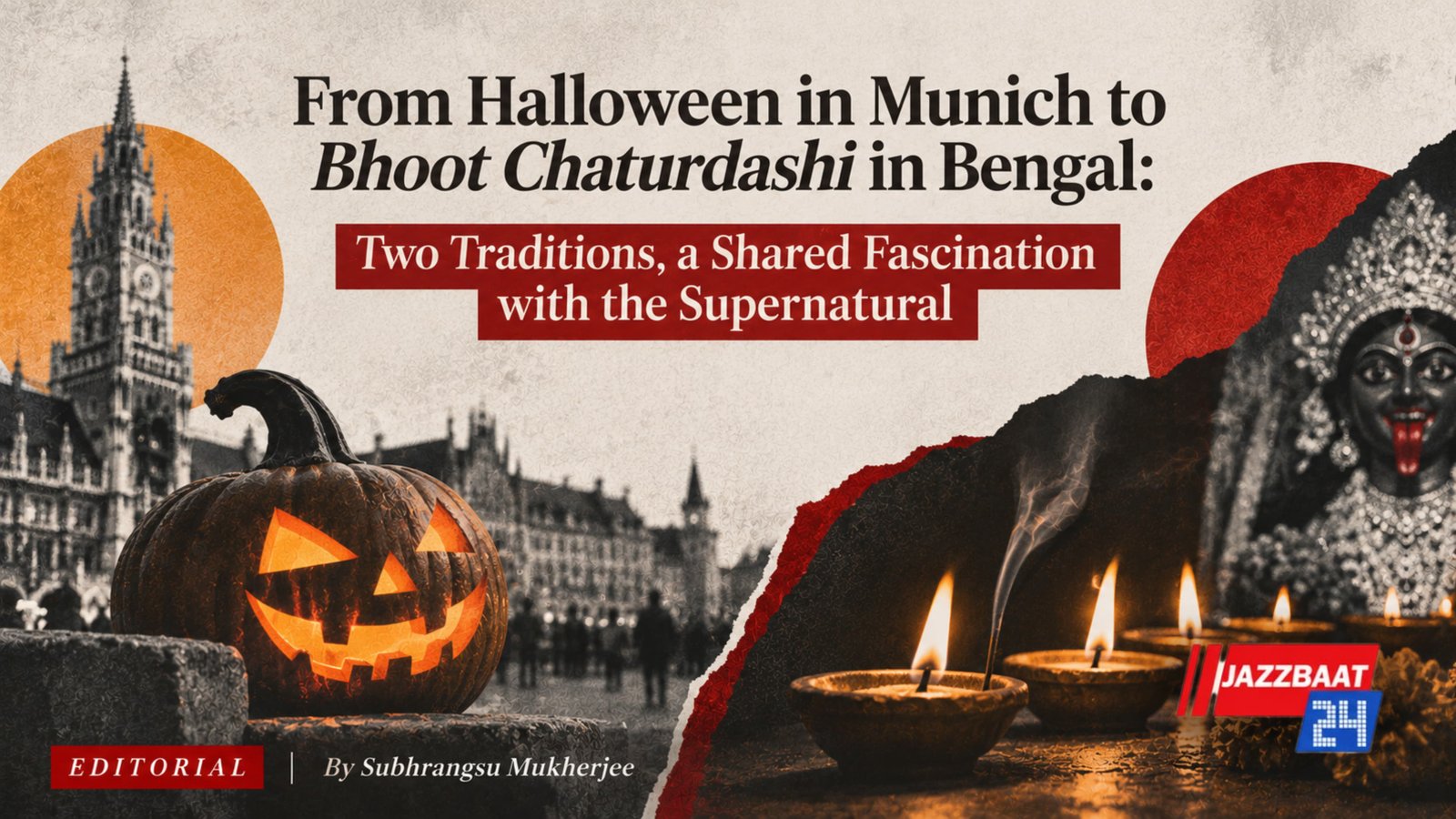
In Munich, illuminated pumpkins have become part of the seasonal landscape. In Bengal, fourteen earthen lamps continue to carry religious and familial significance.
Their meanings may differ, but both traditions demonstrate the enduring influence of folklore, remembrance and cultural memory in shaping how communities understand the world around them.




Reader Comments 0