
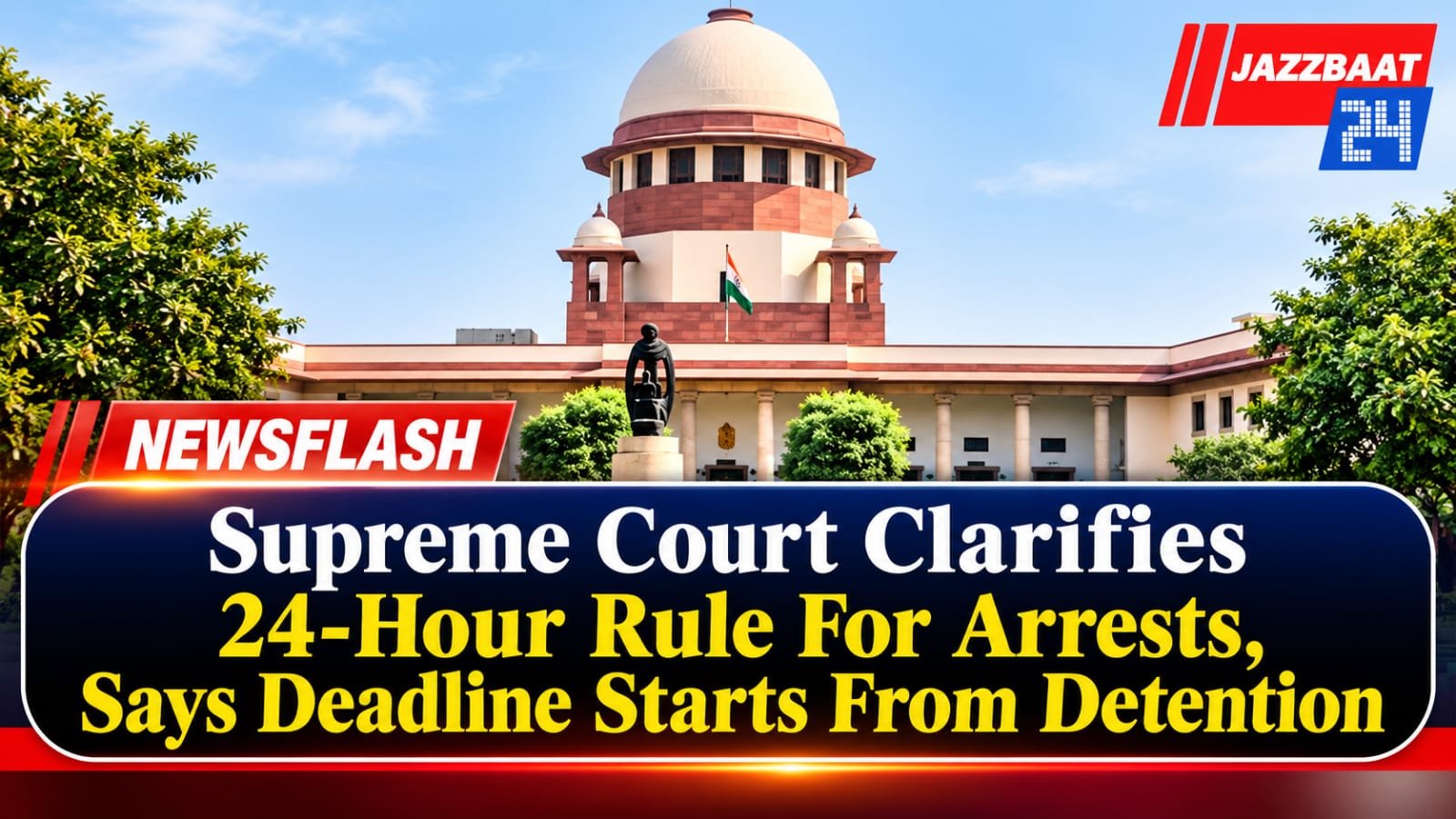
The Supreme Court has delivered an important ruling on the constitutional rights of arrested individuals, clarifying that the 24-hour deadline for producing an arrested person before a magistrate begins from the moment of detention, not from the time the police formally records the arrest. The ruling reinforces safeguards against prolonged detention without judicial oversight.
A bench comprising Justices Ujjal Bhuyan and Atul S Chandurkar ruled on Thursday that there can be no artificial distinction between 'arrest' and 'detention' when calculating the 24-hour constitutional deadline under Article 22(2) of the Constitution.
The court observed that allowing the police to calculate the deadline only from the time of formal arrest would go against constitutional protections and the provisions of Section 56 of the Bharatiya Nagarik Suraksha Sanhita (BNSS).
Under Article 22(2), every person who is arrested and detained in custody must be produced before the nearest magistrate within 24 hours. The only permissible exclusion is the time reasonably required to travel from the place of arrest to the magistrate's court.
In its ruling, the Supreme Court made it clear that the time spent questioning a suspect, conducting investigations, searches or seizures before formally recording the arrest cannot be excluded from the calculation.
This means that authorities cannot detain a person for several hours during an inquiry and then begin a fresh 24-hour countdown after formally announcing the arrest.
The bench also disapproved of earlier interpretations adopted by the Orissa, Madras and Kerala High Courts in separate cases. Those rulings had allowed the period of detention before formal arrest to be excluded while calculating the constitutional deadline.
Emphasising the importance of individual liberty, the Supreme Court stated that anyone detained beyond the permissible 24-hour period without being produced before a magistrate must be released immediately.
The court also underlined that detention should not continue for an unreasonable period even within the constitutionally permitted 24 hours.
The ruling places an additional responsibility on judicial magistrates. They must now record the actual date and time when a person was detained and independently verify whether the constitutional deadline has been followed.
Magistrates must also examine whether the duration of detention is reasonable under the circumstances. If the detention is found to be excessive, they can refuse to authorise remand.
The detailed judgment is awaited. However, the ruling provides an important clarification on how the 24-hour constitutional safeguard must be applied during police investigations and arrest procedures. It also reinforces the principle that procedural formalities cannot be used to delay judicial scrutiny of a person's detention.




Reader Comments 0