
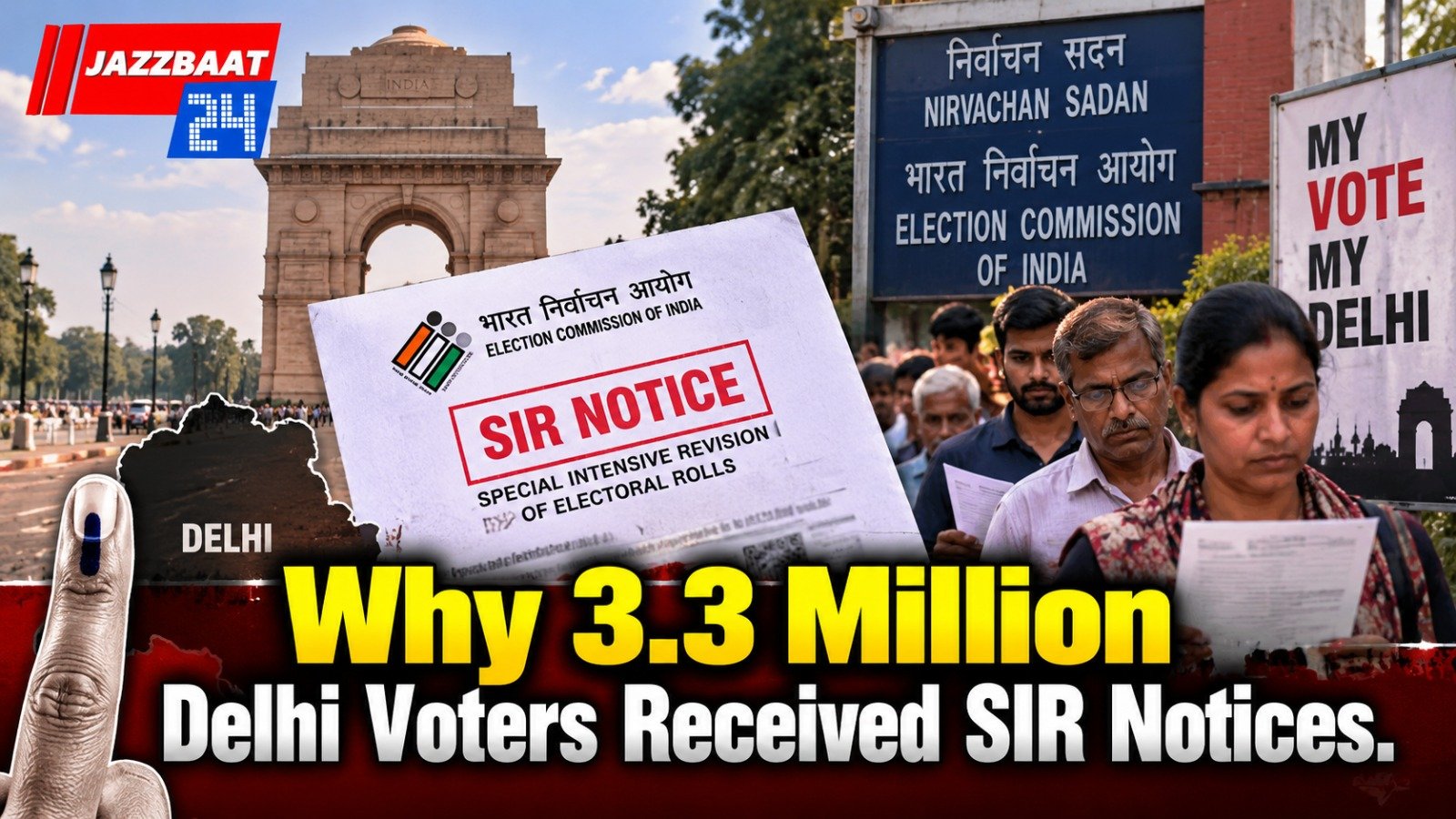
Around 3.31 million voters in Delhi have received notices during the Election Commission's Special Intensive Revision (SIR) of electoral rolls, with discrepancies including unmatched names, differences in age and voters not being mapped to the previous revision.
The notices were issued after the draft electoral roll for Delhi was published on August 31. According to an assessment of the data released by the Delhi Chief Electoral Officer, 3.11 million people, or about 94 per cent of those who received notices, had a single reason listed against their names.
The largest category involved voters who could not be mapped to the previous SIR. Around 1.38 million people received notices for this reason, accounting for about 42 per cent of the notices with a single discrepancy.
Name mismatches were another major reason. These included differences between a voter's current name and the previous electoral roll, as well as discrepancies involving the names of parents. When multiple reasons are counted separately, parent-name mismatches accounted for about 24 per cent of notices, while mismatches involving the voter's own name accounted for around 17 per cent.
Age-related discrepancies were another significant category, accounting for around 16 per cent of notices. These included unusually small or large age differences between parents and children, as well as discrepancies involving grandparents.
The data also showed that around 128,000 notices listed two reasons, nearly 9,000 listed three reasons and more than 400 contained four reasons. At the same time, 59,791 notices reportedly had no reason listed.
There were also unusual entries in the data. Nearly 140,000 people, or about 4.2 per cent of those receiving notices, were flagged because the records indicated that they had six or more children. Another 182 people were marked for discrepancies relating to the eligibility of their parents in the previous SIR.
The age profile of voters receiving notices also varied considerably. The median age was 40, while the oldest 20 per cent were aged 54 or above and the oldest 10 per cent were aged 62 or above. One voter, 125-year-old Shyam Mukhija from the Sadar Bazar Assembly Constituency, was reportedly issued a notice over a self-name mismatch.
Gender-wise, 34.5 per cent of male electors on the draft roll received notices, compared with 33.4 per cent of female electors. Among the 447 transgender electors included in the draft roll, around half received notices.
The proportion of electors receiving notices also varied between Assembly constituencies. The figures ranged from 22.7 per cent in Matia Mahal to 44.2 per cent in Badarpur, according to the analysis.
The Delhi Chief Electoral Officer's data was still being updated. Four polling booths out of 14,947 had not uploaded their notice lists by 6 pm on September 20, while several hundred booths had initially shown that no notices had been generated before their data was subsequently updated.
The Election Commission has clarified that receiving an SIR notice does not by itself mean that a voter's name will be deleted from the electoral roll. The notice process is part of verification, and voters can respond to discrepancies through the prescribed procedure.
The ECI's voter services system also provides facilities for checking electoral-roll information and related applications.
The Delhi SIR is therefore continuing as a verification exercise, with the notices intended to address discrepancies identified in electoral-roll records before the revision process is completed.



Reader Comments 0