
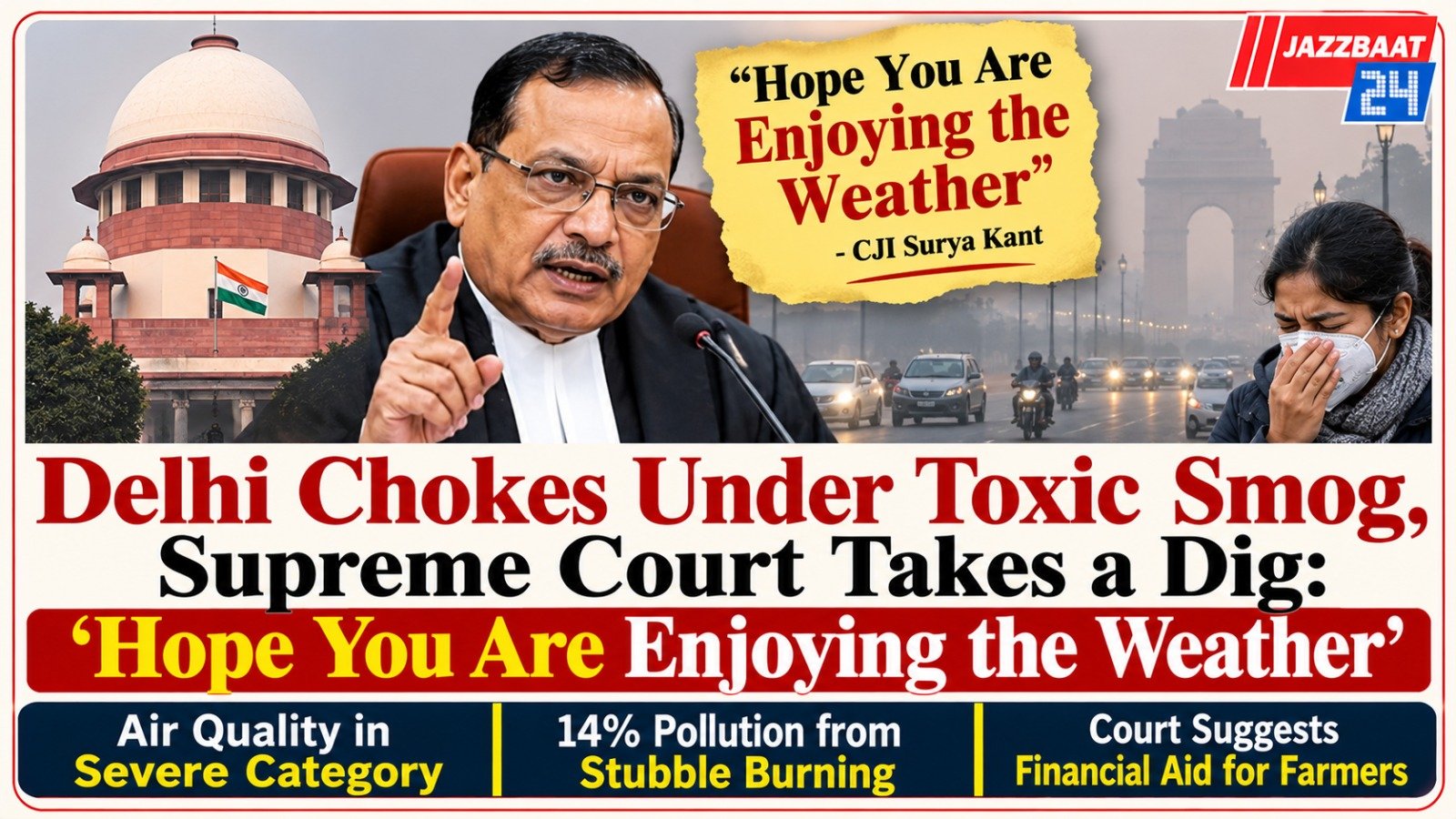
New Delhi: Delhi continues to struggle with alarming levels of air pollution, as a thick layer of smog blankets the national capital and raises serious health concerns. With air quality remaining in the severe category, the Supreme Court once again expressed concern over the worsening situation. During a hearing on Friday, Chief Justice Surya Kant made a pointed remark at the beginning of the proceedings, saying, “Hope you are enjoying the weather in Delhi!” The comment highlighted the seriousness of the pollution crisis and the continuing challenges in controlling it.
A three-judge bench comprising Chief Justice Surya Kant, Justice Joymalya Bagchi and Justice Vipul M. Pancholi heard the case concerning air pollution in Delhi and the National Capital Region (NCR).
Senior advocate Aparajita Singh, who is assisting the court in the matter, brought attention to the continuing poor air quality. She informed the bench that pollution levels across Delhi-NCR remained in the severe category. She also mentioned that the effects of the polluted air had begun affecting her own voice.
Highlighting the possible health impact, Singh compared breathing Delhi's polluted air to smoking approximately 30 cigarettes a day. The comparison was used to underline the seriousness of prolonged exposure to harmful pollutants, even for people who do not smoke.
Rain Brings Temporary Relief
The recent rainfall and its impact on air quality also came up during the hearing. The Supreme Court observed that rain had helped reduce pollution levels to some extent. The court also expressed hope that the beginning of preparations for the next sowing season would help prevent farmers from burning crop residue.
However, Singh pointed out that stubble burning accounts for approximately 14 per cent of Delhi's pollution. She stressed that apart from agricultural burning, local pollution sources such as burning garbage within the city must also be addressed urgently.
Supreme Court Suggests Financial Support for Farmers
The Supreme Court proposed an important measure to discourage stubble burning. It suggested that farmers should be informed well in advance about the financial assistance they would receive for collecting and disposing of agricultural residue.
The bench emphasised that announcing a price alone would not be sufficient. Proper infrastructure must also be developed to collect, transport and manage crop residue. The court suggested involving village panchayats in the process to ensure effective implementation at the grassroots level.
The idea is to provide farmers with a practical and financially viable alternative to burning leftover crop material in their fields.
Multiple Sources Behind Delhi's Pollution
Delhi's pollution crisis cannot be attributed to a single factor. Vehicle emissions, construction dust, industrial pollution, stubble burning and the burning of garbage all contribute to the deteriorating air quality.
During winter, low wind speeds and unfavourable weather conditions often trap pollutants close to the ground, making the situation worse. Rainfall and stronger winds may provide temporary relief, but the underlying sources of pollution remain.
The Supreme Court's latest observations underline the need for a long-term strategy rather than temporary restrictions during the winter months. Better agricultural waste management, financial incentives for farmers and stronger action by local authorities will be essential to tackle the problem.
With millions of residents exposed to unhealthy air, the biggest question remains: how soon will Delhi be able to breathe clean air again?



Reader Comments 0