
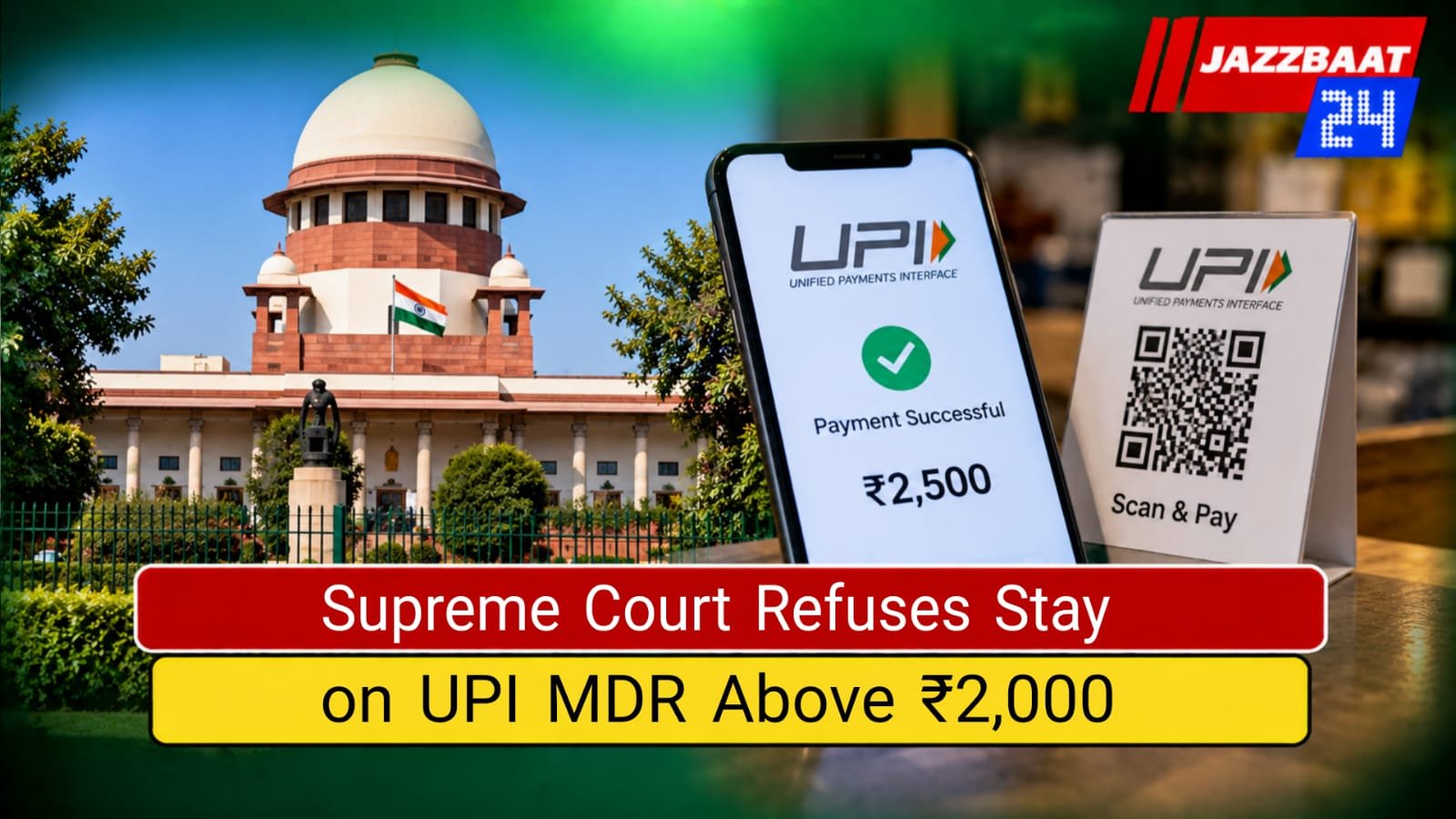
The Supreme Court on Monday refused to grant an interim stay on the Centre’s decision to introduce a Merchant Discount Rate (MDR) on certain UPI person-to-merchant (P2M) transactions above ₹2,000. The new framework is scheduled to come into effect from October 15.
The court, however, agreed to examine a petition challenging the decision and sought responses from the Centre and other concerned parties. The government has been given four weeks to file its counter-affidavit.
During the hearing, the Centre told the Supreme Court that around 96 per cent of users of the payment gateway would remain exempt under the new framework. The court observed that the issue appeared to be more technical than legal at this stage.
Under the new UPI framework announced earlier this month, a 0.4 per cent MDR will apply to specified UPI transactions above ₹2,000 made to merchants. MDR is a charge associated with the merchant payment ecosystem and is not supposed to be directly imposed on customers making UPI payments.
The government has repeatedly clarified that the new arrangement will not affect person-to-person (P2P) UPI transactions. Users will continue to be able to transfer money to another individual through UPI without any charge, irrespective of the amount involved.
According to the government's explanation, approximately 96 per cent of P2M UPI transactions will also remain unaffected by the new MDR structure.
The Centre has further stated that merchants should not pass the MDR cost on to customers. Banks have been advised to ensure compliance with this direction. At the same time, UPI application providers have been prohibited from imposing platform fees or hidden charges on users.
The decision has nevertheless triggered concerns among sections of merchants and opposition parties. Questions have been raised over the possible impact of MDR on businesses that depend heavily on digital payments, particularly transactions involving higher-value purchases.
The Finance Ministry on September 17 also rejected allegations that the decision was influenced by foreign pressure. The clarification came after Congress leader Rahul Gandhi and other opposition leaders alleged that the government had changed its UPI policy because of pressure from the United States.
The Finance Ministry said such claims were false and maintained that India's UPI policy decisions are being taken independently. According to the ministry, the objective is to develop a digital payments ecosystem that is financially sustainable while remaining inclusive and affordable.
The Supreme Court's decision on Monday does not determine the final legal validity of the MDR framework. Instead, the court has allowed the government and other parties to respond to the challenge before it considers the matter further.
For consumers, the immediate takeaway is that there is no interim stay on the Centre's decision. However, the government has maintained that ordinary person-to-person UPI transfers will remain free and that customers should not be separately charged for MDR by merchants or payment applications.

Reader Comments 0