
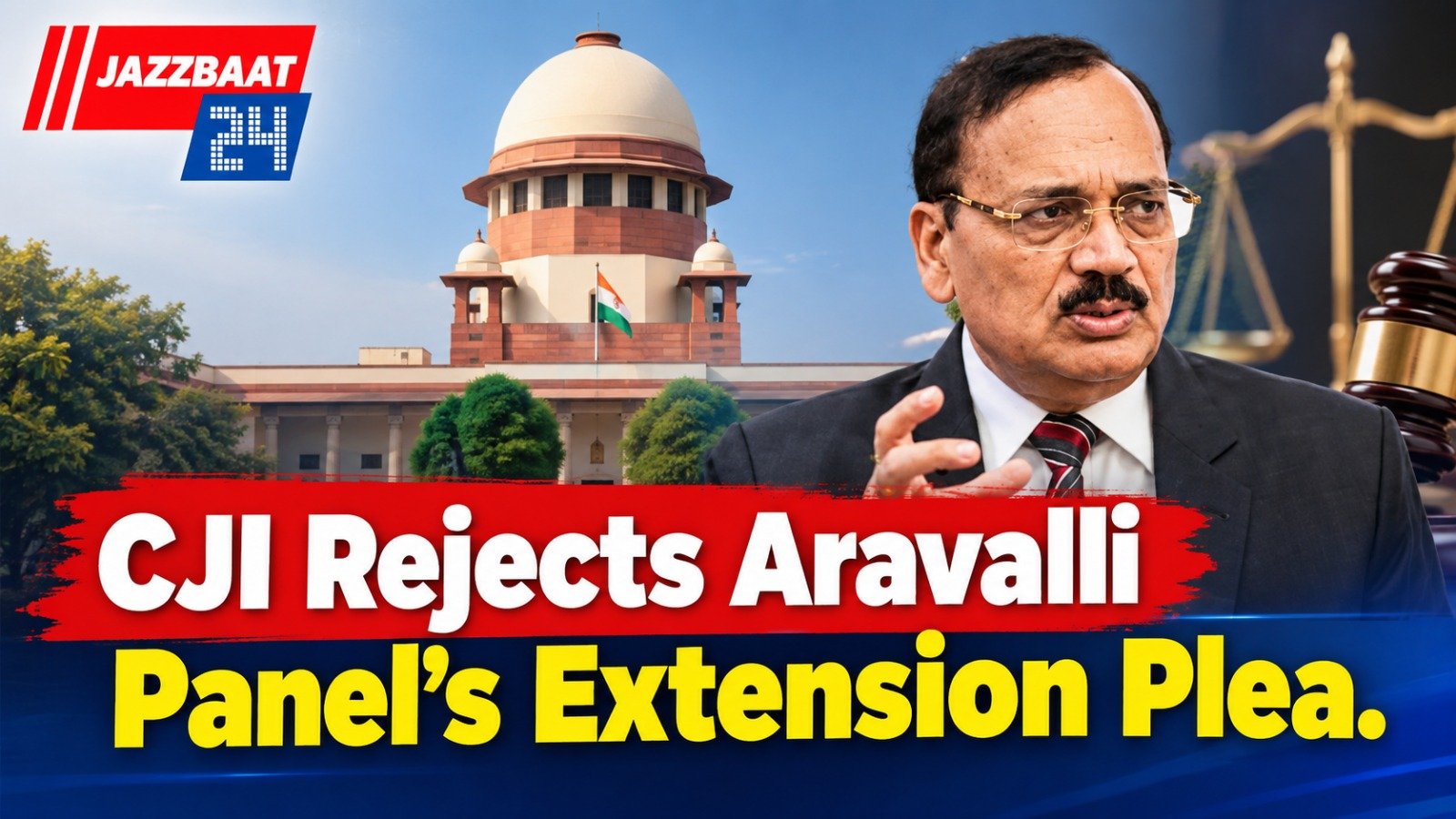
Chief Justice of India Surya Kant on Monday rejected a request from a Supreme Court-appointed committee seeking six more months to complete its work on defining the Aravalli hills and range.
The five-member High-Powered Committee (HPC), headed by Indian Council of Forestry Research and Education Director General Kanchan Devi, had sought time until February 28, 2027. The Supreme Court instead directed the panel to submit its final report by November 30, 2026.
During the hearing, CJI Kant questioned whether the committee was waiting for his retirement. “They should have clearly asked for a date after my retirement,” he remarked. The Chief Justice is scheduled to demit office on February 9, 2027.
The bench, comprising CJI Kant and Justices Joymalya Bagchi and V Mohana, made it clear that no further extension would be granted. The court directed the committee to work intensively and submit the report within the deadline.
The Supreme Court also asked the panel to provide interim reports on specific issues wherever necessary. This will allow urgent matters connected with the Aravallis to be considered without waiting for the complete report.
The issue is significant because the court had earlier put its November 2025 decision on hold after concerns were raised over a proposed definition of the Aravalli hills. The earlier definition suggested that landforms with an elevation of at least 100 metres above local relief would qualify as Aravalli hills, while two or more such hills within 500 metres of each other would form the Aravalli Range.
Environmentalists had raised concerns that the elevation-based approach could leave many smaller hills and hillocks outside the protected landscape and potentially expose ecologically sensitive areas to mining and development.
The Supreme Court subsequently took suo motu cognisance of the controversy and kept its earlier order in abeyance. It also directed that no fresh mining permissions or renewals of existing leases be granted while the new exercise was underway.
The HPC was constituted in May with a broader mandate to scientifically examine the Aravalli landscape and recommend a uniform definition. Its interim report, submitted on August 31, said the range could not be properly understood using only a single elevation or terrain-based criterion.
The committee is examining ecological, geological, hydrological, biodiversity, land-use and socio-economic factors. It has also highlighted the importance of forests, wetlands, groundwater recharge zones, protected areas, traditional pastures and other connected ecosystems.
The court is scheduled to consider the matter again on December 2, by which time the committee is expected to have submitted its final report.




Reader Comments 0