
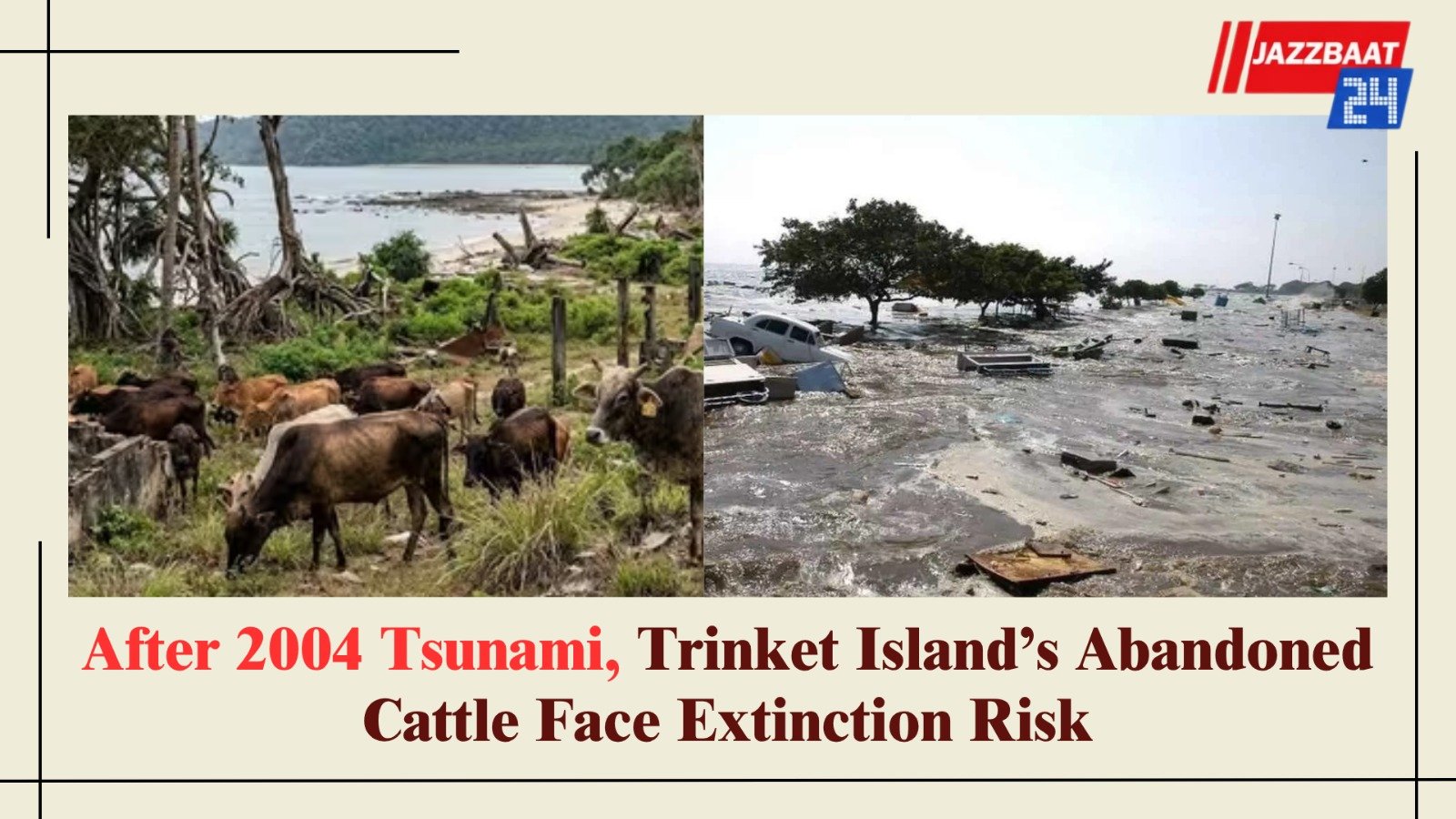
News Desk: The devastating tsunami of December 26, 2004, changed the lives of people and animals across India’s Andaman and Nicobar Islands. On Trinket Island, the disaster forced residents to leave their homes, leaving behind a cattle population that had depended on human care for generations. The animals were left to survive on their own and gradually became completely feral.
According to a 2020 study, only around 150 descendants of the island’s cattle were known to remain, raising concerns about the survival of this rare population.
The history of Trinket’s cattle stretches back more than two centuries. According to the research published in the Journal of Genetics, Danish colonists introduced the animals to the island between 1756 and 1768, apparently to provide milk. After Danish control ended, the indigenous Nicobarese continued to care for the cattle, primarily using them as a source of meat.
Over time, the animals became semi-wild. Historical accounts cited by researchers recorded nearly 50 semi-wild cows on Trinket in the early 20th century. The cattle also influenced the island’s landscape, as parts of its forest were converted into grassland to provide fodder.
The tsunami brought this long-standing relationship between people and cattle to an abrupt end. Trinket was among the islands severely affected by the disaster, and its surviving residents were evacuated to neighbouring islands. With no community left to manage the herd, the cattle had to find food and shelter independently.
Unlike domesticated livestock, the animals no longer received regular feeding, veterinary treatment or controlled breeding. Their survival became dependent on the island’s natural resources and the challenges of living in an isolated environment.
Researchers later examined the health of the surviving cattle, studying blood-related indicators, including haematological values, serum biochemistry and mineral profiles. The results fell within normal physiological ranges and provided baseline information for future health assessments.
Scientists also investigated the animals’ genetic history through mitochondrial DNA analysis, examining the D-loop and cytochrome b regions. The findings placed the cattle within the Bos indicus lineage and identified them as belonging to the I2 sub-haplotype. Researchers suggested that this genetic signature could reflect the historical movement of the lineage towards Southeast Asia.
The findings are significant because the isolated population may preserve a distinctive genetic heritage that could be lost if the cattle disappear.
The reported population of around 150 animals highlights their vulnerability and the importance of conservation efforts. Their history reflects several stages of human involvement, from colonial livestock introduction to indigenous animal husbandry and, finally, abandonment after a natural disaster.
More than two decades after the tsunami, Trinket Island’s cattle remain a reminder of the disaster’s long-lasting effects on the region’s wildlife and rural heritage. Protecting this rare population could help preserve a unique part of the Nicobar Islands’ history and genetic diversity.



Reader Comments 0