
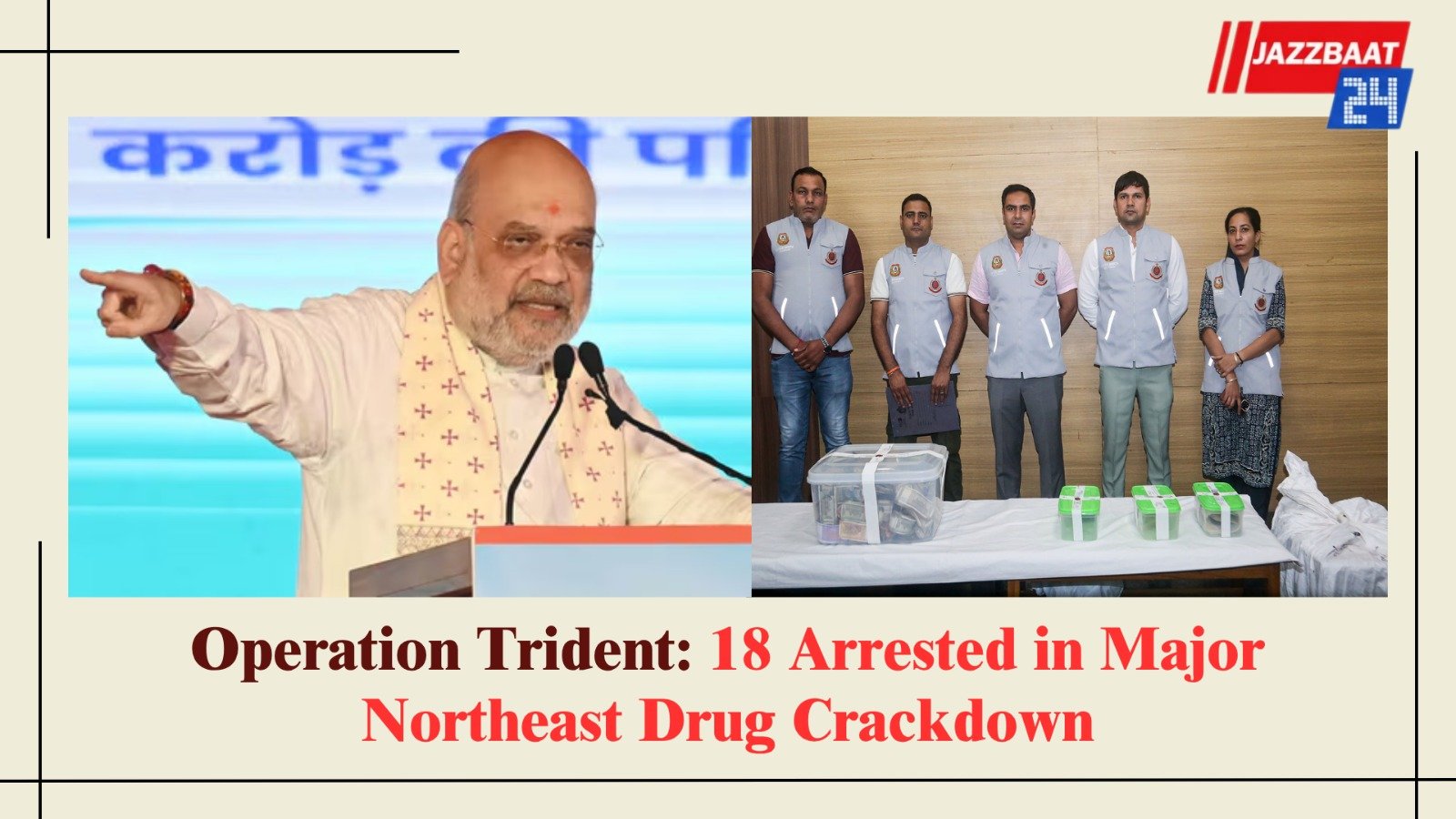
News Desk: Union Home Minister Amit Shah on Sunday announced a major breakthrough in the fight against drug trafficking, saying 18 people had been arrested following coordinated raids across Assam, Manipur and Mizoram under Operation Trident. The operation, conducted on October 23, targeted an international drug trafficking network allegedly operating across the India-Myanmar-Bangladesh border region.
According to Shah, security agencies carried out simultaneous searches at 38 locations across the three northeastern states. The crackdown uncovered financial links and assets allegedly connected to the network, which was suspected of trafficking narcotics across international borders.
In a post on social media platform X, Shah described the operation as another major blow against drug cartels. He said the action demonstrated the government's determination to dismantle organised drug trafficking networks and strengthen internal security.
The home minister said investigators had uncovered hawala transactions worth approximately ₹100 crore. Authorities also froze 1,424 bank accounts and attached properties valued at ₹17.82 crore. In addition, the operation led to the seizure of 500 detonators and ₹12 lakh in cash.
Shah alleged that the network used what he called the “Death Triangle Corridor” to move narcotics across India, Myanmar and Bangladesh. The investigation is expected to examine the network's financial operations, cross-border connections and possible links to other illegal activities.
The operation forms part of the government's broader objective of eliminating drug trafficking networks by December 31, 2029. Shah reiterated that the authorities would continue taking action against organised drug syndicates until their operations were dismantled.
The latest crackdown follows Shah's remarks at a conference of home ministers from BIMSTEC countries on October 13. During the meeting, he referred to the Golden Triangle, a well-known drug-producing and trafficking region encompassing Myanmar, Laos and Thailand, as the “Death Triangle”. He argued that drug trafficking was damaging young people's lives, society and the country's future.
The northeastern region remains particularly vulnerable to cross-border narcotics smuggling because of its proximity to Myanmar and established trafficking routes. According to the Narcotics Control Bureau's 2025 annual report, the Golden Triangle is a major source of methamphetamine entering India through the Northeast.
The report also highlighted the scale of amphetamine-type stimulant seizures, with Mizoram accounting for nearly 42% of such seizures, followed by Manipur and Delhi.
Myanmar's expanding illicit opium production has added to regional concerns. The NCB report noted that production had reached a ten-year high amid political instability, conflict and economic difficulties following the country's 2021 military takeover.
Against this backdrop, the government has also begun fencing the India-Myanmar border to strengthen surveillance and curb illegal cross-border activities.
Operation Trident marks another major enforcement effort against suspected drug trafficking networks in the Northeast. However, sustained investigations, stronger border monitoring and international cooperation will remain crucial to disrupting the supply chains that allow narcotics to enter India.




Reader Comments 0