
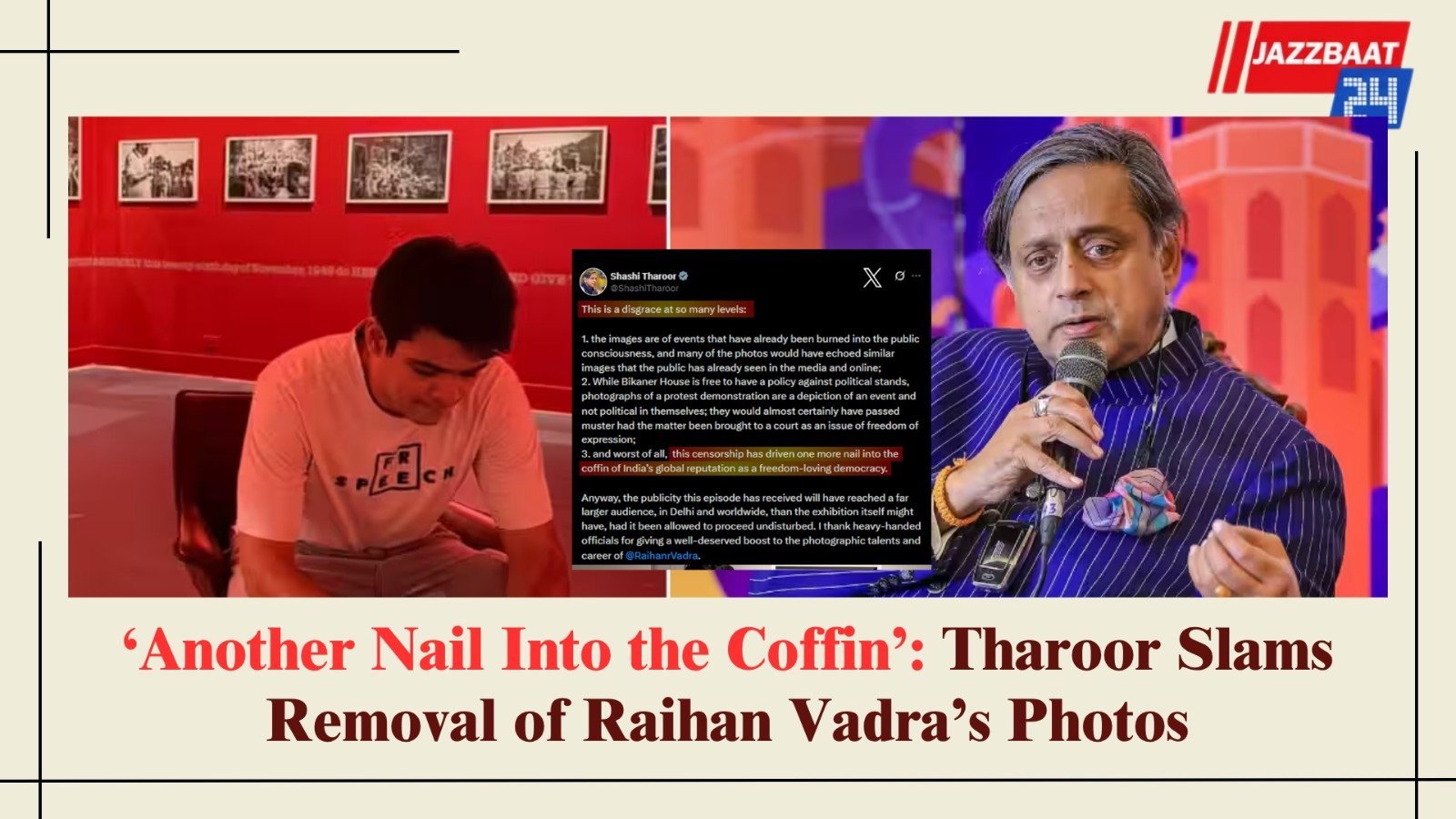
News Desk: Congress MP Shashi Tharoor has criticised the removal of photographs from Raihan Vadra’s exhibition at Bikaner House in New Delhi, saying the move has damaged India’s international reputation as a democracy that respects freedom of expression.
Tharoor described the incident as a “disgrace at so many levels” and argued that photographs documenting protests should not automatically be treated as political statements.
Raihan Vadra, a photographer and visual artist, is the son of Congress leader Priyanka Gandhi Vadra and businessman Robert Vadra. His exhibition, titled No Idea Is Final, features photography, multimedia artworks and installations.
According to Raihan, the Bikaner House administration asked him to remove several photographs documenting recent protests in Delhi shortly before the exhibition opened. He said he was instructed to remove or replace 74 out of 105 photographs. Some of the images reportedly depicted youth-led demonstrations, while the venue also objected to photographs of the Indian national flag.
The Bikaner House Management Society said certain photographs were inconsistent with its policies and had therefore been removed. However, the administration did not publicly specify which images had violated the rules or explain the precise grounds for its objections.
Reacting to the controversy on Friday, October 23, Tharoor argued that images documenting public demonstrations depict events and do not necessarily represent a political position taken by the photographer.
He warned that the incident could have repercussions beyond the exhibition itself, drawing international attention to questions about artistic freedom and censorship in India.
Tharoor also remarked that the controversy had given Raihan’s photographic work far greater publicity than the exhibition might otherwise have received. He thanked the officials involved for inadvertently boosting the young photographer’s visibility and career.
The incident has also drawn criticism from Priyanka Gandhi Vadra, who questioned the decision to restrict the display of her son’s photographs. The controversy has reignited debate over the boundaries between institutional policies governing public exhibition spaces and an artist’s freedom to document politically sensitive events.
Bikaner House, a cultural venue in the national capital, is owned by the Rajasthan government. The exhibition is scheduled to remain open until October 25, while Raihan has indicated that he intends to display the complete collection at another venue.
The episode has sparked a wider discussion about censorship, artistic expression and the role of public cultural institutions in a democracy.



Reader Comments 0