
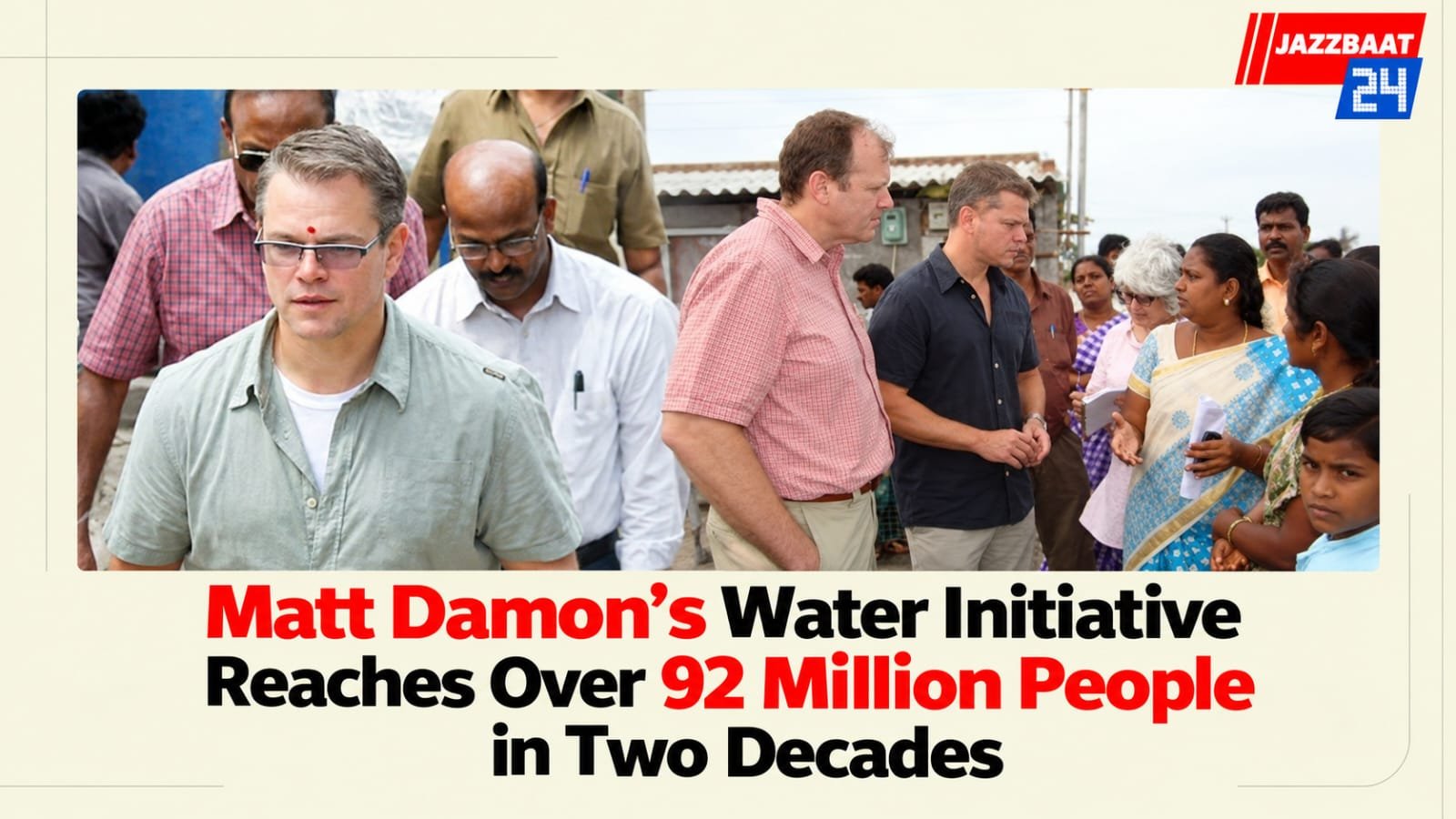
News Desk: Hollywood actor Matt Damon’s journey into global water advocacy began in 2006 after he witnessed the difficulties faced by a young girl collecting water in Zambia. Nearly two decades later, the initiative he helped launch has become part of Water.org, a nonprofit organisation that says it has reached more than 92 million people with access to safe water and sanitation.
Damon founded the H2O Africa Foundation in 2006 to raise awareness and funds for organisations providing clean water to remote communities. His experience in Zambia highlighted the daily challenges faced by people who must travel long distances to collect water, while others can access it simply by turning on a tap.
In July 2009, H2O Africa merged with WaterPartners, a nonprofit founded by engineer Gary White. The merger led to the creation of Water.org, which developed an approach aimed at helping low-income families finance improvements to their water and sanitation facilities.
A loan-based approach to clean water
One of Water.org’s key initiatives is WaterCredit, which partners with local financial institutions to provide small loans to families for household water connections and toilets. Borrowers repay the loans over time, allowing the model to support access to essential facilities without relying entirely on charitable donations.
According to Water.org, 89 per cent of people who take these loans are women. The organisation says it reached nearly 10 million people in 2025 and aims to reach 200 million by 2030. These figures are based on the nonprofit’s own reporting.
The broader global challenge remains significant. A 2025 report by the WHO and UNICEF Joint Monitoring Programme estimated that 2.1 billion people lacked safely managed drinking water in 2024, equivalent to roughly one in four people worldwide. However, 961 million people gained access to safely managed drinking water between 2015 and 2024.
Research highlights both benefits and limitations
Research published in 2022 in the Journal of Water, Sanitation and Hygiene for Development examined survey data from 2,931 households in Indonesia. The study found that households borrowing for water and sanitation needs had better sanitation outcomes, higher average monthly incomes and 28 per cent lower health-related spending.
However, researchers did not find a clear association between the loans and improved access to water. Around 29 per cent of borrowers reportedly still lacked a water facility at their homes. The findings showed associations rather than proof that the loans directly caused the improvements.
The research suggests that the model may be particularly useful for sanitation improvements, while also highlighting the importance of tracking how loan funds are spent.
Nearly 20 years after Damon’s initial effort, Water.org’s work demonstrates how access to affordable credit can help families improve essential facilities. Yet, with billions still facing water insecurity, financing initiatives alone are unlikely to solve the global crisis.



Reader Comments 0