
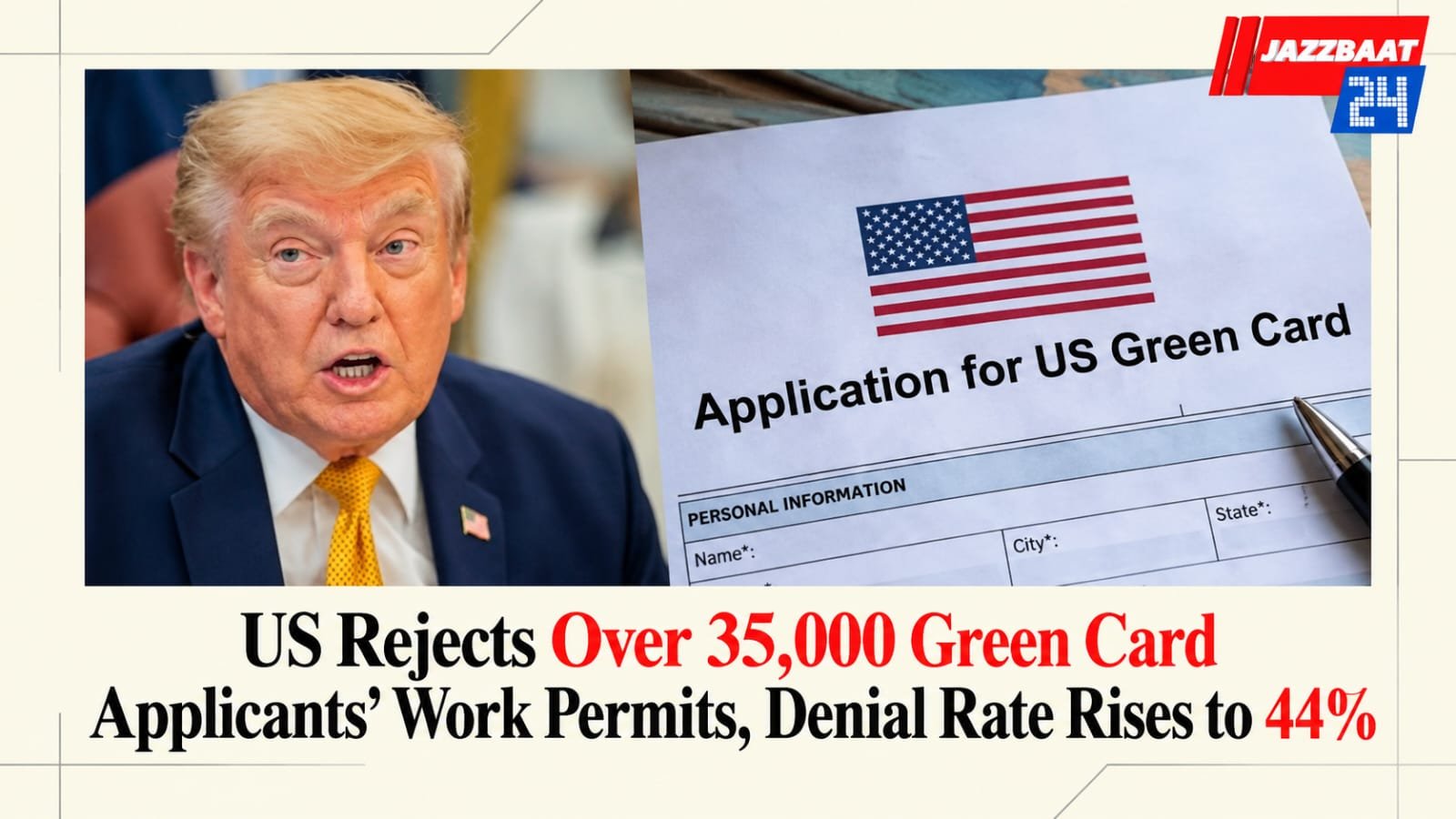
News Desk: The United States has rejected more than 35,000 work permit applications from foreign nationals seeking permanent residency, with the denial rate rising sharply to around 44% between April and June 2026. The latest figures highlight the growing challenges faced by immigrants seeking permission to work while their Green Card applications remain under review.
According to data from the US Citizenship and Immigration Services (USCIS), the agency rejected 35,767 employment authorisation applications during the third quarter of the 2026 fiscal year. The denial rate was significantly higher than the approximately 25% recorded during the first two quarters, covering October 2025 to March 2026.
During the April-June period, USCIS received 153,039 applications under Form I-765 for employment authorisation through the adjustment-of-status process. Of these, 46,405 applications were approved, while 35,767 were rejected.
Form I-765 allows eligible foreign nationals to apply for an Employment Authorization Document (EAD), which permits them to work legally in the US while their immigration applications are being processed, subject to the applicable rules.
Green Card applicants face longer waits
The number of pending Form I-765 applications under the adjustment-of-status category reached 671,362 during the period, with the typical processing time standing at approximately 6.4 months.
The figures indicate that applicants may face considerable uncertainty while waiting for permission to work. Delays can affect immigrants who depend on employment to support themselves and their families while pursuing permanent residency.
Other immigration categories also recorded rejections during the quarter. Applications filed under Form I-129, which covers temporary foreign workers, including many H-1B visa applicants, recorded 39,560 denials against 143,748 approvals, representing a denial rate of around 22%.
Family-based immigration petitions filed under Form I-130 recorded 16,661 denials, accounting for approximately 17% of decisions. Employment-based immigrant petitions under Form I-140 saw 7,069 denials and 37,975 approvals, giving a denial rate of roughly 16%.
Meanwhile, employment-based Green Card applications filed through Form I-485 recorded a comparatively lower denial rate of around 7%, according to the report.
Citizenship applications also face increased rejections
USCIS data also showed a rise in rejected naturalisation applications. During the same quarter, the agency processed 140,179 applications under Form N-400, approving 54,974 and rejecting 12,591. The reported rejection rate increased to approximately 19%, compared with 13% in the previous two quarters.
Pending naturalisation applications climbed to 727,371, with a typical processing time of around 9.5 months.
Immigration costs could rise further
The developments come amid broader changes to US immigration policies and fees. According to the report, USCIS planned to increase certain fees for asylum applications, work permits and Temporary Protected Status from October 16, 2026, in line with annual inflation adjustments.
Separately, the Department of Homeland Security had proposed additional charges relating to universities recommending international students for Optional Practical Training (OPT), including a proposed $70,000 fee and a further $30,000 charge for programme extensions.
The proposal would require further consideration before implementation. If adopted, such charges could increase costs for universities and international students seeking work experience in the United States.
For foreign nationals pursuing employment and permanent residency, the latest figures underline the importance of understanding eligibility requirements, application procedures and processing timelines.




Reader Comments 0