
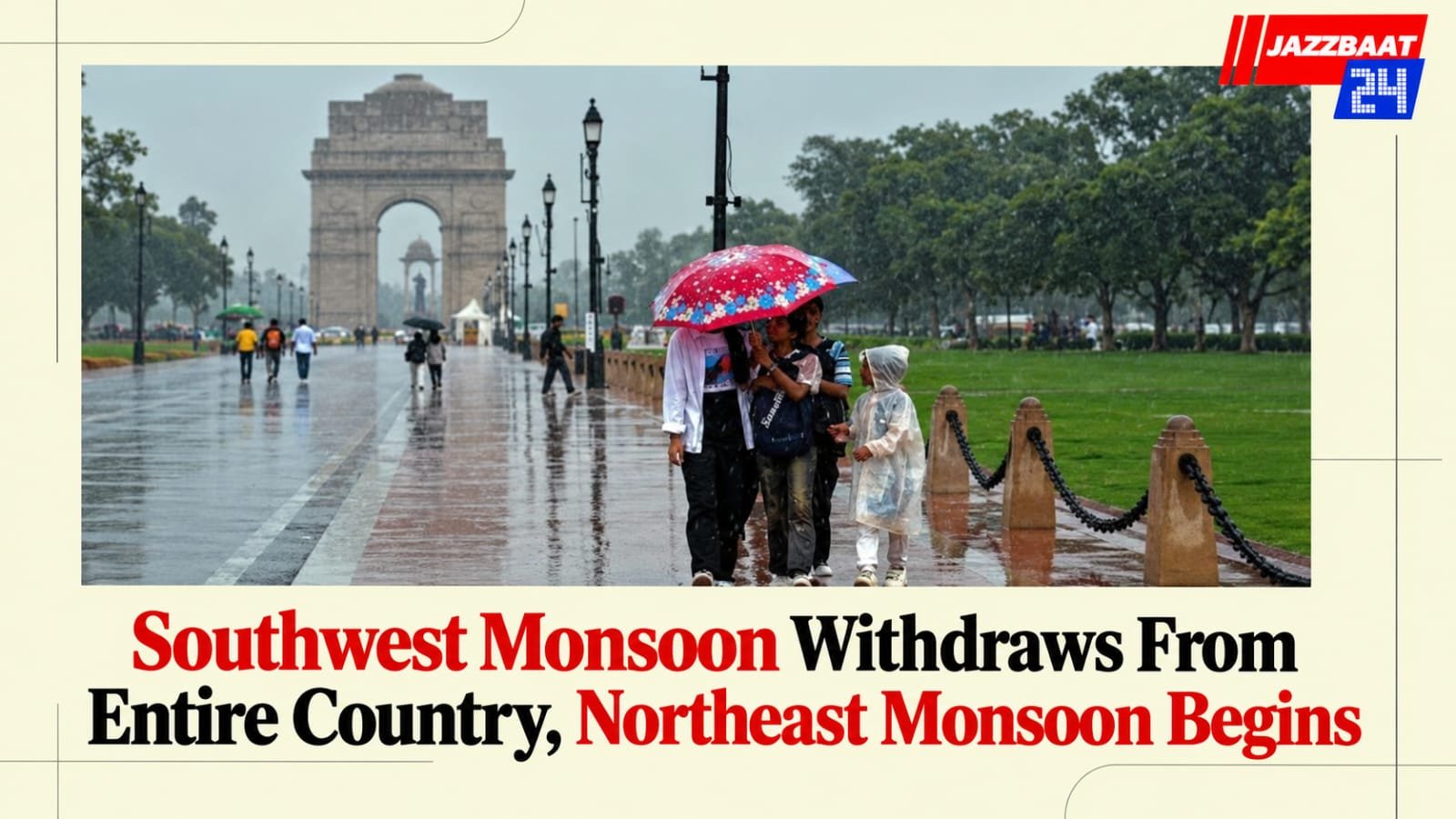
News Desk: The southwest monsoon has withdrawn from the entire country, the India Meteorological Department (IMD) announced on Thursday, October 15. At the same time, the northeast monsoon has begun over southern parts of India, bringing widespread rainfall to Tamil Nadu, Puducherry, Andhra Pradesh, Kerala and Karnataka.
The withdrawal marks the end of the southwest monsoon season, which the IMD officially records from June 1 to September 30. However, rainfall often continues into October, with October 15 considered the normal date for the monsoon to withdraw from the entire country.
In recent years, the withdrawal has taken place around a similar time. The monsoon withdrew nationwide on October 16 in 2025 and October 15 in 2024. In 2023, it was declared withdrawn on October 19, while in 2022 and 2021, the dates were October 23 and October 25, respectively. Since 2000, the most delayed withdrawal occurred in 2010, when it was declared on October 29.
According to an IMD official, the southwest monsoon generally withdraws on or after October 15, around the same time that the northeast monsoon becomes established over the southern peninsula.
The northeast monsoon is particularly important for southern India, where rainfall continues into December. The IMD reported that several weather systems were contributing to the ongoing showers. An upper-air cyclonic circulation over south coastal Tamil Nadu, along with easterly and northeasterly winds, has supported rainfall across the region.
During the 24 hours ending October 15, fairly widespread rainfall was recorded over Tamil Nadu, Puducherry, Karaikal and adjoining areas of south coastal Andhra Pradesh and south Rayalaseema. Heavy rainfall was also reported at a few locations in Tamil Nadu, Puducherry and Karaikal.
Meanwhile, intense showers affected parts of northwest India, including Punjab, Haryana, Rajasthan and Delhi. According to Skymet Weather vice-president Mahesh Palawat, the rainfall was caused by a western disturbance and two cyclonic circulations. Their combined influence was expected to continue bringing showers across the region until Friday.
This year's overall rainfall has also drawn attention. India recorded 759.4 mm of rainfall, around 13% below the long-period average of 868.6 mm. The figure represents the country's fourth-lowest rainfall total since 2001, according to the report, with a strengthening El Niño cited as a major contributing factor.
The World Meteorological Organization warned on October 8 that El Niño could intensify in the coming months and peak around December. The phenomenon may influence global temperatures and rainfall patterns, increasing the risk of droughts and floods in different regions. For India, El Niño conditions are generally associated with a milder winter in northern parts of the country.




Reader Comments 0