
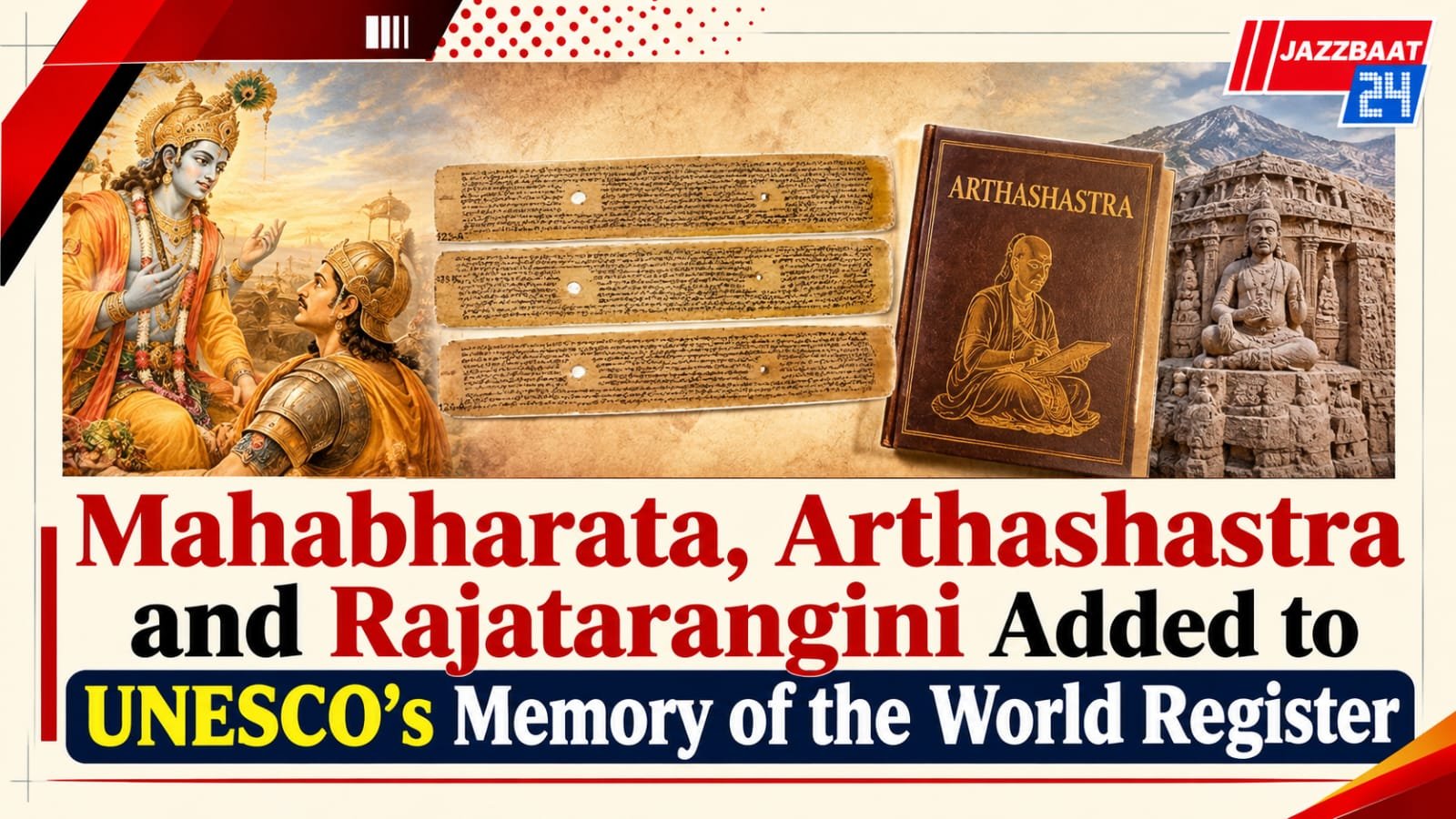
New Delhi, November 6: India's rich literary, historical and intellectual heritage has received significant international recognition, with three iconic works the Mahabharata, Arthashastra and Rajatarangini being included in UNESCO's Memory of the World Committee for Asia and the Pacific (MOWCAP) Regional Register.
The announcement marks an important milestone in the global recognition of India's ancient knowledge traditions. Union Minister for Culture and Tourism Gajendra Singh Shekhawat welcomed the decision, describing it as a moment of immense pride and a landmark recognition of the country's civilisational and documentary heritage.
In a statement shared on social media, the minister said the three works represent India's long-standing traditions of historical research, philosophical thinking and political administration. He added that their knowledge and wisdom continue to hold relevance for humanity.
The three texts offer distinct perspectives on India's intellectual development and have influenced generations across different fields.
The Rajatarangini, written by 12th-century Kashmiri historian Kalhana, is regarded as one of the most important historical chronicles of medieval India. Composed in Sanskrit, the work documents the history of Kashmir through successive dynasties, rulers, political developments and social transformations. Its chronological approach and examination of historical sources make it an important reference for understanding Kashmir's past.
The Mahabharata, one of the longest epic narratives in the world, occupies a central place in India's literary, philosophical and religious traditions. Beyond the legendary conflict between the Kauravas and Pandavas, the epic explores complex questions of morality, justice, duty, power and human relationships. The Bhagavad Gita, which forms part of the Mahabharata, continues to influence philosophical discussions across the world.
The Arthashastra, traditionally attributed to ancient Indian scholar and strategist Kautilya, also known as Chanakya, is a foundational text on governance and statecraft. It examines subjects including administration, economics, taxation, diplomacy, military strategy, intelligence networks and law enforcement. The work provides valuable insights into the functioning of ancient Indian political systems.
UNESCO's Memory of the World Programme was launched in 1992 to safeguard documentary heritage from destruction, deterioration and loss. It aims to preserve historically significant documents and ensure that knowledge remains accessible to future generations.
The programme operates through international, regional and national registers. The latest inclusion in the Asia-Pacific Regional Register further strengthens India's presence in the initiative.
India has previously received recognition for several important documentary collections, including the Rigveda, Saiva manuscripts, Tamil medical texts, Kalachakra Tantra commentaries and the works of Abhinavagupta.
The latest recognition is not merely a cultural achievement for India but also highlights the global significance of its historical records, literary traditions and political philosophy. Together, these three works demonstrate the remarkable depth of ancient Indian knowledge and its continuing contribution to human civilisation.




Reader Comments 0