
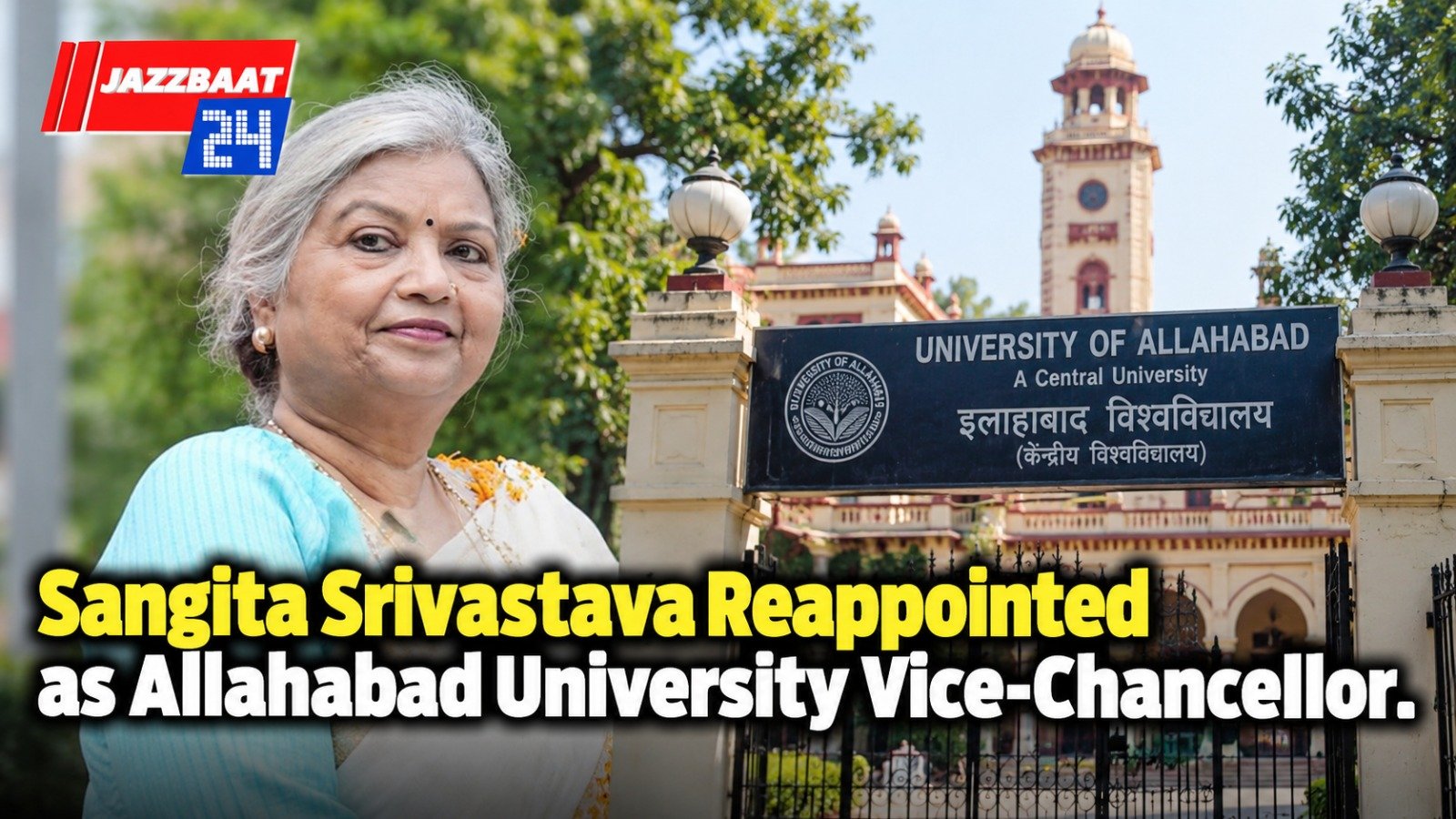
Professor Sangita Srivastava has been reappointed as the Vice-Chancellor of Allahabad University for a second full five-year term. President Droupadi Murmu, who is the Visitor of the university, issued the reappointment order on September 22, with the new term effective from September 16, 2026.
Srivastava became Allahabad University’s first woman Vice-Chancellor when she took charge in November 2020. Her new term will continue for five years or until she reaches the age of 70, whichever comes earlier.
The reappointment makes Srivastava the second permanent Vice-Chancellor of Allahabad University to complete a full term since the institution became a central university in 2005. It also follows an amendment to the university’s rules in 2012 that allows reappointment.
Her first tenure saw several administrative and academic developments, along with a number of controversies. During her tenure, the university secured an A+ grade from the National Assessment and Accreditation Council (NAAC), appointed around 400 teachers and 636 non-teaching employees, and promoted more than 280 faculty members under the Career Advancement Scheme.
The university also introduced four-year undergraduate programmes under the National Education Policy (NEP) 2020. The programmes included options such as certificates, diplomas, double majors and honours with research, alongside skill-based courses.
However, her tenure was also marked by student protests over a significant fee increase. The university had cited financial requirements and the reduction of its recurring non-salary grant as reasons for revising fees. The protests included marches and hunger strikes.
Another controversy arose in 2021 when Srivastava wrote to local authorities about the volume of a nearby mosque’s loudspeaker. The matter drew public attention after she referred to an Allahabad High Court ruling concerning the use of loudspeakers.
Questions were also raised during her first term over restrictions on university employees communicating with the media. In 2024, the Executive Council approved an advisory requiring staff to obtain approval before providing inputs to the media or writing about the university on social media.
Her reappointment has received differing reactions from academics. Some education experts cited in the report said continuity can help universities complete long-term projects and avoid administrative gaps. Others questioned whether the same Vice-Chancellor should serve for ten years when a large pool of experienced academics is available.
Professor Furqan Qamar said reappointment can be appropriate when university statutes permit it and the incumbent goes through the prescribed selection process. Association of Indian Universities secretary general Pankaj Mittal also noted that both continuity and fresh leadership can have advantages.
Former UGC chairman Sukhdeo Thorat, however, distinguished between the legal provision allowing reappointment and the question of whether a decade-long tenure is desirable.
The university has said that the subjects of questions concerning the reappointment did not fall under its purview. The education ministry has also not responded to queries seeking details about the search-cum-selection panel and the reasons behind the reappointment.


Reader Comments 0