
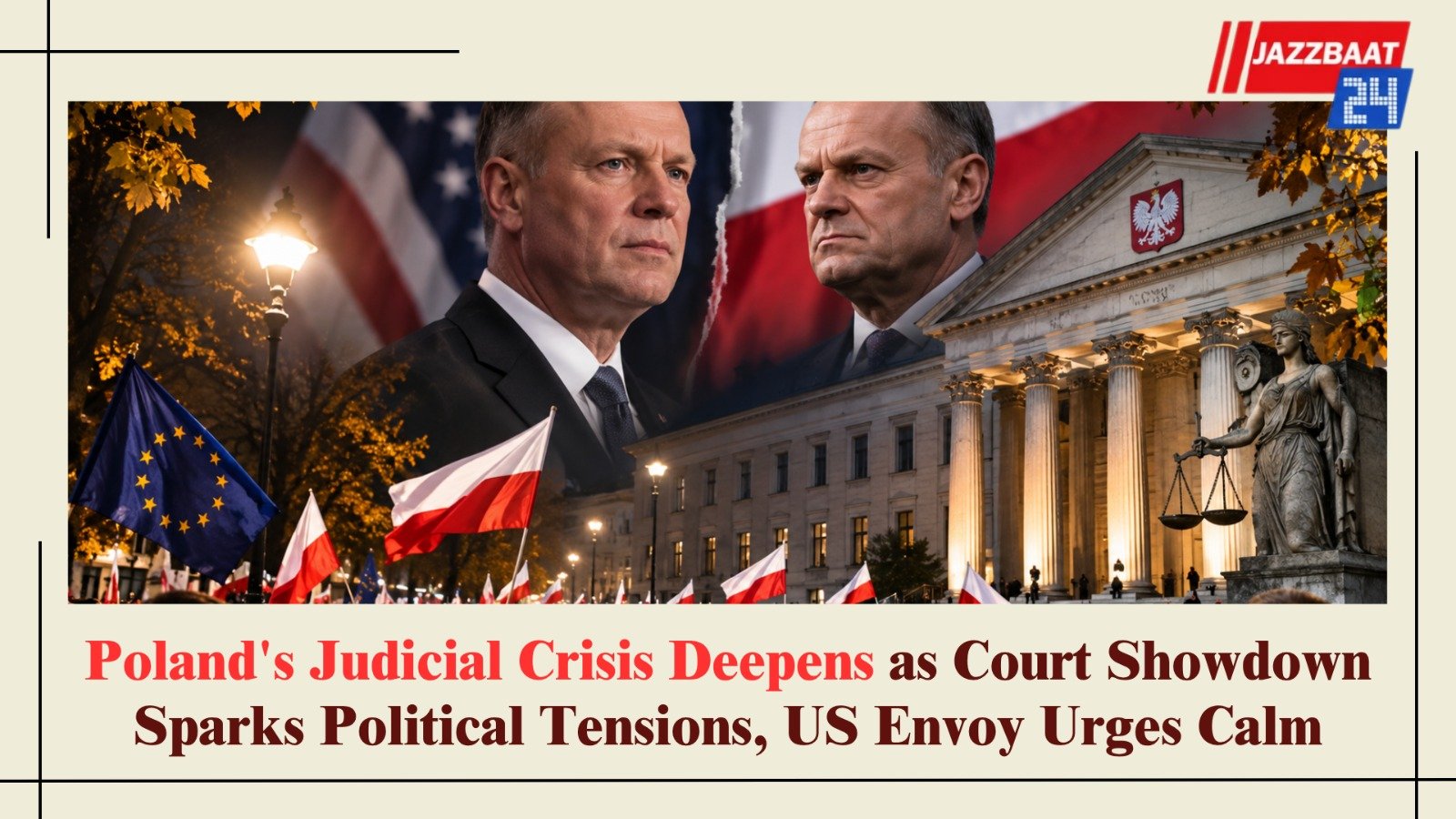
Poland's long-running judicial crisis has entered a new phase following a dramatic confrontation at the country's Constitutional Tribunal in Warsaw. The dispute over judicial appointments and the authority of the top constitutional court has triggered protests, a police deployment and a fresh political standoff between Prime Minister Donald Tusk's government and President Karol Nawrocki.
The latest developments unfolded on Friday, October 30, when a group of judges moved to suspend Constitutional Tribunal President Bogdan Święczkowski and his deputy, Bartłomiej Sochański, for one month. Judge Anna Korwin-Piotrowska announced the decision and said she would temporarily take charge of the institution.
The move immediately triggered strong opposition from the suspended judges and the right-wing opposition Law and Justice party (PiS). Święczkowski described the action as a "coup d'état", while PiS leader Jarosław Kaczyński accused the government-aligned judges of attempting to take control of the court.
The situation escalated as protesters gathered outside the tribunal's headquarters in Warsaw. Riot police were deployed to secure the premises, and three demonstrators were detained following clashes with security personnel.
President Nawrocki, who is aligned with PiS, cut short his official visit to Senegal and returned to Warsaw after learning about the developments. He described the suspension of the tribunal's leadership as a violation of Poland's constitutional order.
On Saturday, Nawrocki held emergency consultations with representatives of several parliamentary parties at the presidential palace, seeking to address the growing political crisis. However, Prime Minister Tusk's Civic Coalition did not participate in the meeting, and no immediate breakthrough was reported.
Tusk defended the move, arguing that restoring the rule of law and judicial independence was a responsibility of his government. He accused the previous PiS administration of weakening judicial independence during its eight years in power between 2015 and 2023.
The conflict has its roots in a decade-long dispute over judicial appointments. Tusk's government has been attempting to reverse controversial judicial reforms introduced under PiS, while Nawrocki has resisted several appointments proposed by the parliamentary majority.
The European Commission has also urged Nawrocki to accept the appointment of new judges at the centre of the dispute.
Meanwhile, US Ambassador to Poland Tom Rose called for restraint, warning that the confrontation could escalate into something far more serious. He said both sides were presenting sharply different accounts of the events and stressed that Poland needed stability, security and respect for democratic institutions.
The crisis is unfolding ahead of Poland's parliamentary elections scheduled for next year, raising concerns about further political polarisation and the future independence of the country's judiciary.



Reader Comments 0