
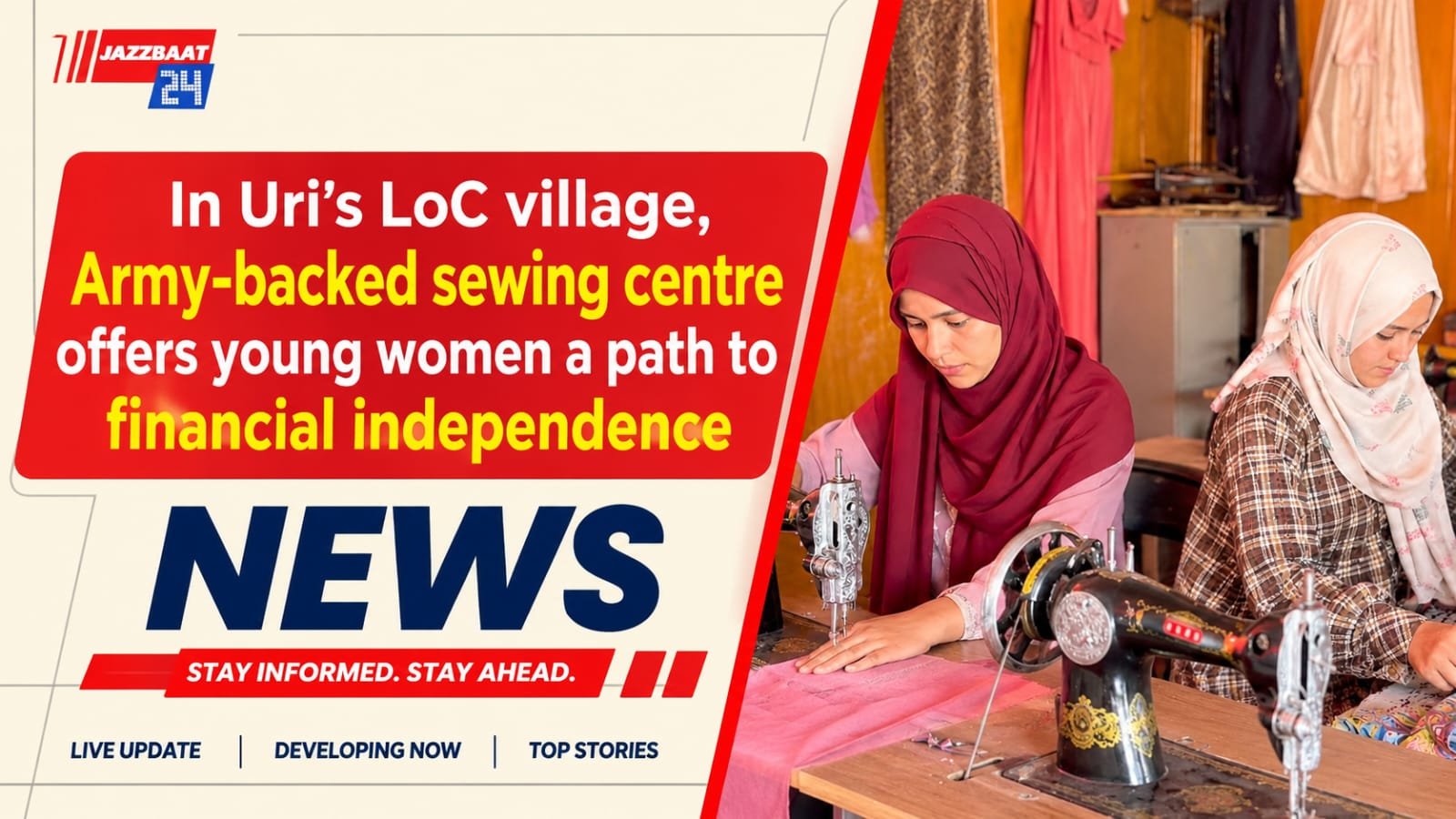
Srinagar, Nov 09: In Churanda, a remote village along the Line of Control (LoC) in north Kashmir’s Uri sector, a modest vocational training centre is seeking to expand livelihood opportunities for young women, offering them a chance to acquire skills that could eventually translate into financial independence.
For many women in the border village, geographical isolation, limited employment opportunities and poor access to vocational institutions have meant few avenues to develop professional skills or earn an independent income. An Army-supported sewing centre is now attempting to address that gap by providing local girls with training in stitching and tailoring.
Around 16 to 17 girls are currently undergoing training at the centre, which has been equipped with sewing machines and other necessary facilities. The trainees are being taught by Saima, a local woman who has taken up the responsibility of imparting tailoring skills.
For Saima, the initiative is about more than teaching girls how to stitch clothes. It is about enabling them to develop a skill they can use without having to leave their village or depend on employment opportunities elsewhere.
"Earlier, many girls would remain at home without any work. They had very few opportunities to learn something or do anything independently. Now, with the centre opening, they come here, learn sewing and can eventually start working from their homes," Saima told.
She said tailoring could provide women with an opportunity to earn while remaining connected to their families and communities.
"Not every girl gets an opportunity to go outside the village for studies or employment. But if she learns tailoring, she can do the work from her own home. She can stitch clothes for people and earn something through her own efforts," she said.
The centre has also created a shared space where young women can come together, learn and spend their time acquiring a practical skill.
"There are around 16 to 17 girls learning here. They are showing interest, and it makes us happy to see them coming regularly. Our effort is to teach them properly so that one day they can work independently," Saima added.
For the trainees, the opportunity represents a possible alternative to remaining dependent on limited livelihood options in the village.
Kulsuma, one of the girls undergoing training, said the centre had provided local women with an opportunity they had long needed.
"Earlier, many girls would sit at home because there was nothing available for them to learn. Now we have a place where we can come, learn sewing and utilise our time in a productive way. It gives us hope that we can do something on our own in the future," she said.
Thanking the Army for supporting the initiative, Kulsuma said the centre had encouraged girls in the village to think about becoming self-reliant.
"The Army has done a very good job for us by providing this centre. We are grateful that they have thought about girls living in a remote village like ours. We are learning a skill which can help us earn in the future," she said.
She also credited their instructor for helping them learn the basics of stitching.
"Our instructor teaches us with patience. We are learning step by step. We hope that after completing the training, we will be able to stitch clothes ourselves and earn from this work," she added.
The initiative reflects the Army's wider community outreach efforts in Jammu and Kashmir, particularly in villages close to the LoC, where difficult terrain, inadequate infrastructure and limited connectivity often restrict access to education, healthcare and employment.
Through Operation Sadbhavana and other outreach programmes, the Army has undertaken initiatives in education, healthcare, vocational training and livelihood generation in remote and underserved areas.
In north Kashmir's Gurez Valley, Army-supported initiatives have included training in tailoring, embroidery and computer skills. Women have also been encouraged to explore income-generating activities, including detergent-making, to create livelihood opportunities within their communities.
Similarly, the Chinar YUVA Centre at Dangiwacha in north Kashmir has focused on vocational education, entrepreneurship and skill development among local youth, including women.
For women living in border areas, such interventions assume particular significance as difficult transportation, geographical isolation and limited access to employment centres often make it challenging to pursue jobs or vocational courses outside their villages.
An official told *Kashmir Convener* that skills such as tailoring and embroidery could provide women with an opportunity to earn from home, balance household responsibilities and contribute to their families' incomes.
However, translating vocational training into sustainable livelihoods remains a challenge. Access to sewing machines, raw materials, financial assistance, advanced training and markets for finished products will be crucial if the trainees are to turn their newly acquired skills into viable sources of income.
The success of the Churanda centre, therefore, will depend not only on how many girls complete the training but also on how many are eventually able to use those skills to establish independent sources of income.
For now, in a village where livelihood opportunities for young women have remained limited, the sewing machines offer a starting point — a chance to move beyond traditional constraints and build an economic identity of their own.




Reader Comments 0