
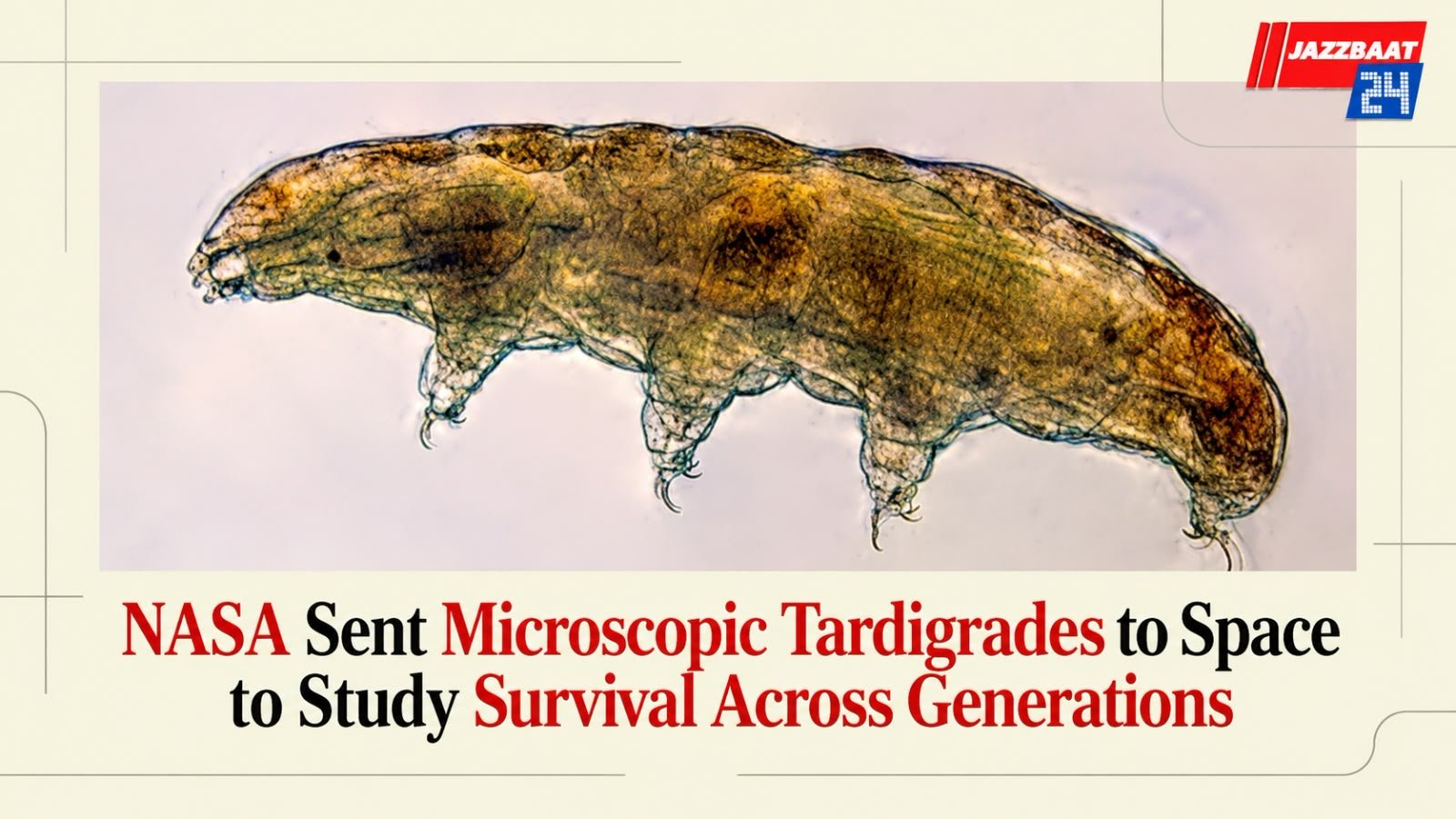
News Desk: NASA sent microscopic creatures known as tardigrades to the International Space Station in 2021 to investigate how living organisms respond to the stressful conditions of spaceflight and how their biological responses change across generations.
Also called “water bears” because of their appearance under a microscope, tardigrades are tiny invertebrates famous for their ability to survive extreme environmental conditions, including freezing and dehydration. Their remarkable resilience makes them valuable subjects for scientific research into how living cells cope with stress.
The tardigrades were transported to the space station aboard SpaceX’s 22nd commercial resupply mission on June 3, 2021. The experiment, known as Cell Science-04, focused on understanding the genetic mechanisms that help these organisms respond to challenging environments.
Researchers used the species Hypsibius exemplaris, which is suitable for laboratory studies. The investigation aimed to examine the animals’ short-term responses to spaceflight and changes in gene expression over several generations.
Gene expression refers to the process through which cells use information stored in genes to produce molecules needed for their functions. By studying these changes, scientists hoped to identify biological processes involved in the tardigrades’ ability to withstand stressful conditions.
The experiment also involved RNA interference, a technique that can suppress the activity of specific genes. Researchers planned to use it to investigate whether particular genes played a role in the creatures’ stress tolerance.
According to NASA’s research plans, scientists intended to compare the responses of an early generation with those of tardigrades maintained in space for longer periods. This would help them examine whether immediate reactions to spaceflight differed from changes observed over successive generations.
The research could eventually contribute to a better understanding of how living organisms respond to microgravity and other environmental stresses encountered during space missions.
Scientists are particularly interested in whether studying tardigrades could help identify biological mechanisms relevant to astronaut health during extended journeys beyond Earth. However, the experiment has not established that these mechanisms can directly protect humans.
Tardigrades and humans have substantial biological differences, meaning that any potential application would require extensive further research and testing.
Cell Science-04 formed part of NASA’s wider effort to understand the effects of spaceflight on living systems at the cellular and molecular levels. Such research is increasingly important as space agencies prepare for longer missions that could expose astronauts to unfamiliar and demanding conditions.
Although the tiny creatures are famous for their extraordinary resilience, understanding exactly how their biological systems respond to space remains a scientific challenge. NASA’s experiment was designed to provide valuable insights into these mechanisms and help guide future research into the effects of spaceflight on life.




Reader Comments 0