
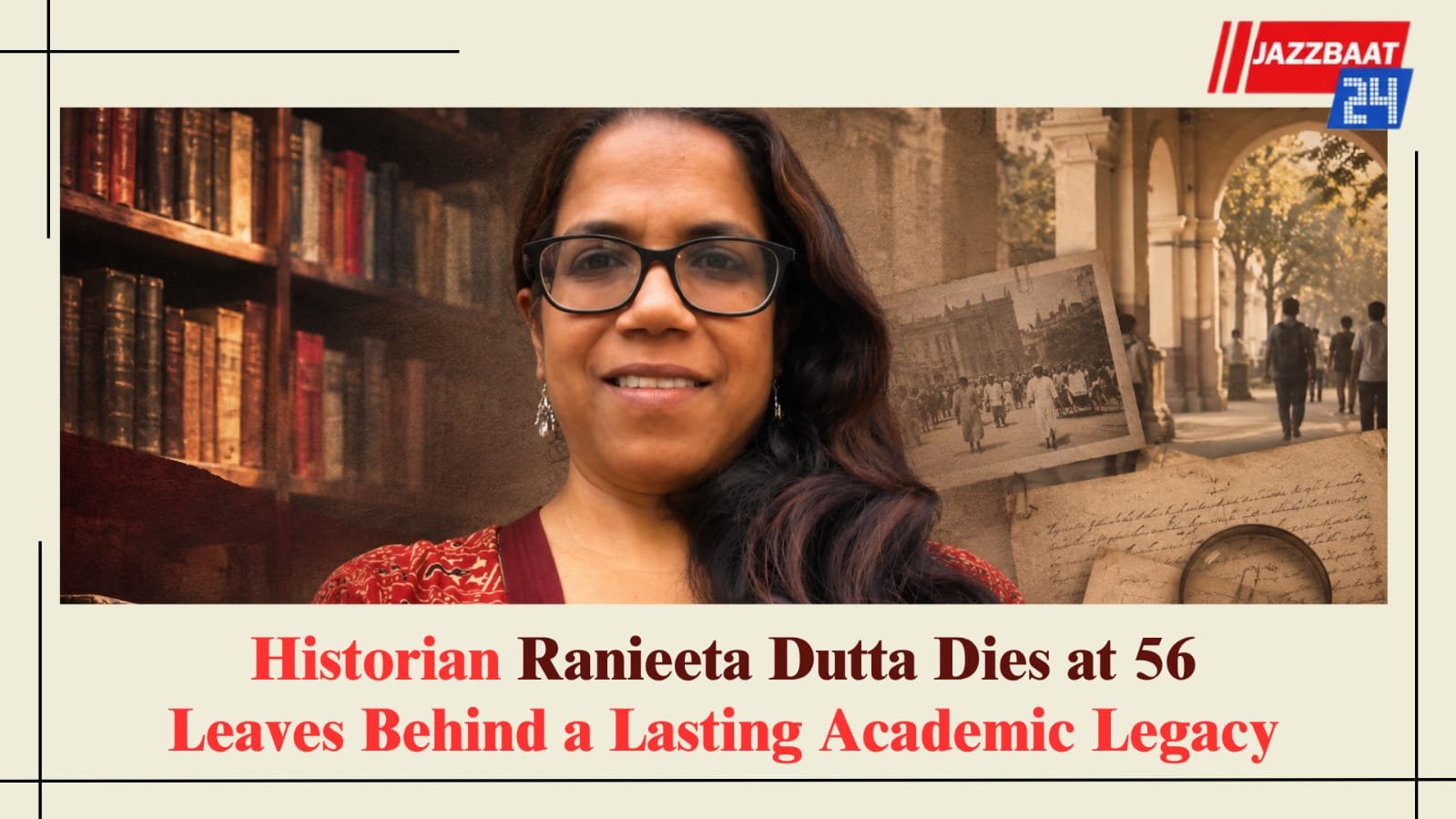
News Desk: Renowned historian and Jawaharlal Nehru University (JNU) academic Ranjeeta Dutta has passed away at the age of 56, leaving the Indian academic community mourning the loss of a distinguished scholar. She died on October 25, 2026, following a brief illness. Her death has come as a shock to students, colleagues and historians who admired her contribution to the study of medieval and early modern Indian history.
Dutta was associated with JNU's Centre for Historical Studies, where she made significant contributions through her teaching and research. She was widely recognised for her work on the history of medieval and early modern South India, particularly the relationship between religion, society, historical memory and urban development.
Born into a Bengali family, Dutta developed a deep academic interest in the religious and cultural traditions of southern India. Her research took her beyond conventional historical narratives, focusing on how religious traditions evolved and influenced social identities over different periods. To pursue her research, she also learned Tamil alongside Sanskrit, enabling her to examine historical texts and regional traditions more closely.
One of her most significant academic contributions was her 2014 book, From Hagiographies to Biographies: Ramanuja in Tradition and History, published by Oxford University Press. The book examined the changing historical representations of Ramanuja, a prominent philosopher and religious figure associated with the Srivaishnava tradition of South India. Through this work, she explored how religious narratives, community memories and historical evidence could be studied together to understand the past.
Her research interests also included temple towns, pilgrimage centres, urbanisation and the historical development of religious institutions. Her work on Srirangam, particularly its temple traditions and evolving urban character, offered fresh perspectives on the relationship between sacred spaces and society.
Apart from her research, Dutta was also deeply involved in academic publishing. She played an important editorial role in the Medieval History Journal, helping manage its peer-review process and maintaining its academic standards. She was also remembered as a dedicated teacher and mentor who supported young researchers.
The University of Erfurt's Max Weber Centre for Cultural and Social Sciences also expressed its condolences, remembering her contribution to research on religion and urban development in India. Dutta had spent time there as a research fellow in 2020, working on a project examining sacred spaces, urbanism and tradition in Srirangam.
Her passing marks a significant loss for Indian historical scholarship. Her research, publications and contribution to academic life are expected to remain an important source of knowledge and inspiration for future generations of historians.



Reader Comments 0