
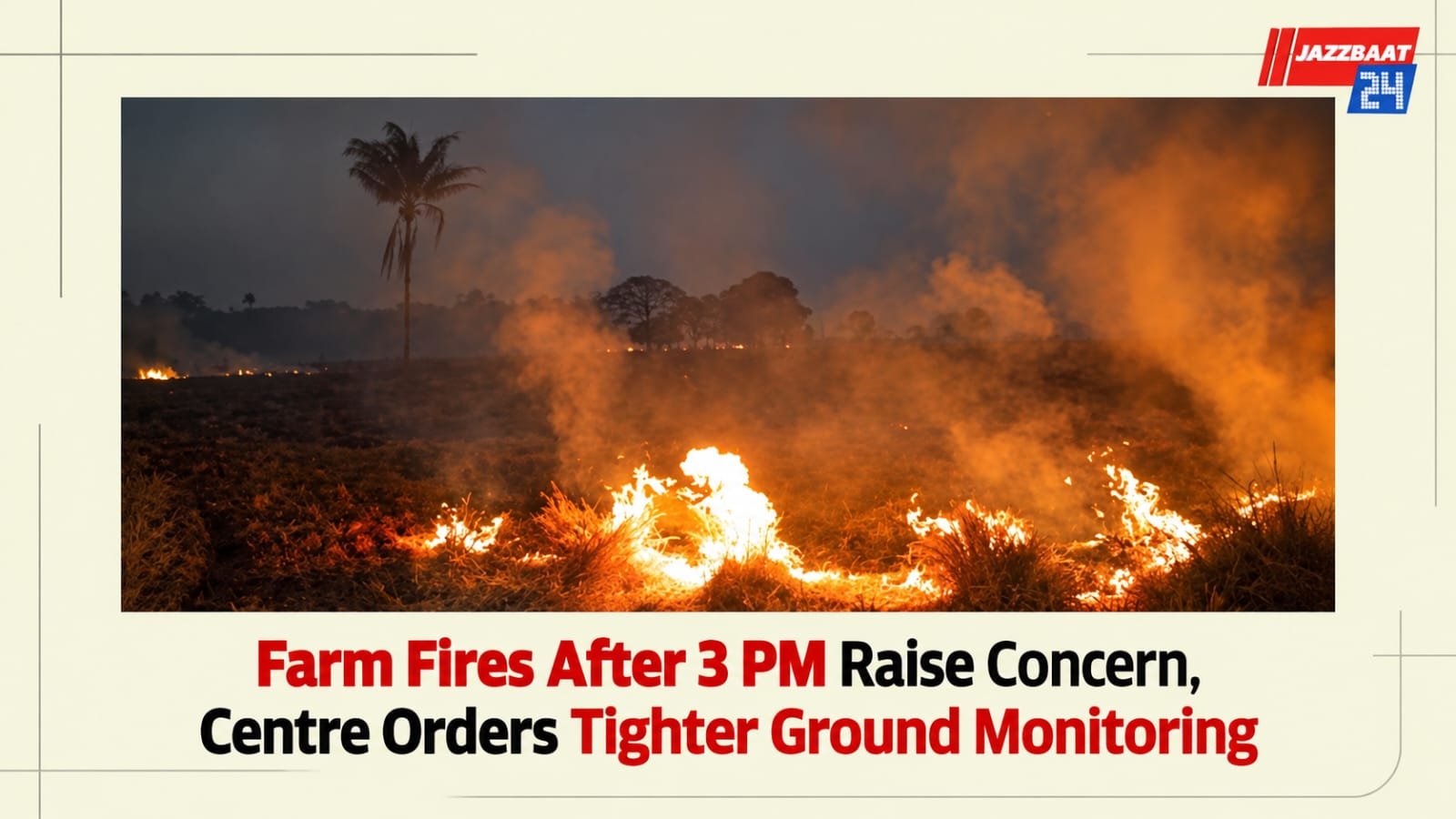
News Desk: The Centre has directed Punjab and Haryana to intensify ground-level monitoring of stubble burning after reports suggested that some farmers were setting fire to crop residue after 3 pm to avoid detection by satellites. The move comes as air quality in Delhi and the National Capital Region (NCR) begins to deteriorate ahead of winter.
At a joint review meeting on Tuesday, Union Environment Minister Bhupender Yadav called for stronger surveillance and enforcement to prevent crop residue burning. He stressed that authorities should not rely solely on satellite data and directed district administrations to increase ground patrolling and deploy flying squads during hours when satellite monitoring may miss farm fires.
The Centre has identified several districts for special attention, including Sangrur, Tarn Taran, Amritsar, Patiala and Gurdaspur in Punjab, along with Kaithal, Karnal, Kurukshetra, Ambala and Fatehabad in Haryana. Officials have also been asked to assess harvesting patterns and monitor areas where stubble burning is more likely to occur.
Union Agriculture Minister Shivraj Singh Chouhan called for urgent action to prevent the practice while emphasising the need to provide farmers with affordable and accessible alternatives. He directed officials to ensure that crop residue management machines reach farmers without delay.
Stubble Burning Incidents Show Mixed Trends
According to figures cited by Chouhan, stubble-burning incidents between September 15 and October 12 declined by 53.3% in Haryana and around 32% in Uttar Pradesh compared with the corresponding period last year.
Punjab recorded a marginal decline during the same period, while Rajasthan and Madhya Pradesh remained areas of concern. The Centre has asked the two states to identify affected districts and villages and introduce targeted action plans.
Authorities are also working to connect stubble-burning data with information from the Commission for Air Quality Management (CAQM) and the Central Pollution Control Board (CPCB) to improve monitoring and enforcement.
Drones to Track Fires Missed by Satellites
The government is increasingly turning to drone surveillance to detect farm fires in real time. The CAQM issued a standard operating procedure in July for deploying drones across Punjab, Haryana, Uttar Pradesh and Rajasthan during the winter pollution season.
Drone operations have been recommended particularly between 3 pm and 9 pm, when farmers may be more likely to burn crop residue outside the usual satellite observation window.
Studies have highlighted the changing timing of farm fires. Research by the International Forum for Environment, Sustainability and Technology in December 2025 found that many fires in Punjab and Haryana were being lit after 3 pm. An Indian Space Research Organisation study published in Current Science also reported a shift in peak fire activity towards around 5 pm in 2024.
Stubble burning releases pollutants that contribute to winter air pollution, although emissions from vehicles, industries, power plants and other sources also affect Delhi's air quality.
With winter approaching, the Centre is seeking stricter enforcement alongside practical support for farmers to reduce crop residue burning and limit its impact on public health.




Reader Comments 0