
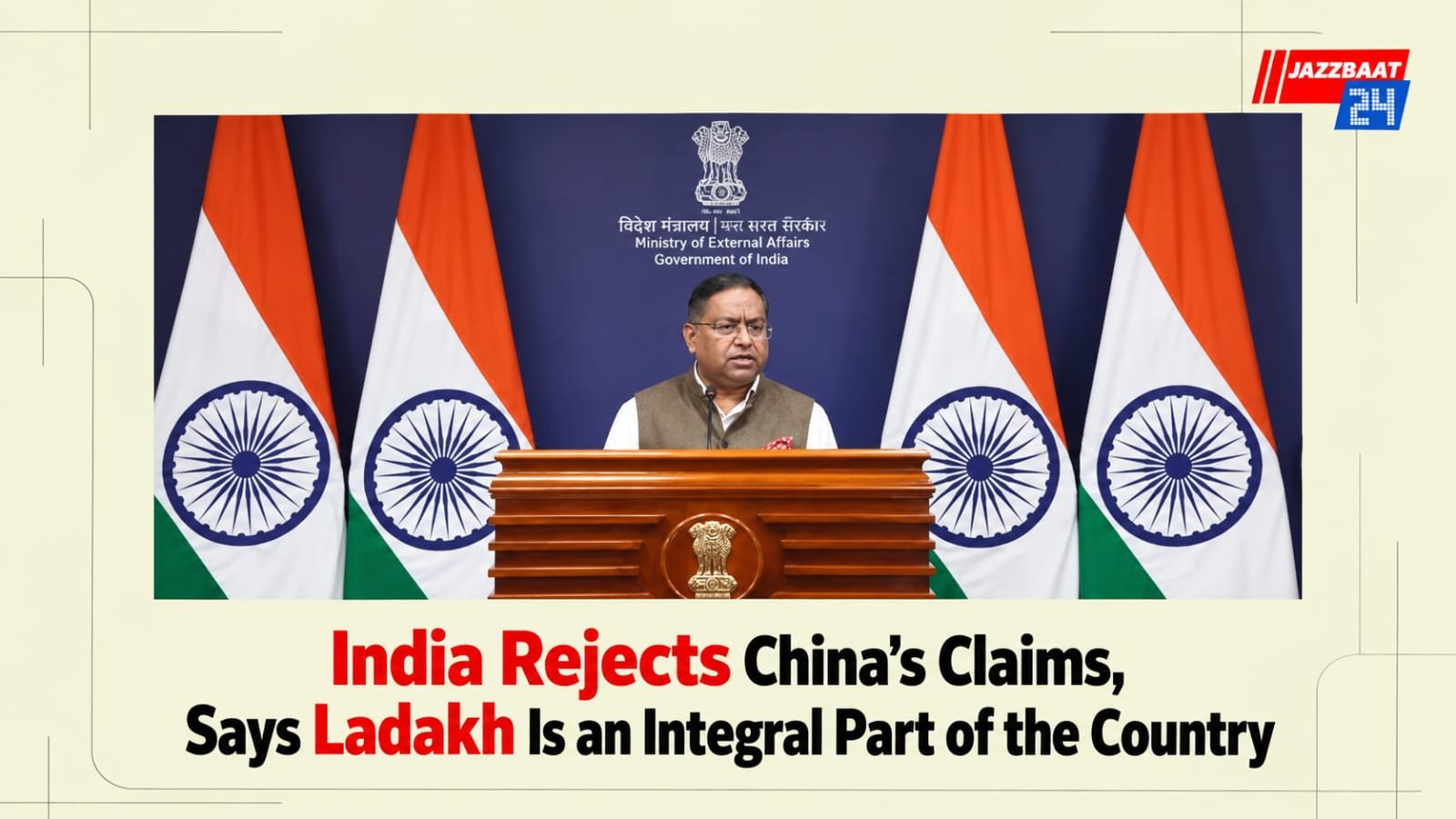
News Desk: India on Tuesday firmly rejected China’s objections to the Union government’s decision to officially identify 28 geographical locations in Ladakh, reiterating that the Union Territory is an integral and inalienable part of the country. The Ministry of External Affairs (MEA) said that China’s denial cannot change this established fact.
The response came after Chinese Foreign Ministry spokesperson Mao Ning criticised India’s recent move to assign standard names to 28 locations and geographical features in Ladakh. Beijing described the decision as “illegal and invalid” and reiterated that it does not recognise Ladakh as a Union Territory of India.
Responding to the remarks, MEA spokesperson Randhir Jaiswal said, “It is reiterated that the UT of Ladakh is an integral and inalienable part of India. No amount of denial by the Chinese side can change this established fact.”
Jaiswal also clarified that the Union Home Ministry’s announcement on October 2 was self-explanatory. The locations were formally identified using standard place and feature names on the official map of the Survey of India, in consultation with the Union Territory administration and local stakeholders.
According to the Home Ministry, the 28 geographical features include 10 mountain peaks, two passes, three mountains, seven land areas, two glaciers, two water bodies, one valley and one river. The initiative aims to ensure accurate identification of these locations and improve public awareness about the region.
The latest exchange comes amid continuing tensions between India and China over their disputed border. Relations between the two countries deteriorated sharply following the military standoff along the Line of Actual Control (LAC) in 2020, which continued for more than four years. Although both sides have taken steps towards normalising ties, the boundary dispute remains unresolved.
India’s decision to formally identify geographical features in Ladakh is also seen in the context of China’s repeated attempts to rename locations in territories claimed by Beijing. Earlier, the Indian government issued a similar list of standard names for 27 locations in Arunachal Pradesh.
China has announced several rounds of names for places in Arunachal Pradesh in 2017, 2021, 2023 and 2024. Beijing refers to the state as “South Tibet”, a claim consistently rejected by New Delhi.
India has maintained that such naming exercises cannot alter the ground reality or change the status of its territories.
Ladakh became a separate Union Territory in October 2019, following the reorganisation of the former state of Jammu and Kashmir after the revocation of its special status in August that year.
The latest diplomatic exchange highlights the continuing disagreement between New Delhi and Beijing over territorial claims, even as both countries seek to maintain dialogue and improve bilateral relations.




Reader Comments 0