
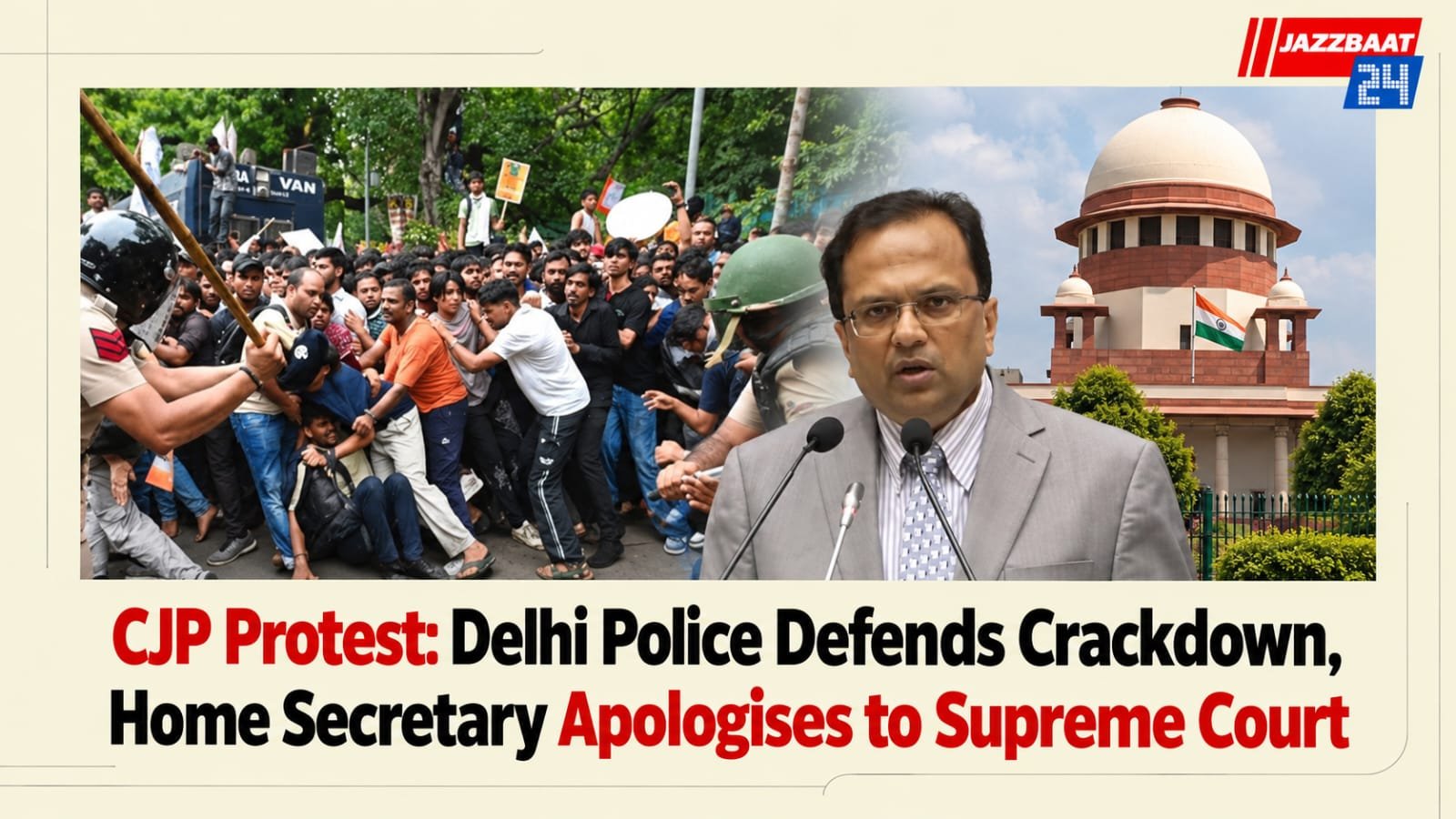
News Desk: Delhi Police has defended its decision to deny permission for the Cockroach Janta Party (CJP)’s October 10 march and detain protesters, citing concerns over public safety and the organisation’s alleged history of violence. The defence comes as the Supreme Court examines possible contempt of court over restrictions imposed around the protest.
In an affidavit filed before the court, Delhi Police Commissioner Anurag Kumar said the measures were necessary to maintain law and order and prevent damage to public and private property. He argued that the police could not ignore the risks associated with the proposed demonstration, particularly in the national capital, which houses several sensitive institutions.
The affidavit referred to CJP’s July 20 march over the NEET-UG paper leak, describing it as unauthorised and unlawful. Police alleged that the earlier gathering involved violence and attacks on personnel, claiming that more than 240 police officers and personnel were injured. These allegations were cited to justify the decision to deny permission for the October 10 march.
The commissioner also referred to demonstrations held on October 6, 7 and 8, alleging that they disrupted traffic in central Delhi, stranded commuters and resulted in injuries to more than a dozen police personnel. According to the affidavit, some protesters also behaved aggressively towards officers, including women personnel.
Police maintained that those detained on October 10 were released within a few hours and were not kept in police lock-ups or jails. The commissioner described the action as timely, proportionate and lawful.
Meanwhile, Union Home Secretary Govind Mohan has tendered an “unconditional and unqualified apology” before the Supreme Court while denying any deliberate disobedience of its directions. His affidavit defended the temporary suspension of cellular internet services around Raisina Hill, saying the measure was intended to prevent rumours and maintain public order.
The suspension remained in force from 10 pm on October 9 to 10 pm on October 10 within a four-kilometre radius of Raisina Hill. The government stated that broadband and Wi-Fi services were not suspended. The home secretary has also requested permission for internet suspensions in necessary circumstances, subject to legal safeguards.
The Railway Board, meanwhile, informed the court that services were cancelled in view of the prevailing situation. According to its affidavit, 41 mail and express trains scheduled to arrive at New Delhi, Hazrat Nizamuddin and Tilak Bridge between 4 am and 2 pm on October 10 were cancelled. Around 200 passenger trains terminating in or passing through Delhi were also cancelled during a separate period spanning October 9 and 10.
The Supreme Court issued contempt notices on October 11 to the Union home secretary, Delhi Police commissioner and Delhi Metro Rail Corporation chairperson over alleged non-compliance with its earlier directions. The court had directed authorities not to impose blanket restrictions on Metro and other rail services, but to regulate operations and inform commuters about arrangements.
The matter places renewed focus on balancing the right to peaceful protest with public safety and the need to comply with judicial directions.


Reader Comments 0