
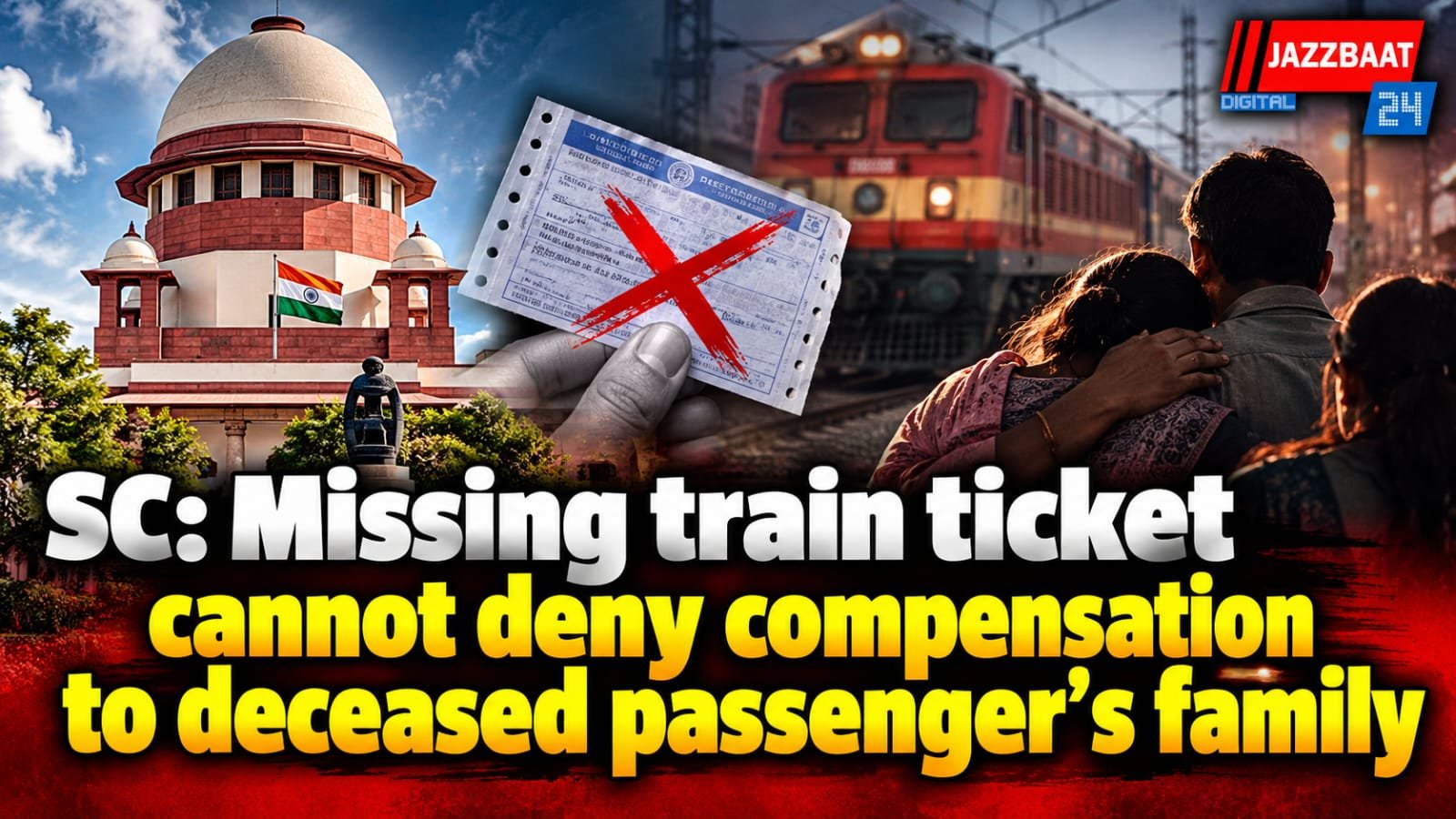
The Supreme Court has ruled that the failure to recover a train ticket from a deceased passenger cannot, by itself, be a reason to reject a compensation claim. The court restored an ₹8 lakh compensation awarded to the parents of a man who died after falling from a moving train in Gujarat in 2017.
A bench of Justices Ujjal Bhuyan and AS Chandurkar set aside a Gujarat High Court order that had rejected the compensation awarded by the Railway Claims Tribunal. The case involved Maheshbhai, who suffered serious injuries after allegedly falling from a general compartment following a sudden jerk while travelling towards Surat via Ahmedabad on September 27, 2017.
The passenger remained hospitalised for more than a month after the incident and eventually died from his injuries on October 31, 2017.
The Supreme Court observed that the High Court had given excessive importance to the fact that the railway ticket was not recovered. The bench said the circumstances of the case, including the statement made on oath by the victim's father, supported the conclusion that Maheshbhai was a genuine railway passenger.
The court held that the absence of a recovered ticket could not defeat the compensation claim when the overall evidence supported the claim.
The Railway Claims Tribunal had ruled in favour of the deceased's parents on June 17, 2022. It classified the incident as an “untoward incident” involving an accidental fall and awarded the family ₹8 lakh in compensation, along with nine per cent annual interest from the date of the incident until the date of the order.
During the proceedings, the victim's parents stated that his railway ticket, along with personal belongings including a handkerchief, wristwatch, comb and cash of around ₹800-900, had been lost. His father also told the tribunal under oath that his son had purchased a ticket for the journey.
The Supreme Court noted that this evidence was sufficient to initially establish the claim that the deceased was a bona fide passenger. The burden then shifted to the Railways to rebut that claim.
The bench also pointed out that railway witnesses had failed to check the pockets of the injured passenger. In these circumstances, the court found that the tribunal was justified in accepting the family's claim.
Another issue considered by the Supreme Court was the delay in preparing the railway investigation report. The report was prepared on May 17, 2018, around seven months after the incident. The court said the delay could not be attributed to the family and that the Railways could not benefit from a delay caused by its own authorities.
The Supreme Court therefore declined to rely on the delayed investigation report against the claimants.
Referring to Section 124-A of the Railways Act, 1989, the bench concluded that the compensation awarded by the tribunal was justified. It directed that the ₹8 lakh compensation awarded in 2022 be restored to the deceased's parents.
The court further ordered that the amount be paid to them within 30 days, bringing an end to the dispute over whether the missing train ticket could be used as a ground to deny compensation.


Reader Comments 0