
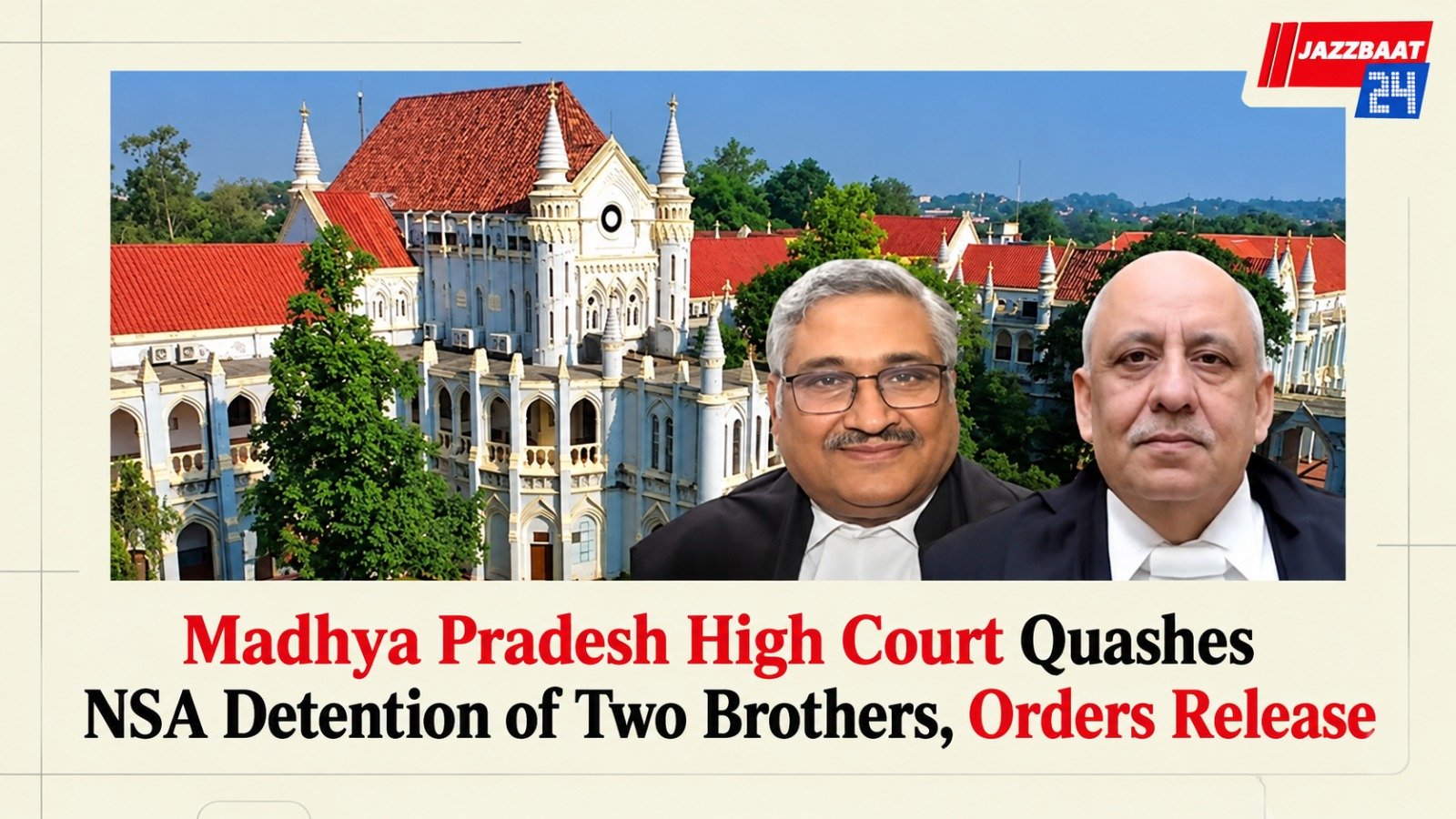
Jabalpur, October 9: The Madhya Pradesh High Court has quashed the preventive detention of two brothers under the National Security Act (NSA), ordering their immediate release and criticising the authorities for invoking the stringent law without proper application of mind.
In its order, the court observed that preventive detention was intended to be an extraordinary measure but had increasingly been used recklessly, as though it were an ordinary legal procedure. The ruling was delivered by a bench comprising Justice Vivek Agarwal and Justice Avanindra Kumar Singh at the Jabalpur bench. The order, dated September 11, was uploaded on October 5.
The case concerns Rajendra Thakur and Rajesh Thakur, whose detention was ordered by the Jabalpur collector on January 6 for an initial period of three months. The authorities cited concerns over public order. Their detention was subsequently extended under the NSA, which permits preventive detention for up to 12 months without trial, subject to the law’s requirements.
The High Court found that the authorities had failed to record the necessary satisfaction that the brothers posed a threat to public order, as required under Section 3(1) of the NSA.
“There is no requisite satisfaction recorded by the detaining authority that the detenus are a threat to public order,” the bench observed, pointing to the speed with which the detention proposal had been processed and approved.
According to the court, the proposal submitted by the Jabalpur superintendent of police and the collector’s detention order passed through four officials before being cleared on the same day. The bench held that such haste undermined the independent application of mind required before ordering preventive detention.
The court also examined the criminal records cited in connection with the brothers. It noted that they had been named in 14 cases and had been acquitted in 11 of them by the time the detention order was passed.
The remaining three cases involved allegations relating to an obscene act, causing hurt and wrongful confinement, and allegedly throwing a crude bomb to create unrest.
The bench expressed concern that the relevant information about the brothers’ criminal records had not been properly placed before the competent authority. It observed that checking the Crime and Criminal Tracking Network and Systems (CCTNS) could have helped officials establish the correct position before approving the detention.
The court’s observations highlighted the importance of verifying records and carefully assessing whether an individual’s activities genuinely threaten public order before invoking preventive detention laws.
Preventive detention allows authorities to restrict a person’s liberty to prevent anticipated activities that could threaten public order or security. However, the power is subject to legal safeguards and cannot be exercised merely because a person has been accused in criminal cases.
By setting aside the detention orders, the High Court reaffirmed the need for authorities to follow the statutory requirements and independently evaluate the material before them.
The ruling does not amount to a determination on the merits of the separate criminal cases against the brothers. Instead, it addresses the legality of their preventive detention under the NSA.
The court ordered their immediate release, bringing their detention under the challenged orders to an end. The judgment serves as a reminder that extraordinary powers affecting personal liberty must be exercised with due care and in accordance with the law.



Reader Comments 0