
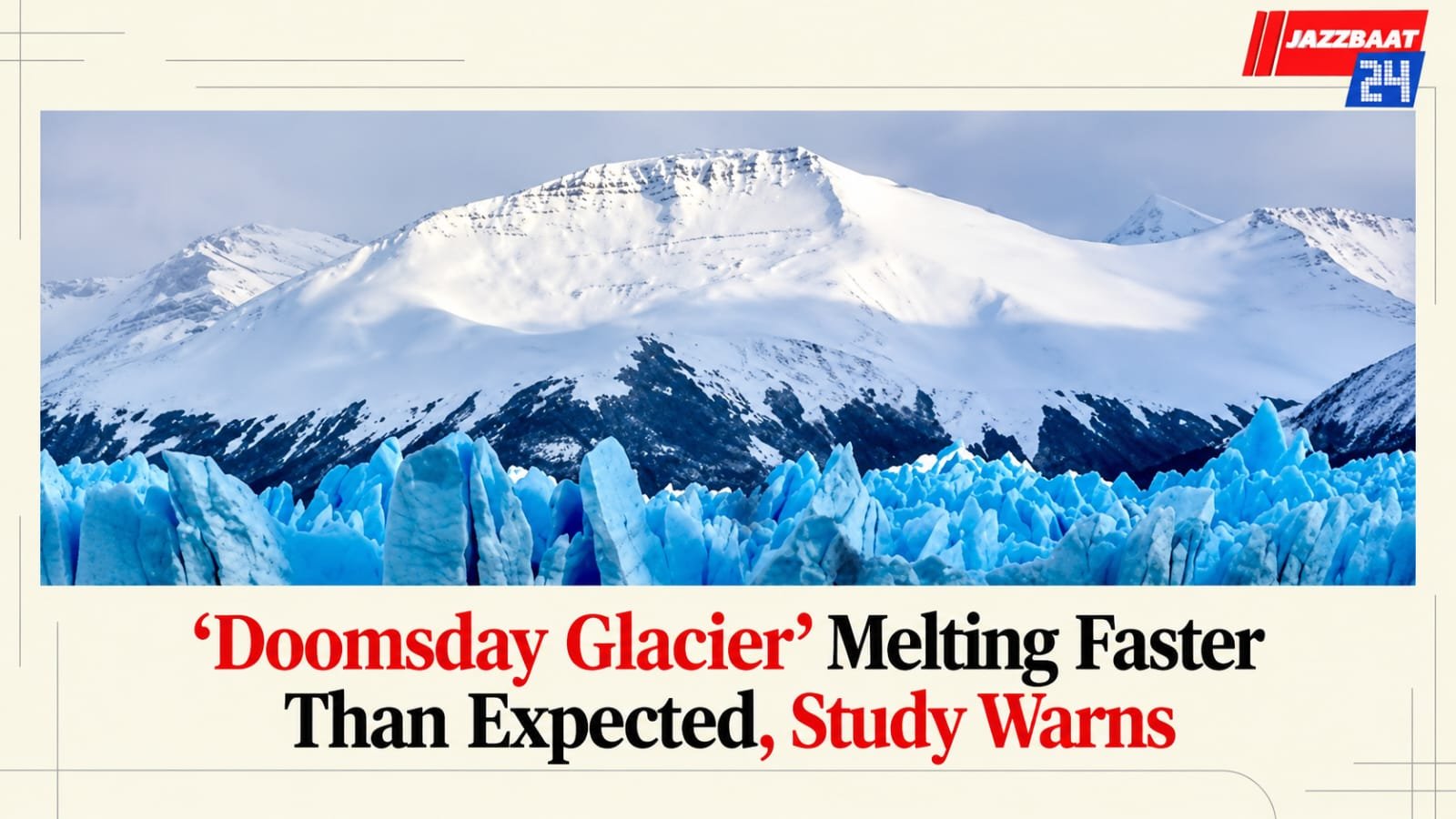
News Desk: Antarctica’s Thwaites Glacier, widely known as the “Doomsday Glacier”, is melting faster than previously projected, raising fresh concerns about future global sea-level rise, according to a new scientific study.
Researchers from the University of California, Irvine, and NASA’s Jet Propulsion Laboratory have developed an updated ice-sheet model to better understand the processes taking place beneath the glacier in West Antarctica. Their findings, published in Nature Communications, suggest that Thwaites could contribute up to 1.2 inches to global sea levels by 2100 twice the amount predicted by earlier estimates cited in the report.
The glacier is particularly important because its retreat could affect the stability of the wider Antarctic ice sheet. It currently contributes around 4% of global sea-level rise, according to the report.
### Why Is the Glacier Melting Faster?
Scientists have focused on a region known as the “grounding zone”, where the glacier transitions from resting on the seabed to floating as an ice shelf.
Earlier ice-sheet models often treated this area as a relatively narrow and stable boundary. However, satellite observations indicate that the grounding zone can extend for miles, allowing seawater to flow beneath the ice as tides rise and fall.
This process, known as tidal pumping, enables relatively warm ocean water to penetrate beneath the glacier and accelerate melting.
The researchers also found that the glacier is gradually detaching from an underwater ridge called the Mouginot Ridge, which currently helps slow its movement towards the ocean. They estimate a 60% chance that the ice will break free from this ridge by the end of the century.
If that happens, the glacier could retreat more rapidly towards another underwater ridge as the seabed slopes downward.
Why Does It Matter?
Thwaites contains enough ice to raise global sea levels by more than two feet if the glacier were to collapse completely. Its role in holding back surrounding Antarctic ice also means that a wider collapse could eventually contribute to much greater sea-level rise.
The potential consequences include increased coastal flooding, threatening communities in low-lying areas and cities such as Miami and Manila.
Even a rise of 1.2 inches could significantly worsen flood risks in vulnerable coastal regions, researchers warn.
What Happens Next?
Scientists plan to collect direct observations from the grounding zone during an expedition in 2028. Instruments will be installed to measure how seawater moves beneath the ice and how this affects melting.
Researchers say reducing greenhouse gas emissions remains essential to limiting future climate impacts. However, they warn that some additional sea-level rise is already unavoidable because of damage caused by past warming.
The findings highlight the need for improved glacier monitoring and more accurate predictions of how Antarctica could reshape global coastlines in the decades ahead.




Reader Comments 0