
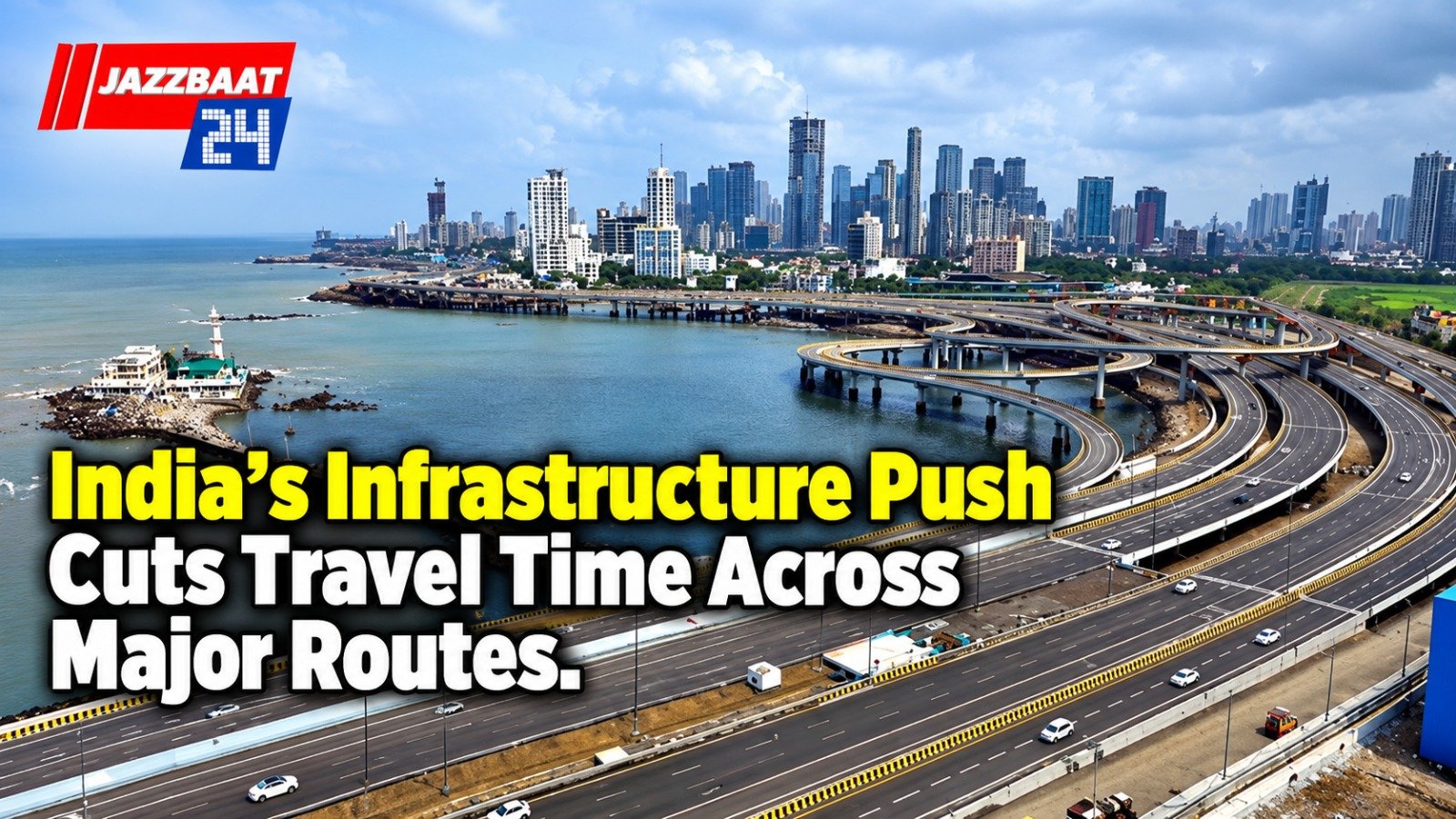
India’s expanding network of expressways, bridges, tunnels and modern trains is significantly reducing travel time across several important routes, according to a government factsheet highlighted by the Press Information Bureau.
The infrastructure projects are aimed at improving connectivity by creating shorter and faster routes, particularly in areas where difficult terrain, rivers and long road distances have traditionally added hours to journeys.
The Delhi-Mumbai Expressway, for instance, is being developed to reduce the road journey between the two cities to around 12 hours, compared with nearly 33 hours earlier. Other expressways have already delivered major reductions. The Delhi-Meerut Expressway has brought the journey down from about 2.5 hours to around 50 minutes, while the Bengaluru-Mysuru Expressway has reduced travel time from nearly three hours to about 75 minutes.
The Delhi-Dehradun Economic Corridor has also shortened the journey from more than six hours to around 2.5 hours. Meanwhile, the Mumbai-Nagpur Samruddhi Mahamarg has reduced travel time between the two cities from approximately 16 hours to around eight hours.
Several projects in northern and northeastern India have similarly improved connectivity. The Bhupen Hazarika Setu, also known as the Dhola-Sadiya Bridge, has reduced travel time between Rupai in Assam and Meka/Roing in Arunachal Pradesh from around six hours to one hour.
The Bogibeel Bridge over the Brahmaputra has transformed travel between Dhemaji and Dibrugarh, with journeys that previously took almost a full day now taking roughly one to two hours. In Bihar, the Kosi Rail Mahasetu has reduced the rail journey between Nirmali and Saraigarh from around eight hours to just 30 minutes.
Tunnels have played an important role in improving connectivity through mountainous regions. The 9.02-km Atal Tunnel bypasses the Rohtang Pass, cutting the Manali-Sarchu route by 46 km and saving around four to five hours. The Dr Syama Prasad Mookerjee Tunnel in Jammu and Kashmir has shortened the road distance on the Jammu-Srinagar route by about 30 km and saves nearly two hours.
Rail connectivity is also being upgraded. According to the factsheet, 549 trains were speeded up under the 2026 railway timetable. New-generation Vande Bharat trains have further reduced journey times on several routes. The Katra-Srinagar service takes about three hours, while the Howrah-Guwahati Vande Bharat Sleeper service has reduced the journey from roughly 17 hours to around 14 hours.
Another major project is the Mumbai-Ahmedabad High-Speed Rail Corridor. The 508-km corridor, designed for speeds of up to 320 kmph, is expected to reduce the journey to about 1 hour 58 minutes. The first service is targeted for August 2027.
The government has also announced seven additional high-speed rail corridors under the Union Budget 2026-27, covering nearly 4,000 km with an estimated investment of ₹16 lakh crore.
Together, these projects reflect a broader push to make travel faster, improve regional connectivity and reduce the impact of distance and difficult terrain across India.




Reader Comments 0