
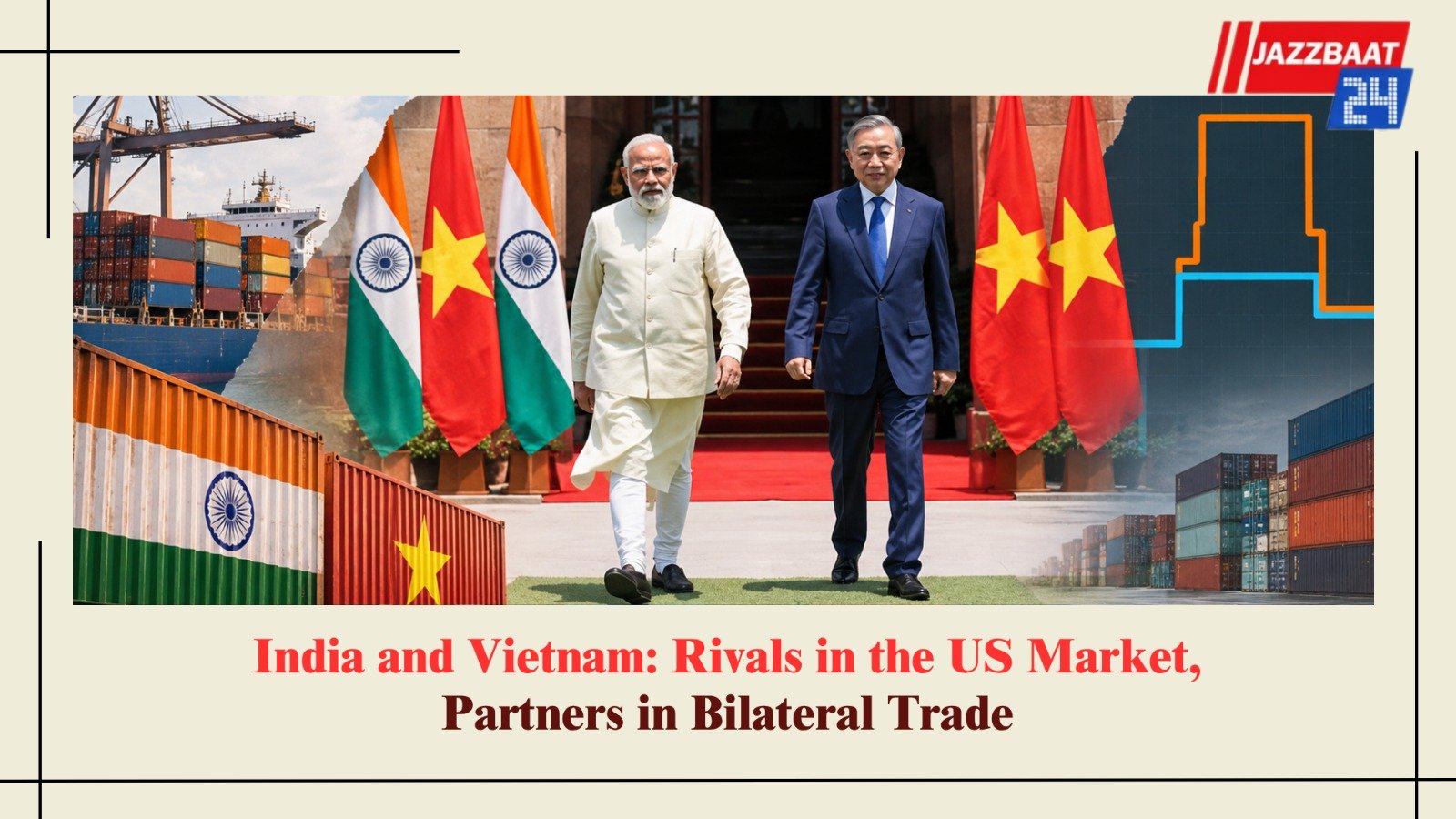
New Delhi, November 3: India and Vietnam are increasingly finding themselves in an unusual economic relationship: competing for the same customers in the United States while simultaneously strengthening trade ties with each other. Both countries are emerging as major alternatives to China in global manufacturing, particularly in electronics and smartphones. However, their growing industrial ambitions are also creating areas of competition.
The changing relationship comes at a time when both nations are seeking to expand their presence in international supply chains. Smartphones have become a particularly important export category for both countries in the American market.
In 2025, India's smartphone exports to the United States reached approximately $25.8 billion, making smartphones the country's largest export category to that market. Vietnam has also established itself as a major smartphone manufacturing and export hub.
According to an analysis of US import data, the similarity between India's and Vietnam's export baskets to America increased significantly. Their export similarity index rose from around 20 between 2014 and 2019 to 37.9 in 2025. It remained at 37.1 during the first eight months of 2026. Smartphones account for a substantial portion of this overlap. The Print
Growing trade partnership at home
Despite competing in international markets, India and Vietnam are expanding their bilateral economic relationship.
In the financial year 2025-26, bilateral trade reached a record $18.27 billion, representing a year-on-year increase of 22.78 per cent. India's exports to Vietnam stood at $6.66 billion, while imports from the Southeast Asian country reached $11.61 billion. IBEF +1
India primarily exports engineering goods, agricultural products, pharmaceuticals, chemicals, marine products and textiles to Vietnam. In return, it imports electronics, machinery, steel, plastics, chemicals and other industrial products.
Electronics alone accounted for approximately $5.36 billion of India's imports from Vietnam in FY26, highlighting the importance of the sector in bilateral trade. IBEF
A shared ambition to reduce dependence on China
Both countries are attempting to strengthen their domestic manufacturing capabilities while reducing excessive dependence on Chinese supply chains.
However, this remains a major challenge. Indian electronics manufacturers continue to depend heavily on imported components, particularly from China. Vietnam's export-oriented manufacturing sector also relies significantly on imported inputs.
The two countries have therefore identified opportunities to cooperate in areas such as critical minerals, rare earths, energy, technology and supply-chain development.
During Vietnamese President To Lam's visit to India in May 2026, the two nations upgraded their relationship to an Enhanced Comprehensive Strategic Partnership. Prime Minister Narendra Modi also announced a target of increasing bilateral trade to $25 billion by 2030. Reuters +1
Competition and cooperation will go hand in hand
The relationship is not without challenges. Both countries compete in sectors such as textiles, footwear, steel, electronics and other manufactured products. Differences in industrial policies and trade protection measures could create further friction.
Nevertheless, their expanding economic partnership offers opportunities for both sides. The challenge for New Delhi and Hanoi will be to balance competition in global markets with cooperation in regional trade and manufacturing.
Ultimately, India and Vietnam may remain rivals in some international markets while becoming increasingly important economic partners at home.




Reader Comments 0