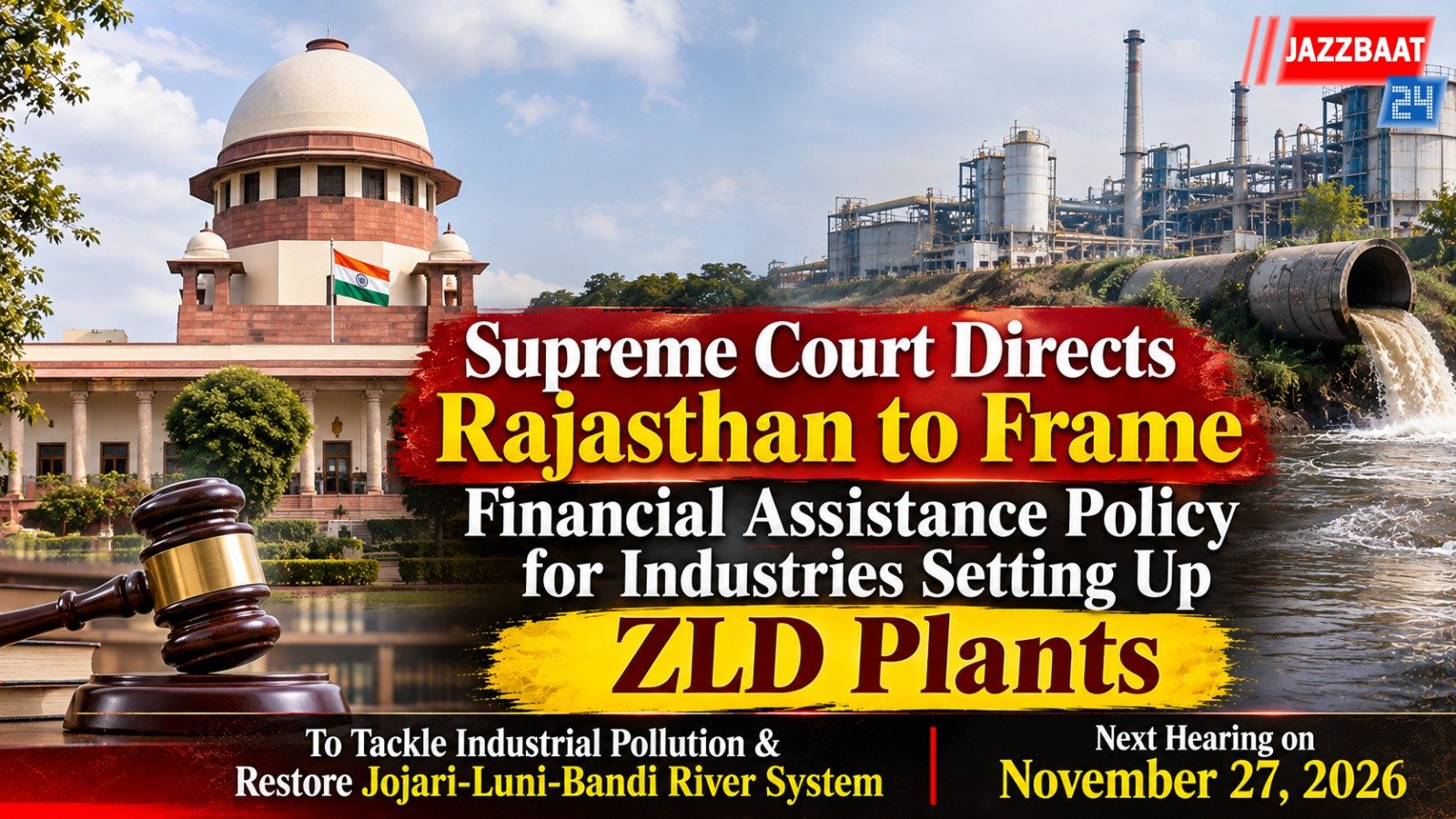
The Supreme Court has directed the Rajasthan government to formulate a comprehensive policy providing financial assistance to industrial units willing to establish Zero Liquid Discharge (ZLD) plants to tackle industrial pollution. The direction comes amid growing concerns over contamination in the Jojari-Luni-Bandi river system, which has affected the environment and the lives of approximately 20 lakh people.
A bench comprising Justice Vikram Nath and Justice Sandeep Mehta issued the directions while hearing a suo motu case concerning pollution in the river system. The court made it clear that the state government must share responsibility for restoring the polluted rivers instead of placing the entire burden on industries and municipal authorities.
Until the proposed policy is finalised, the Rajasthan government has been instructed to examine applications from industrial units seeking financial assistance on a case-by-case basis. Such applications must undergo proper technical assessment and verification, with decisions taken without unnecessary delay.
The court also directed the state to develop an appropriate pipeline network to transport and reuse treated wastewater and Reverse Osmosis (RO) permeate. The proposed infrastructure is expected to help industrial units reuse treated water, reduce freshwater consumption and minimise the discharge of industrial effluents into rivers.
The government has further been asked to assess the technical and financial requirements for establishing the pipeline network and prepare a time-bound implementation plan.
The directions follow concerns raised by the High-Level Ecosystem Oversight Committee over inadequate progress in establishing and expanding Common Effluent Treatment Plants (CETPs) and ZLD facilities across the industrial clusters of Jodhpur, Pali and Balotra.
The committee observed that administrative assurances and projected completion dates were not enough to address the problem unless adequate treatment capacity was created to handle the actual volume of industrial wastewater.
It also pointed out that the proposed four-million-litre-per-day ZLD facility in Jodhpur would serve as an immediate remedial measure but would not, by itself, achieve the broader objective of complete Zero Liquid Discharge.
During the proceedings, Justice Sandeep Mehta emphasised that the government could not escape responsibility for the pollution, particularly when regulatory authorities had allegedly failed to discharge their obligations.
The bench referred to the polluter-pays principle, observing that both the state and industries must contribute towards addressing the environmental damage.
The matter has been listed for further hearing on November 27, 2026.


Reader Comments 0