
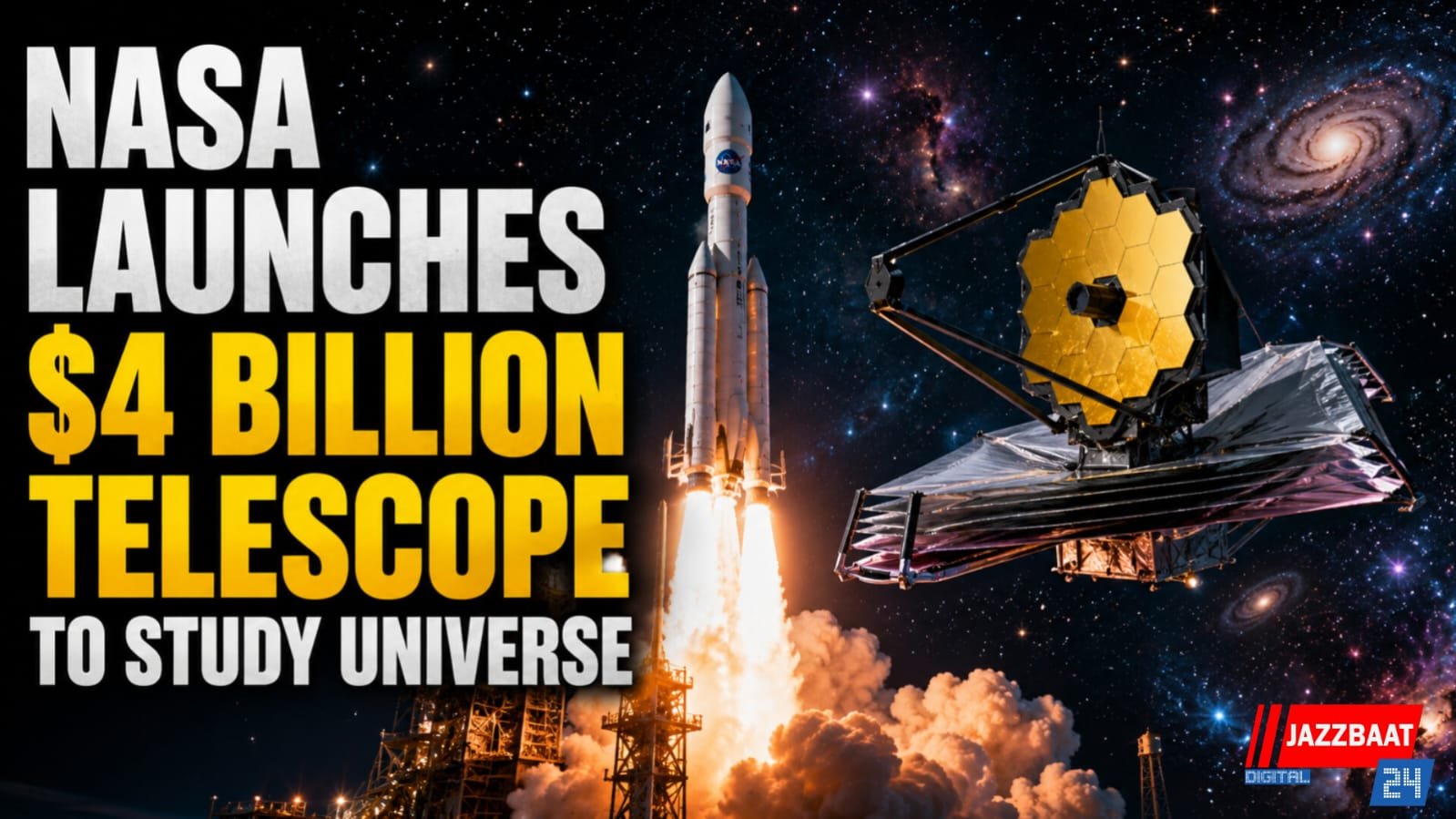
NASA has launched its new Nancy Grace Roman Space Telescope on a mission to explore some of the biggest mysteries of the universe, including dark matter, dark energy and planets beyond our solar system.
The telescope was launched from NASA's Kennedy Space Center in Florida aboard a SpaceX Falcon Heavy rocket on Sunday. The roughly $4 billion observatory is expected to transform the way scientists study the cosmos.
After reaching space, Roman will travel towards Lagrange Point 2, an orbital location around 1.6 million kilometres from Earth. Its primary mission is planned to last five years, although NASA says it could potentially continue for another five years if enough fuel remains.
Roman is designed to complement NASA's Hubble Space Telescope and James Webb Space Telescope. While Webb is known for its ability to observe distant objects in extraordinary detail, Roman will have a much wider field of view.
NASA scientists compare Webb to a zoom lens and Roman to a wide-angle camera. Roman will be able to survey huge portions of the sky much faster than previous observatories.
Scientists expect the telescope to create one of the most detailed three-dimensional maps of the universe ever produced. Its main survey is expected to cover more than two billion galaxies and provide valuable information about how the universe has evolved.
One of Roman's major goals is to investigate dark energy, the mysterious force believed to be responsible for the accelerating expansion of the universe. Scientists estimate that dark energy makes up around 68 per cent of the universe.
The telescope will also study dark matter, which cannot be directly seen but can be detected through its gravitational influence on galaxies and stars. Dark matter is estimated to account for roughly 27 per cent of the universe, while ordinary matter makes up only about 5 per cent.
Roman will also search for exoplanets, or planets outside our solar system. NASA expects it to discover thousands of new worlds and help scientists understand how planetary systems are formed.
The observatory's launch comes after years of development and funding uncertainty. NASA said Congress preserved funding for the project despite efforts during the Trump administration to reduce or eliminate its budget.
The launch also took place nine months earlier than originally planned, according to NASA.
Scientists say Roman could make discoveries that were not anticipated before its launch. By combining its wide-field observations with the deep views provided by Webb and the capabilities of Hubble, researchers hope to gain a much clearer picture of the universe and answer some of astronomy's biggest unanswered questions.




Reader Comments 0