
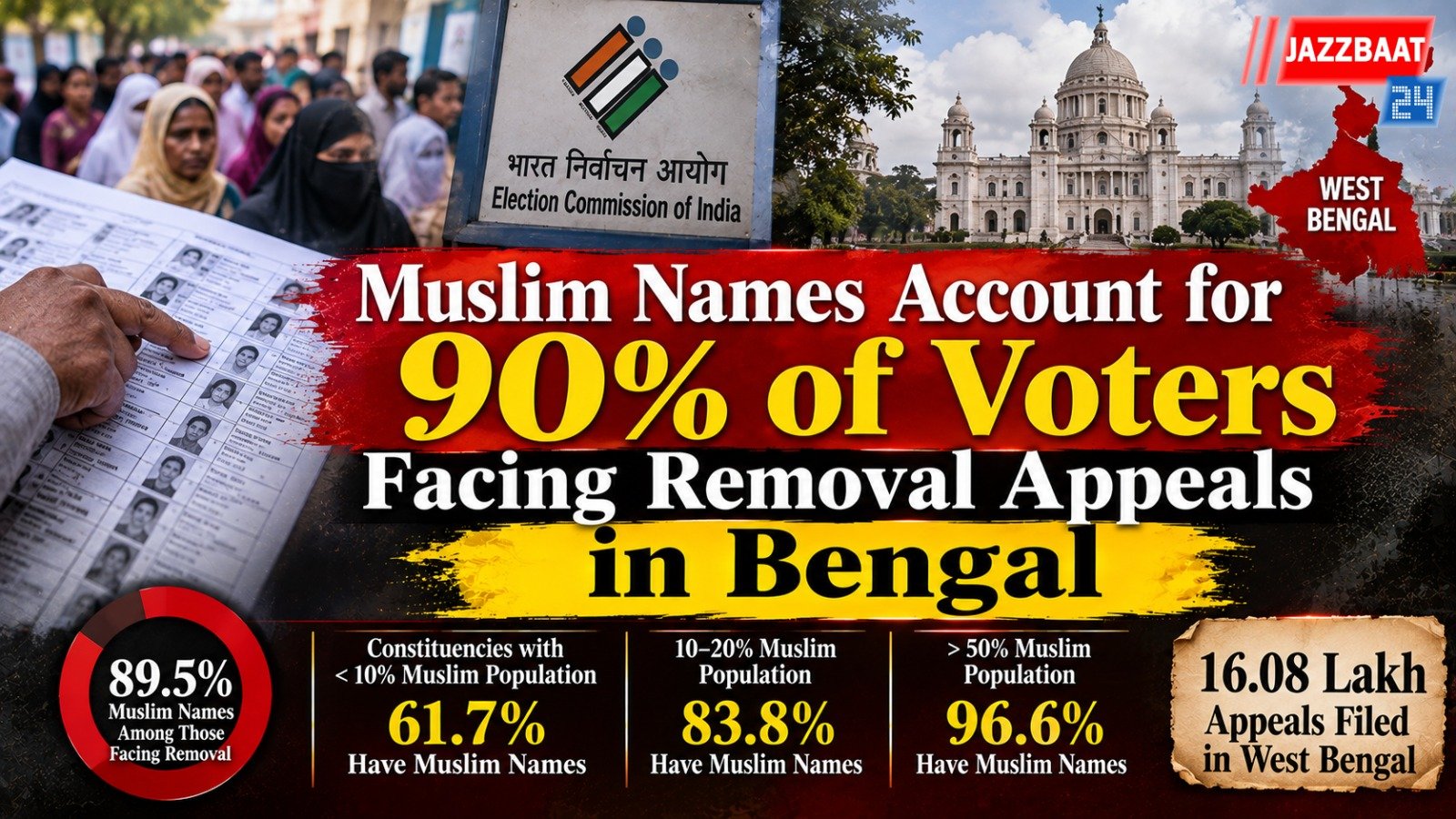
A fresh analysis of electoral revision records in West Bengal has raised serious questions over the pattern of voter deletions and appeals filed by the Election Commission of India (ECI). According to the findings, nearly nine out of every ten voters whom the Commission is seeking to remove from the electoral rolls, despite being declared eligible by judicial officers, have Muslim names.
The analysis is based on 16,08,175 appeals filed against the inclusion of voters who had been examined and cleared by judicial officers during the Special Intensive Revision (SIR) exercise. Of these, at least 14,39,797 voters, or approximately 89.5 per cent, have Muslim names. The figures have brought renewed attention to concerns about the possible disproportionate impact of the electoral revision process on minority communities.
The findings are particularly significant because the pattern is not limited to Muslim-majority border districts. Several constituencies with relatively small Muslim populations have also recorded a disproportionately high number of appeals against voters with Muslim names.
In constituencies where Muslims account for less than 10 per cent of the population, around 61.7 per cent of the voters facing these appeals have Muslim names. The figure rises to 83.8 per cent in constituencies where Muslims make up between 10 and 20 per cent of the population. In seats where the Muslim population exceeds 50 per cent, the proportion reaches 96.6 per cent.
Some district-level figures have also drawn attention. In Purba Medinipur, 92.9 per cent of the voters facing appeals have Muslim names, while the figure stands at 95.9 per cent in Purba Bardhaman. In Bankura, it is 80.4 per cent, despite Muslims accounting for only 7.4 per cent of the district's population.
The analysis also examines the situation involving voters whose names were actually deleted by judicial officers. Out of approximately 27.06 lakh such voters, more than 22.17 lakh have approached appellate tribunals. Around 79.3 per cent of these appellants have Muslim names.
The Election Commission has maintained that the revision exercise is intended to ensure accurate electoral rolls and remove ineligible entries. In an affidavit submitted to the Supreme Court on October 26, the Commission stated that the appeals against voters cleared by judicial officers were filed by officials from the office of the Chief Electoral Officer of West Bengal.
However, questions remain over the criteria used to select voters for appeals and the reasons behind challenging decisions that had already declared them eligible.
The controversy has added another dimension to the ongoing debate over electoral transparency, equal voting rights and the implementation of the SIR process in West Bengal.
The figures are based on an analysis of voter names and do not independently establish the religious identity of every individual concerned. Nevertheless, the scale of the disparity has intensified demands for greater transparency in the electoral revision process.
Reader Comments 0