
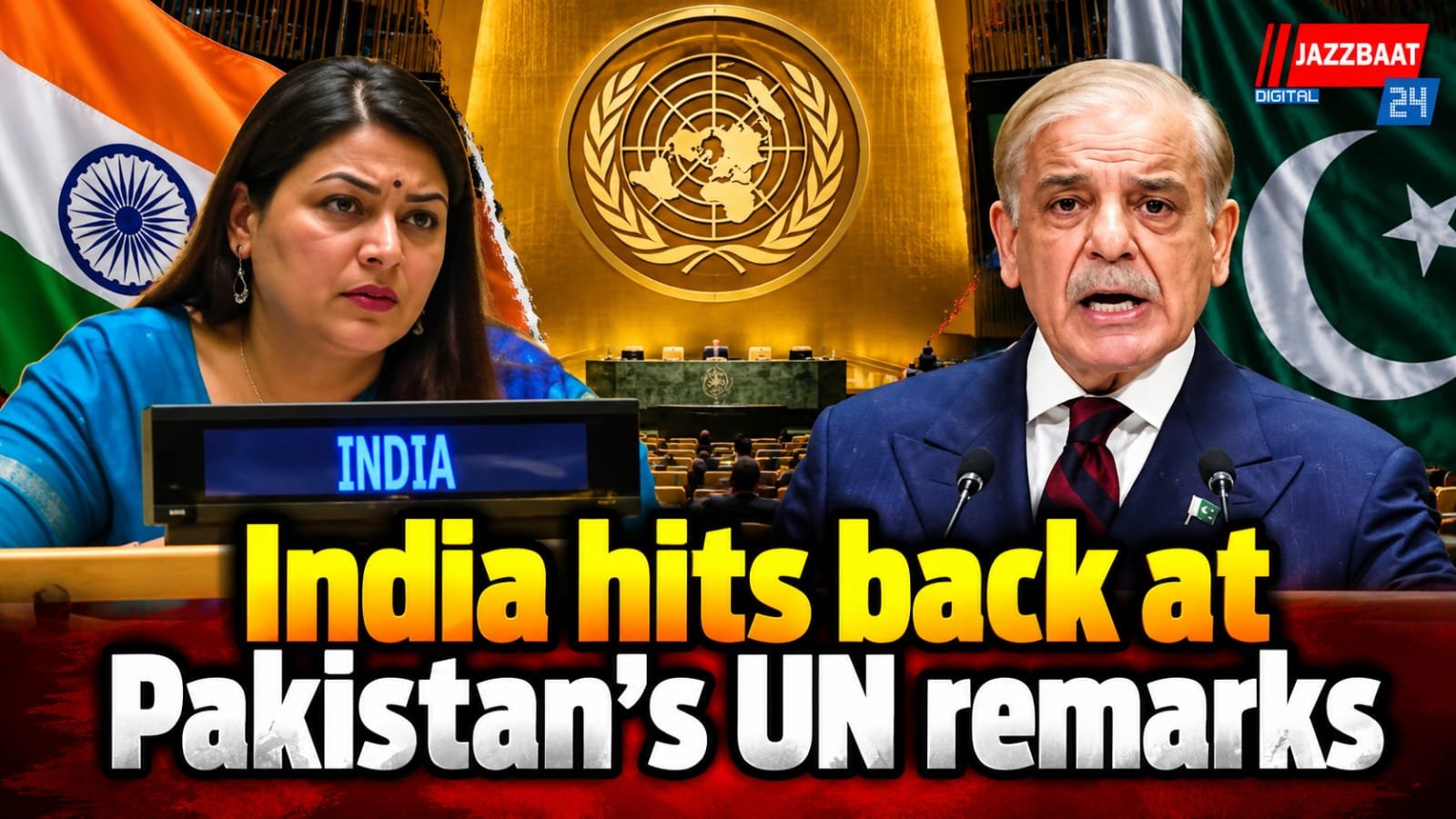
India on Saturday strongly responded to Pakistan Prime Minister Shehbaz Sharif’s address at the United Nations General Assembly, accusing Islamabad of supporting cross-border terrorism and rejecting its remarks on Jammu and Kashmir.
Exercising India’s right of reply, Petal Gahlot, First Secretary at India’s Permanent Mission to the United Nations, said Pakistan’s “long-standing” policy of cross-border terrorism had consequences. She said India had demonstrated its ability to respond to terrorist threats and would continue to exercise its right to defend itself.
Gahlot rejected Pakistan’s claims regarding India and Jammu and Kashmir and accused Islamabad of repeatedly presenting what New Delhi described as false narratives before the international community.
She also criticised Pakistan’s comments on democratic rights and human values. Referring to the role of the military in Pakistan’s political system, Gahlot alleged that the country’s military establishment continues to exercise significant influence over governance.
Her remarks came after Sharif raised Jammu and Kashmir and the Indus Waters Treaty during his UN General Assembly address. India reiterated its position that Jammu and Kashmir is an integral part of the country and instead highlighted the situation in Pakistan-occupied Jammu and Kashmir.
Gahlot also referred to Osama bin Laden, saying the al-Qaeda founder had lived near Pakistan’s premier military academy before he was killed by US forces in Abbottabad in 2011. She used the reference while questioning Pakistan’s criticism of India on terrorism.
India also accused Pakistan of failing to adequately protect minority communities and criticised what it described as religious intolerance in the country. Gahlot referred to Pakistan’s blasphemy laws and alleged that minorities continue to face difficulties.
The exchange came amid renewed tensions between the two countries over terrorism, Jammu and Kashmir and water-sharing arrangements.
Sharif had also referred to the military confrontation between India and Pakistan in May 2025 and India’s Operation Sindoor. Pakistan has continued to raise the Kashmir issue at international forums, while India has maintained that terrorism emanating from Pakistani territory remains a central concern in bilateral relations.
New Delhi has also consistently rejected internationalisation of the Kashmir issue and maintained that matters concerning Jammu and Kashmir are internal to India.
The latest exchange at the UN reflects the continuing diplomatic differences between the two neighbouring countries. While Pakistan used its UN address to raise Kashmir and water-related concerns, India used its right of reply to focus on terrorism, security and Pakistan’s internal political and human-rights record.
Both sides have continued to present sharply different positions on the issues, with no immediate indication of a change in their respective stances.


Reader Comments 0