
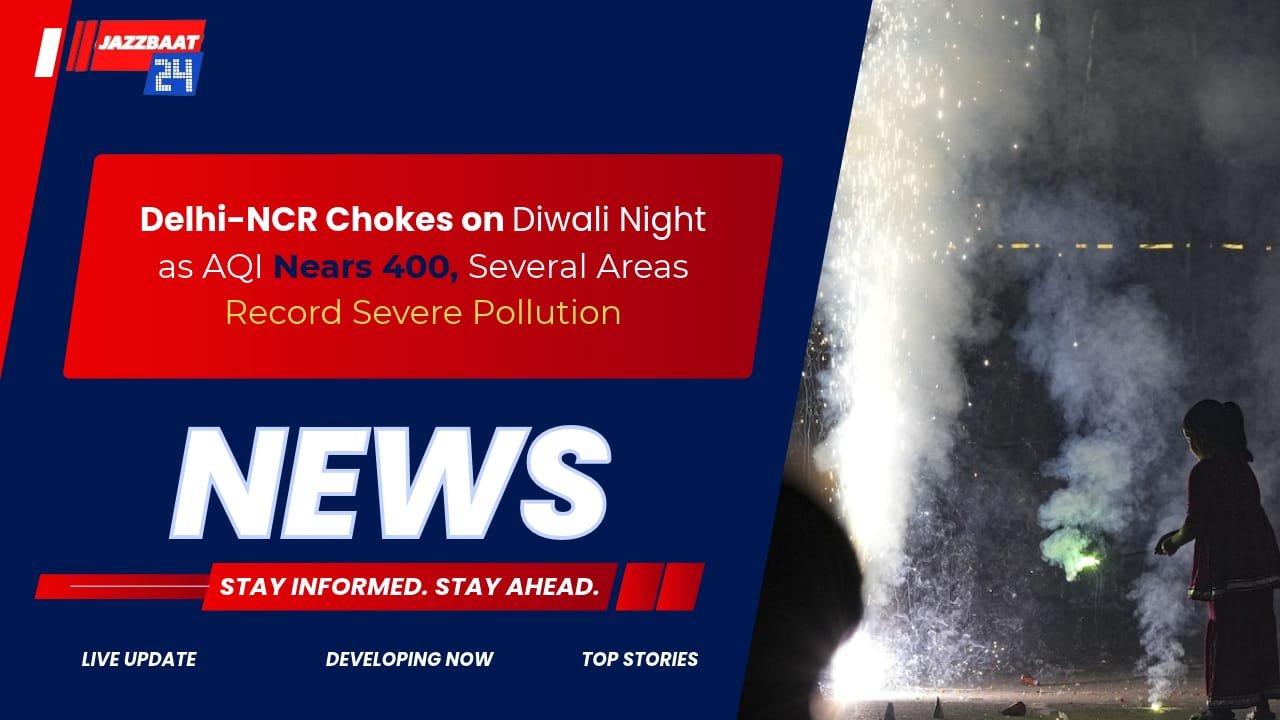
Delhi and the National Capital Region (NCR) witnessed a sharp deterioration in air quality on Diwali night as thick smoke engulfed the city following celebrations. Reduced visibility and rising pollution levels triggered fresh concerns over the impact of firecrackers on public health, with the overall Air Quality Index (AQI) approaching 400.
According to data from the Central Pollution Control Board (CPCB), Delhi's overall AQI stood at 373 at 11:05 pm on November 8, placing it in the 'very poor' category. The situation was similarly concerning across neighbouring cities. Noida recorded an AQI of 319, while Ghaziabad registered 360. Gurugram and Faridabad reported AQI levels of 280 and 297, respectively.
Several areas of Delhi experienced even worse conditions, with pollution levels crossing the 400 mark and entering the 'severe' category. These included Alipur, Bawana, Burari, Chandni Chowk, Mundka, Punjabi Bagh, Rohini and Vivek Vihar.
The situation is expected to deteriorate further. According to forecasts issued by the Air Quality Early Warning System, Delhi's air quality could enter the 'severe' category from November 9 and remain at dangerous levels for the following few days.
Ahead of Diwali, the Commission for Air Quality Management (CAQM) had already implemented Stage 3 of the Graded Response Action Plan (GRAP) across Delhi-NCR. The restrictions were introduced as a preventive measure amid predictions of worsening air quality during the festive period.
However, despite the restrictions, questions have emerged over the effectiveness of pollution control measures and their enforcement.
Environmental activist Bhavreen Kandhari has raised concerns about the accuracy of official pollution data. She argued that government monitoring figures do not always reflect the actual conditions experienced by residents on the ground.
According to Kandhari, several citizens who regularly monitor pollution using independent AQI devices have recorded readings that raise questions about the official figures. She also pointed to the visible smoke and continuous bursting of firecrackers as evidence of the worsening situation.
She further questioned the enforcement of restrictions on firecrackers, warning that children and vulnerable people face serious health risks from prolonged exposure to polluted air.
Kandhari also alleged that at least 11 monitoring stations experienced data gaps on November 6, with 22 hourly PM2.5 readings and 27 PM10 readings missing. Monitoring stations at IIT Delhi, Nangloi and NSIT Dwarka reportedly experienced significant outages.
The CPCB classifies AQI levels between 301 and 400 as 'very poor', while readings between 401 and 500 fall under the 'severe' category.
With winter approaching, Delhi-NCR once again faces the challenge of controlling toxic air pollution, raising questions about the effectiveness of existing measures and the need for stronger enforcement.



Reader Comments 0