
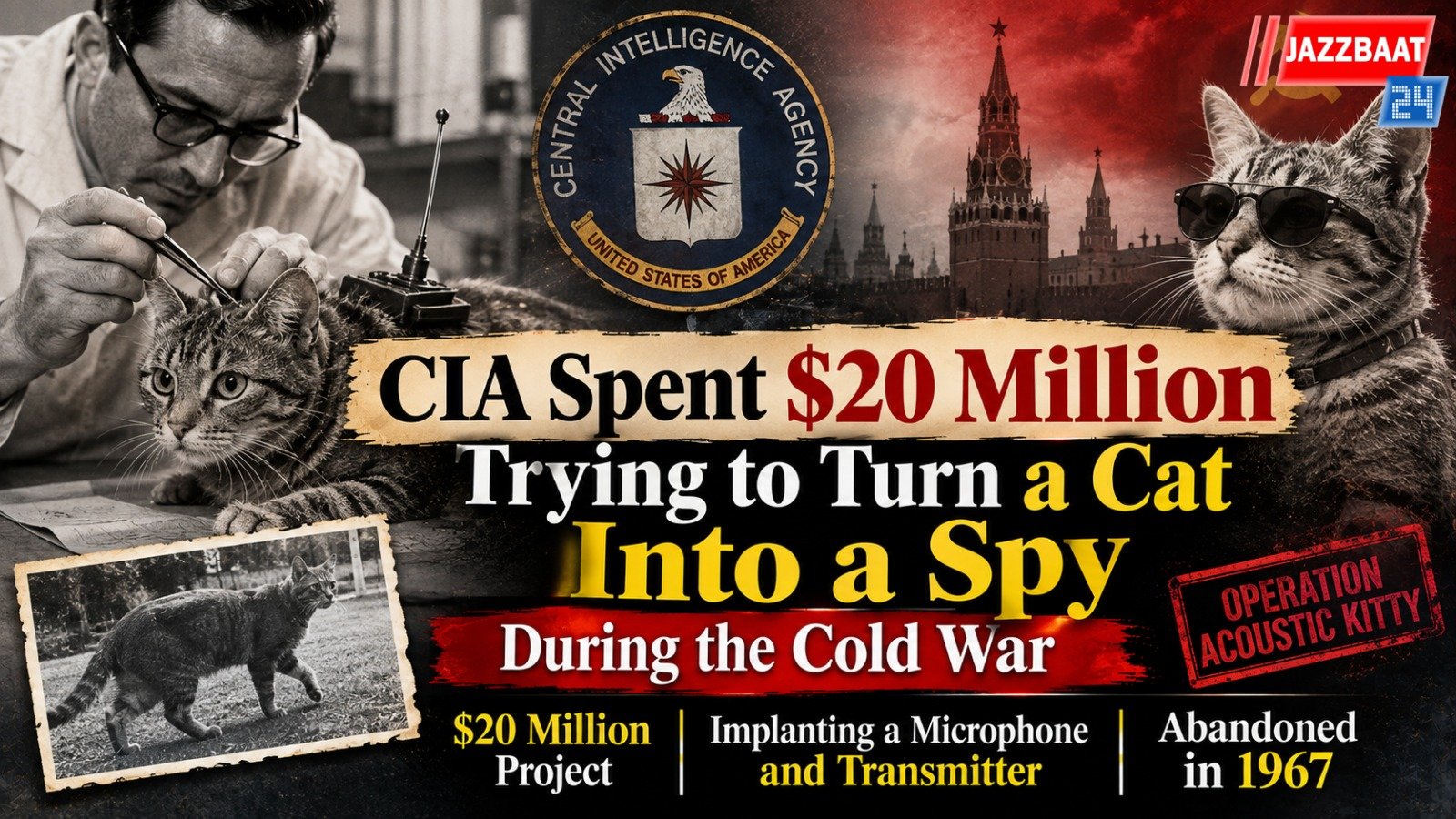
During the Cold War, the US Central Intelligence Agency (CIA) came up with an unusual idea to strengthen its espionage operations. Instead of sending human agents into sensitive locations, the agency explored whether an ordinary domestic cat could be transformed into a secret surveillance device. The bizarre experiment, known as Operation Acoustic Kitty, reportedly cost around $20 million before being abandoned.
The project began in 1964, when CIA officials were looking for ways to secretly monitor conversations between foreign agents and their Soviet handlers. Cats appeared to be ideal candidates because they could move freely through public spaces without attracting much attention. A cat sitting near people on a park bench would rarely raise suspicion.
The plan was to turn the animal into a mobile listening device capable of recording conversations and transmitting them to intelligence officers nearby.
How the CIA turned a cat into a listening device
The experiment involved a series of highly specialised surgical procedures. According to the CIA's own account, a tiny microphone was implanted inside the cat's ear, while a miniature radio transmitter was placed beneath its skin. A thin antenna was then woven into the animal's fur.
The technology was designed to capture conversations happening close to the cat and transmit the audio to operatives monitoring the signal from a distance.
Although the technical equipment reportedly worked, the CIA soon discovered that its biggest challenge was not technology but the animal itself.
The biggest problem was the cat's behaviour
Despite the sophisticated equipment and training, the cat refused to behave like a disciplined intelligence agent. It wandered wherever it wanted, became distracted easily and could not reliably be directed towards specific targets.
Hunger, curiosity and unpredictable movements made it difficult for handlers to control the animal during field tests.
One widely circulated account claimed that the cat was taken to a park for its first operational test, where it was supposed to record a conversation between two men sitting on a bench. Instead, it reportedly wandered into the road and was struck by a taxi.
However, the CIA later challenged this version of events. The agency said the taxi story originated from a former official who had admitted that his remarks were intended as a joke.
Why the operation was abandoned
By 1967, the CIA had officially discontinued Operation Acoustic Kitty. The agency concluded that despite proving the technology was possible, using cats for real intelligence operations was impractical because their movements could not be controlled reliably.
The story became public in greater detail after previously classified documents were released in 2001.
Today, Acoustic Kitty remains one of the most unusual experiments in intelligence history, demonstrating how far espionage agencies were willing to go during the Cold War in search of an unconventional advantage.




Reader Comments 0