
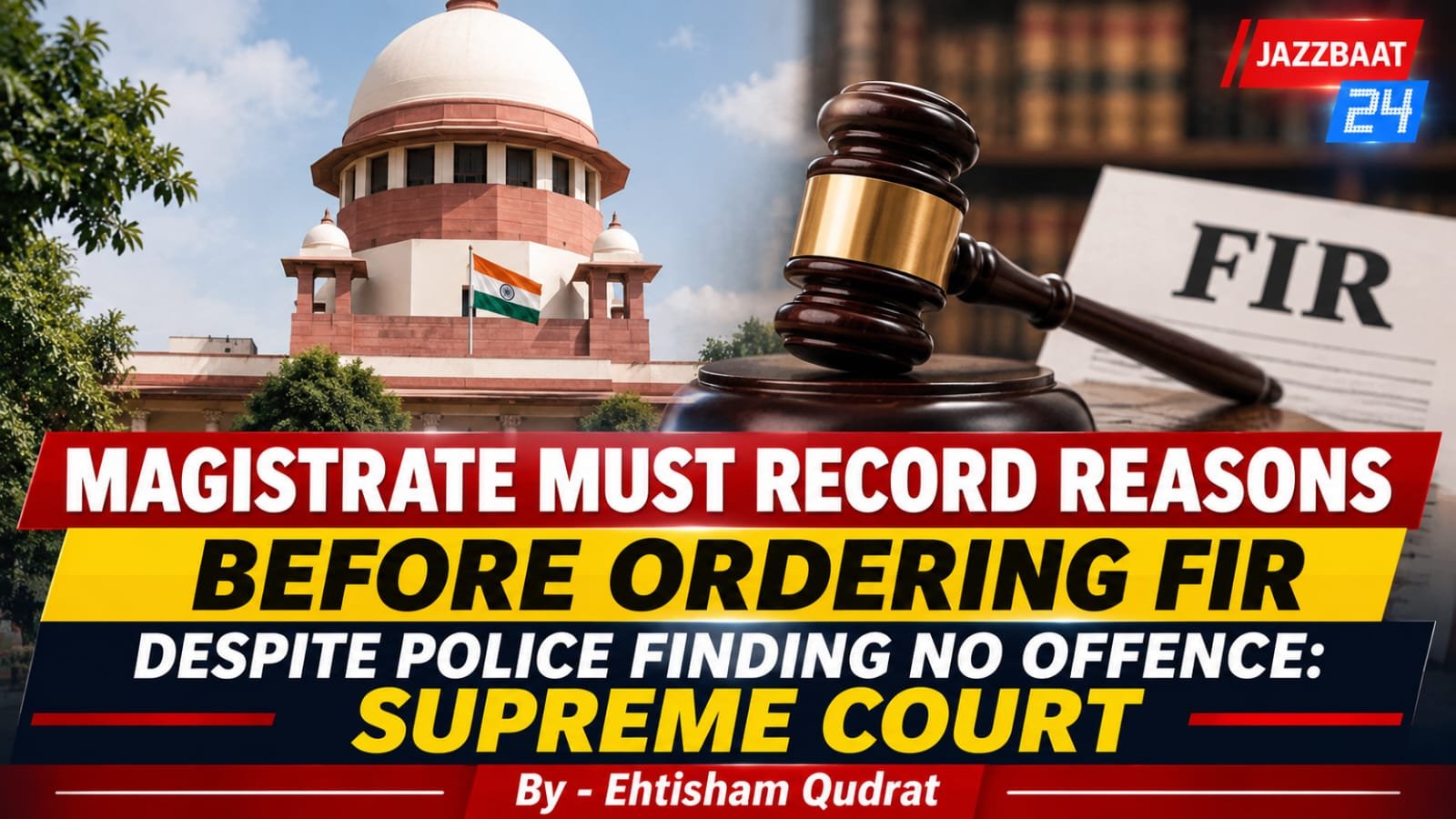
New Delhi, November 23: The Supreme Court has ruled that a Magistrate must record reasons before directing the registration of an FIR if the police have submitted a report stating that no cognizable offence has been made out.
A bench comprising Justice Vikram Nath and Justice Sandeep Mehta observed that a Magistrate cannot reject the police's findings mechanically while exercising the power to order an investigation under Section 156(3) of the Code of Criminal Procedure (CrPC), now covered under Section 175(3) of the Bharatiya Nagarik Suraksha Sanhita (BNSS).
The Supreme Court made the observation while quashing an FIR registered by the Economic Offences Wing (EOW) of Delhi Police against L&T Finance Limited and Edelweiss Asset Reconstruction Company Limited (EARC).
The case originated from a complaint filed by a group of landowners against a developer and its lenders, alleging cheating, criminal breach of trust and criminal conspiracy. Following a preliminary inquiry, the EOW concluded that no cognizable offence was made out and closed the complaint.
However, after the complainants approached the Magistrate, the police submitted an Action Taken Report reiterating its earlier findings. Despite this, the Magistrate directed the registration of an FIR.
The Supreme Court held that although an Action Taken Report does not legally bind a Magistrate, it cannot simply be ignored. The Magistrate must independently examine the material and explain why the police's conclusion is being rejected.
The bench emphasised that judicial orders must demonstrate the application of judicial mind, particularly when they trigger criminal investigations against individuals or institutions.
The Court further observed that reasons need not be elaborate, but they must exist and must be connected to the material available on record.
Referring to earlier judgments, including Maksud Saiyed v. State of Gujarat and Priyanka Srivastava v. State of Uttar Pradesh, the bench cautioned against the routine use of Section 156(3) CrPC.
The Court also noted that the dispute was predominantly commercial in nature and that criminal proceedings against the financial institutions appeared to have been initiated to exert pressure in a monetary dispute.
Holding that continuation of the FIR against the appellants amounted to an abuse of the process of law, the Supreme Court quashed the FIR against them.




Reader Comments 0