
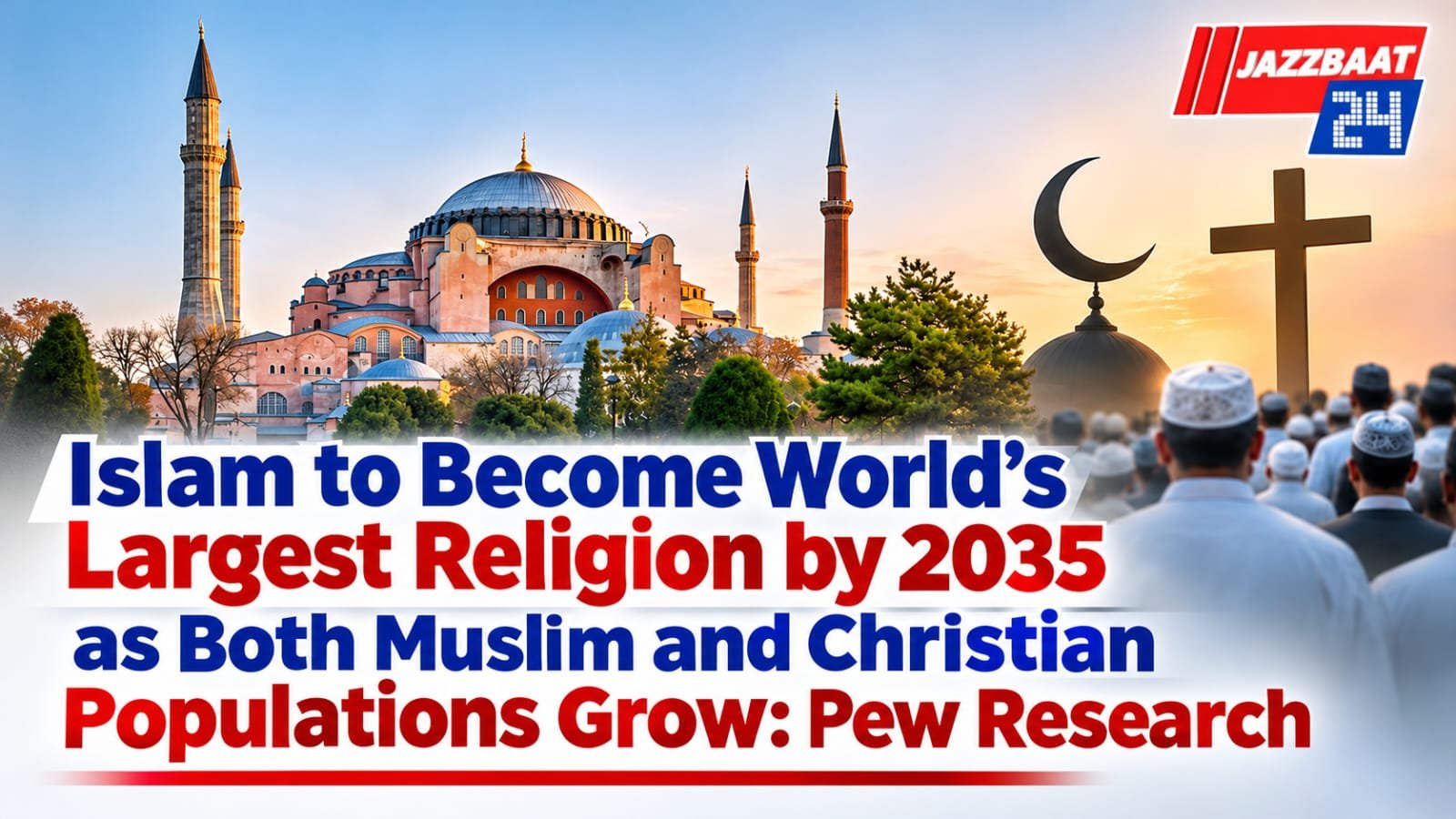
Islam is projected to overtake Christianity as the world's largest religion by 2035, according to a new analysis published by the Pew Research Center on November 18, 2026. The projections indicate that both religious groups will continue to grow in the coming decades, although the Muslim population is expected to increase at a faster rate.
Currently, Christians constitute the world's largest religious group, followed by Muslims. However, this ranking is expected to change by 2035, with Muslims surpassing Christians in population, according to the research.
The analysis, authored by Pew Research Center senior demographer Conrad Hackett, examines the demographic factors driving the growth of the two largest religious groups worldwide.
Higher Fertility Rates Driving Muslim Population Growth
Higher fertility rates are identified as the primary factor behind the faster growth of the Muslim population.
According to Pew Research Center, Muslim women had an average of 3.1 children between 2020 and 2025, compared with 2.5 children among Christian women. Women belonging to other religious groups had an average fertility rate of 1.6 children during the same period.
The study projects that between 2020 and 2070, Muslims will gain approximately 1.6 billion people through natural population growth, which accounts for the difference between births and deaths. The corresponding increase among Christians is projected at 792 million.
Religious Conversion Also Influences Population Trends
Religious switching is another factor influencing the projected growth of both communities, although its impact is expected to be smaller than natural population growth.
Pew estimates that between 2020 and 2070, Islam will experience a net loss of approximately 8 million people through religious switching. Christianity, meanwhile, is projected to lose around 105 million followers through the same process.
Most people leaving Christianity are expected to identify as religiously unaffiliated, including atheists and agnostics.
The research also estimates that approximately 9.2 million Muslims will convert to Christianity, while around 9 million Christians will convert to Islam during the projection period. This indicates that the projected growth of the Muslim population is not primarily driven by conversions from Christianity.
Pakistan Expected to Have World's Largest Muslim Population
The analysis also highlights how Muslim and Christian population growth will be distributed geographically.
Most of the projected increase in the global Muslim population between 2020 and 2070 is expected to occur in countries where Muslims already constitute the majority.
Pakistan's Muslim population, for instance, is projected to increase from 227 million in 2020 to 461 million by 2070, making it the country with the world's largest Muslim population.
Similarly, the Democratic Republic of the Congo is expected to witness significant Christian population growth, with its Christian population projected to rise from 92 million in 2020 to 299 million by 2070.
The United States, which had the world's largest Christian population in 2020, is projected to experience the biggest numerical decline, with its Christian population falling from 217 million to 174 million by 2070.
Christians to Remain Largest Religious Group in Most Regions
Despite the projected global shift, Christians are expected to remain the largest religious group in most regions of the world.
According to Pew, Muslims are projected to account for 95% of the population in the Middle East and North Africa by 2070. The Asia-Pacific region is expected to witness a change in its largest religious group, with Muslims projected to surpass the religiously unaffiliated population.
In sub-Saharan Africa, the Christian population is expected to grow by 129% between 2020 and 2070, while the Muslim population is projected to increase by 166%.
The projections are based on demographic factors such as fertility, mortality, migration and religious switching. Pew Research Center cautioned that the findings are based on the continuation of recent trends and do not account for all potential future developments, including wars, natural disasters and epidemics.



Reader Comments 0