
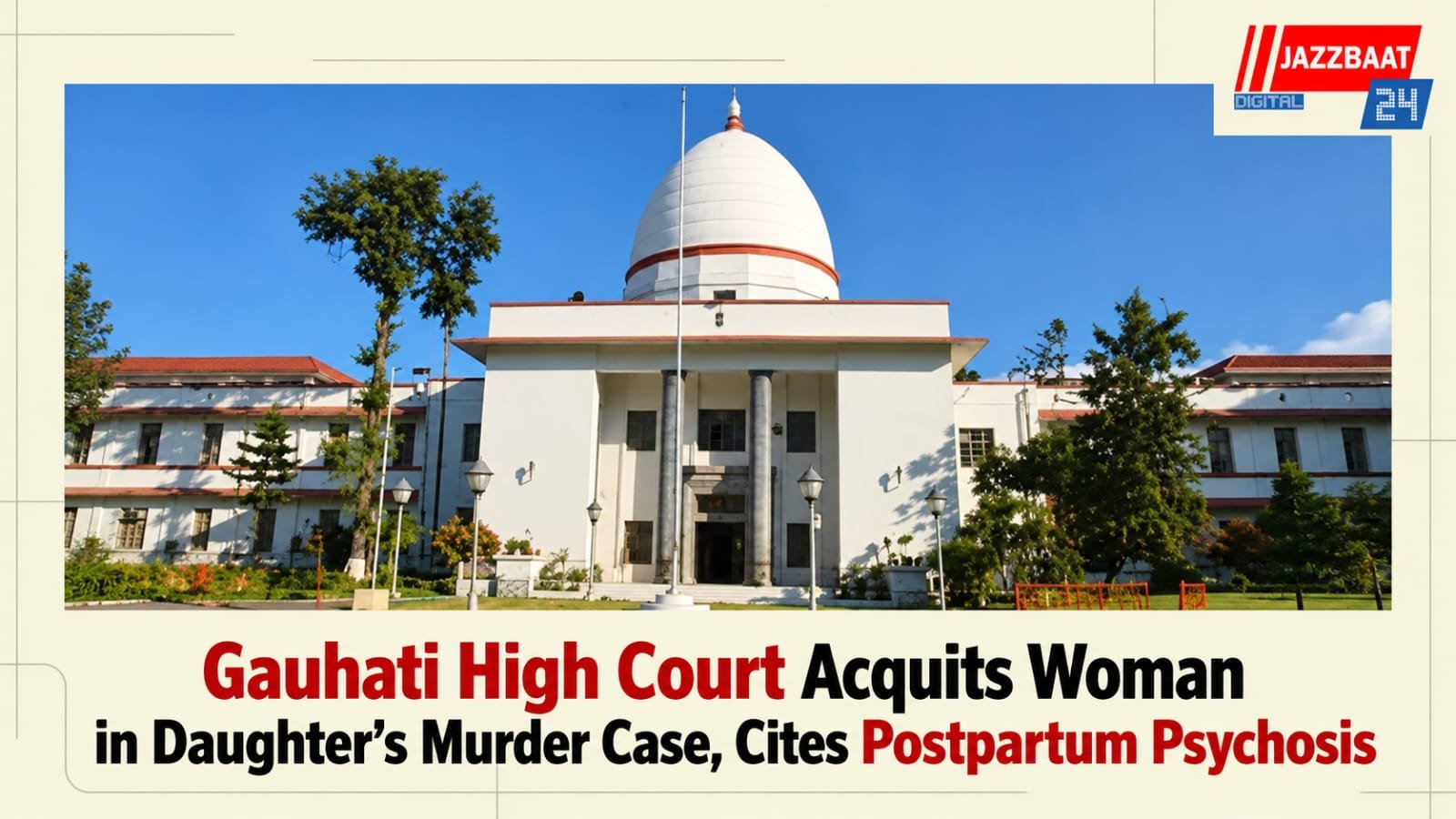
The Gauhati High Court has acquitted a woman who was sentenced to life imprisonment for allegedly murdering her one-month-old daughter in Assam, observing that the prosecution failed to establish her guilt beyond reasonable doubt.
A division bench of Justices Michael Jothankhuma and Rajesh Mazumdar set aside the trial court’s September 12, 2023 judgment in an order issued on October 6. The court held that the woman’s alleged confession could not be treated as admissible evidence because it was recorded in the presence of a policewoman.
The case dates back to October 15, 2016, when the woman’s husband filed an FIR at Disangmukh police station in Sivasagar district, reporting that their one-month-and-eight-day-old daughter had gone missing during the night.
According to the prosecution, the woman was with the infant and her two-year-old son when the incident allegedly occurred. During police interrogation, she reportedly confessed to killing the baby and disposing of the body in the Dikhow River.
However, during the trial, the woman’s husband denied telling investigators that she had confessed to villagers about throwing the child into the river. Other witnesses also said they had learned about the alleged confession from the police.
The High Court noted that the woman’s conviction was primarily based on her confessional statement recorded before a judicial magistrate. Since a policewoman was present when the statement was recorded, the court said the accused could not be considered completely free from police influence or pressure.
The court also noted that the infant’s body was never recovered despite an extensive search. It further observed that the woman’s statement during the sentencing hearing could not be treated as additional evidence because it was not made under oath.
Another significant aspect of the judgment was the court’s observation regarding postpartum psychosis (PPP), a serious but temporary mental health condition that can occur after childbirth. The woman had reportedly stated that she was mentally unwell after giving birth and did not like the child.
The court said the trial court should have considered the possibility of postpartum psychosis before convicting her under Sections 302 and 201 of the Indian Penal Code.
According to psychiatrist Nahid Suraiya Islam, postpartum psychosis can cause hallucinations, delusions and severe mood disturbances, potentially putting both the mother and baby at risk. She said the condition is temporary and can be treated with medication.
The High Court ultimately acquitted the woman and directed that she be released from custody immediately, unless she was required in another case.




Reader Comments 0