
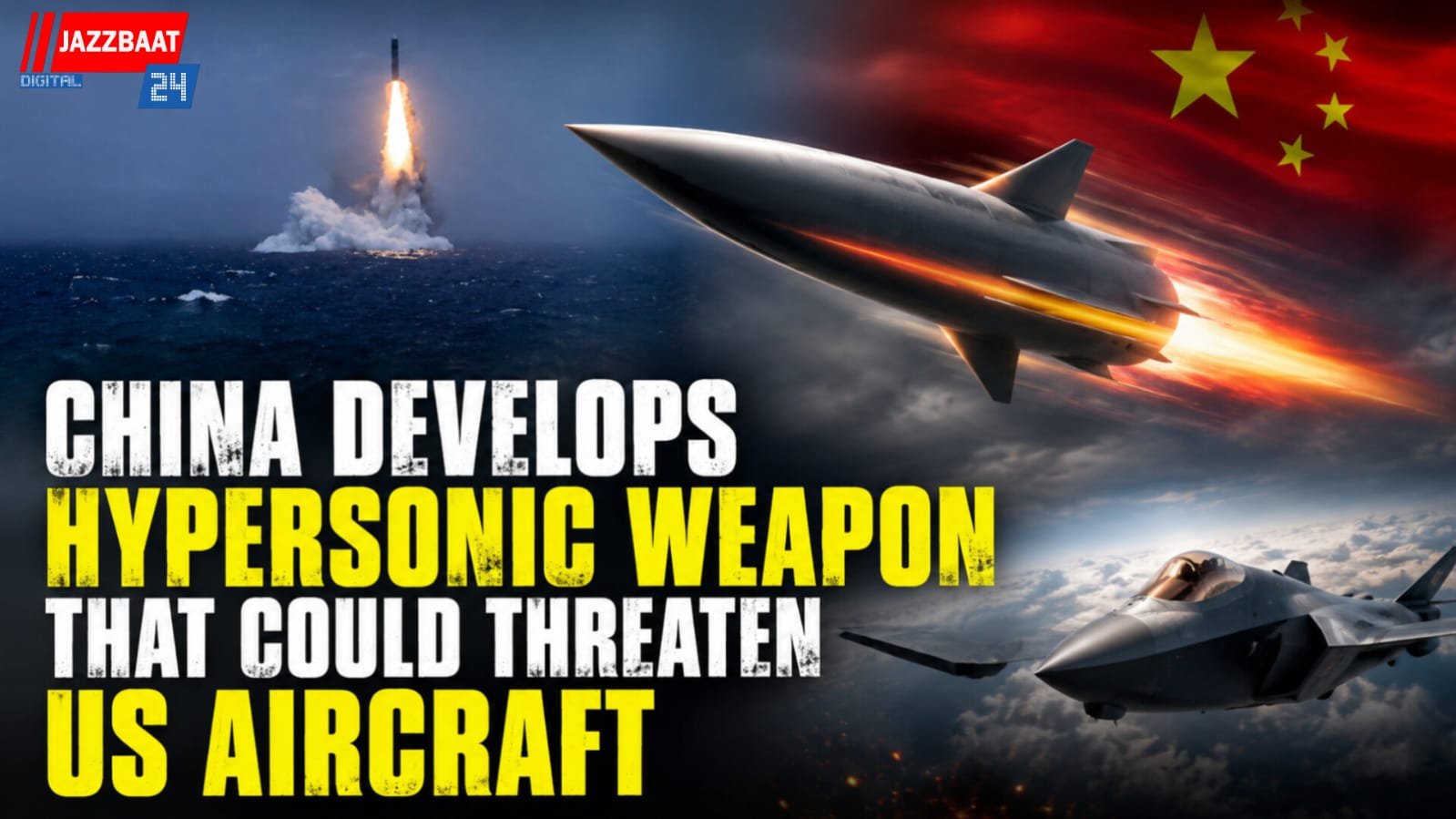
Beijing: China has developed a highly unusual hypersonic weapon capable of potentially targeting aircraft thousands of kilometres away, a development that could pose a new challenge to the United States in any future conflict in the Indo-Pacific.
According to a Bloomberg report cited by NDTV, China is the only country publicly known to be developing and operating hypersonic glide vehicles (HGVs) that can launch air-to-air weapons. The technology could allow Chinese forces to threaten high-value American aircraft operating far from the battlefield.
Unlike conventional air-to-air missiles, the reported system uses a hypersonic glide vehicle launched by a missile. The vehicle travels through the atmosphere at speeds above Mach 5 and can manoeuvre during flight, making its trajectory more difficult to predict.
The capability is particularly significant because it could target aircraft that normally operate well behind fighter jets and away from the immediate combat zone. These include aerial refuelling tankers, airborne early-warning and control aircraft and flying command centres. Such aircraft provide fuel, surveillance, communications and battlefield coordination to combat fighters.
The reported range is also striking. An HGV launched from China's DF-17 missile could travel roughly 2,414 kilometres, according to the report. That is slightly less than the distance between mainland China and Guam, a strategically important US territory and military hub in the Pacific. China's more powerful DF-27 missile is believed to have a range of around 8,000 kilometres, potentially putting targets much farther away at risk.
However, possessing the technology does not automatically mean China could easily destroy a moving aircraft at such distances. Hitting an aircraft travelling hundreds of kilometres per hour requires extremely accurate information about its location. A missile taking many minutes to reach its target could arrive after the aircraft has moved significantly.
This creates a complex “kill chain” involving satellites, radar, surveillance aircraft and communications networks. China would need to continuously track the aircraft and transmit updated targeting information to the weapon.
The system could nevertheless alter US military planning. American forces rely heavily on tanker aircraft and airborne command-and-control platforms to extend the range and effectiveness of fighter aircraft. Moving these valuable assets farther from potential combat zones could reduce their ability to support operations.
There is also a potential escalation risk. A long-range missile launch could be difficult for an opponent to immediately identify, raising concerns about miscalculation during a crisis.
China has been rapidly expanding its missile capabilities, including hypersonic and long-range systems. The latest reported development highlights Beijing's broader effort to challenge the traditional advantages enjoyed by the US military in the air and across the Indo-Pacific.


Reader Comments 0