
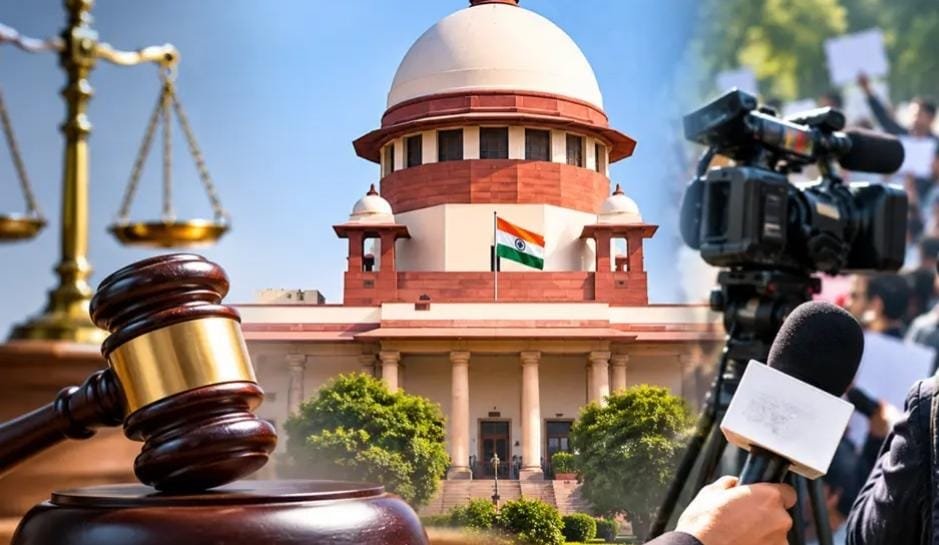
New Delhi, Nov 26: The Supreme Court on Thursday indicated that it would examine whether accredited journalists enjoy greater protection than independent or self-proclaimed reporters while covering protests, raising questions about the definition of a journalist, press freedom and police powers.
A bench comprising Chief Justice Surya Kant and Justices Joymalya Bagchi and V Mahadevan was hearing petitions filed by media organisations, including the Kerala Union of Working Journalists (KUWJ), over allegations that Delhi Police detained, manhandled and obstructed journalists covering protests demanding the resignation of Chief Election Commissioner Gyanesh Kumar.
“Self-proclaimed journalists may not have the same protection as accredited journalists,” Justice Bagchi observed during the hearing.
The court raised broader questions about who qualifies as a journalist, whether accreditation or institutional affiliation should determine the protection available to media personnel, and whether journalists enjoy any special privileges vis-a-vis law enforcement agencies while reporting from protest sites.
It also sought to examine whether the forcible removal of a journalist from a protest site amounts to custody and what constitutional consequences such action could entail.
The bench indicated that the issue involved balancing journalistic freedom with the requirement of maintaining public order, while examining whether the existing framework adequately addresses police interaction with media personnel covering demonstrations.
The court disposed of a KUWJ petition concerning the alleged detention and manhandling of seven journalists, directing that their individual grievances be examined by a court-appointed inquiry committee without expressing any opinion on the merits of the allegations.
The journalists whose complaints have been referred to the committee include Suhail Muhammed and V S Rahul of 24News, Sajin of Asianet News, Roshni Rajan of Reporter TV, Vishnuprasad of Mathrubhumi, Miji P Jose of Manorama News and independent reporter Farasana.
Delhi Police had earlier filed an affidavit before the Supreme Court, maintaining that it had not knowingly obstructed journalists from discharging their professional duties.
The police also argued that social media influencers, content creators and reel-makers could not automatically claim the same protection available to accredited journalists under the court's earlier directions regulating movement at protest sites.
“The Delhi Police has, at no point, sought to obstruct, impede or interfere with the bona fide discharge of journalistic duties, whether during the protests in question or otherwise,” the affidavit stated.
The petitions filed by organisations including the Network of Women in Media, India, Free Speech Collective, Delhi Union of Journalists and KUWJ alleged that police action against journalists violated the Supreme Court's earlier directions concerning media personnel at protest sites.
The proceedings bring into focus the changing nature of journalism, with reporting increasingly undertaken by freelancers, independent reporters and digital journalists who may not have formal accreditation or institutional backing.
While accreditation serves as a mechanism for identifying media personnel, the broader question before the court is whether the absence of formal credentials can affect the protection available to those engaged in genuine journalistic work.
The Supreme Court's observations do not constitute a final ruling on the rights of independent or unaccredited journalists. The larger legal questions remain open for examination, even as the individual allegations have been referred to the inquiry committee.
The matter could have implications for journalists covering protests and other sensitive situations, particularly where restrictions are imposed by authorities in the name of crowd control and public order.
Reader Comments 0