
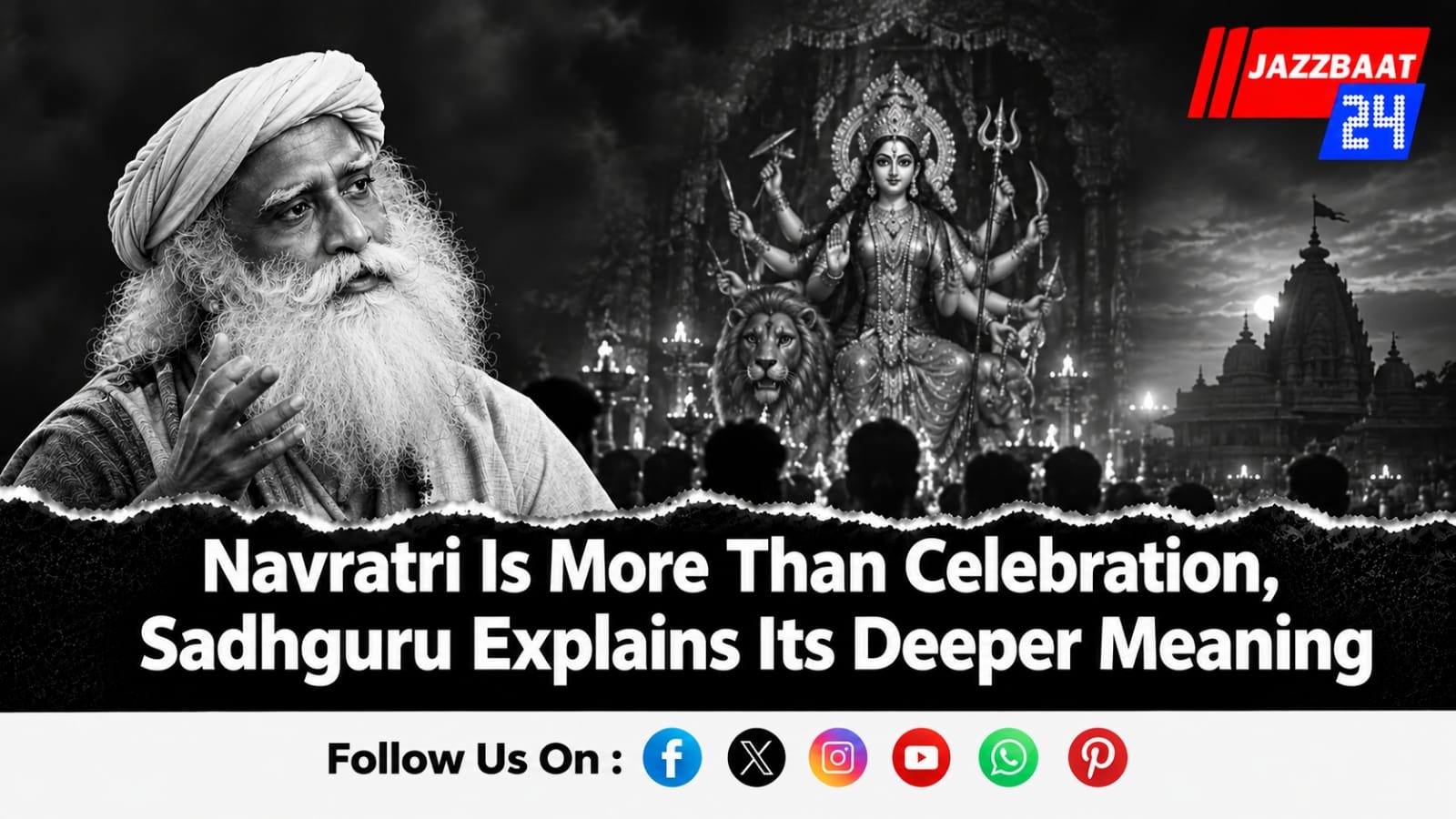
Navratri is widely associated with devotion, fasting, music, dance and festive celebrations. However, according to spiritual leader Sadhguru, the nine-day festival can also be viewed as a period of inner exploration and transformation.
Sharad Navratri in 2026 will begin on October 11 and conclude on October 19. Sadhguru’s explanation of the festival focuses on the three qualities of tamas, rajas and sattva, which are traditionally understood as different aspects of human nature and experience.
The nine nights are divided into three phases of three days each. The first three days are associated with tamas, the next three with rajas, and the final three with sattva. According to Sadhguru, each phase offers an opportunity to observe a different dimension of life and become more conscious of one’s thoughts, actions and inner state.
The first three days are connected with Durga and Kali and the quality of tamas. Sadhguru relates tamas to the Earth, physical existence, birth and stillness. This phase can be used to reflect on the physical body and its connection with nature. He also highlights the temporary nature of the body as a reminder to look beyond purely physical concerns.
The middle three days are associated with Lakshmi and rajas. Rajas represents activity, movement and the drive to act. Sadhguru encourages people to examine the way they engage with their daily activities during this period. According to his teaching, action itself is not necessarily binding or liberating; its impact can depend on the level of awareness with which it is performed.
The final three days are linked to Saraswati and sattva, which is associated with clarity, knowledge and spiritual awareness. This phase can provide an opportunity to step away from constant activity, focus on learning and create space for reflection.
The festival culminates in Vijayadashami, the tenth day. Sadhguru describes this day as representing a movement beyond the three qualities rather than simply the pursuit of power, wealth or knowledge.
From this perspective, Navratri becomes more than a traditional festival. It can also be seen as a period for self-observation, reflection and greater awareness. The nine nights offer a structured way to look at different aspects of human experience, while Vijayadashami represents the possibility of moving beyond these limitations.
Sadhguru’s interpretation therefore places the focus not only on how Navratri is celebrated externally, but also on how consciously the festival is experienced within.



Reader Comments 0