
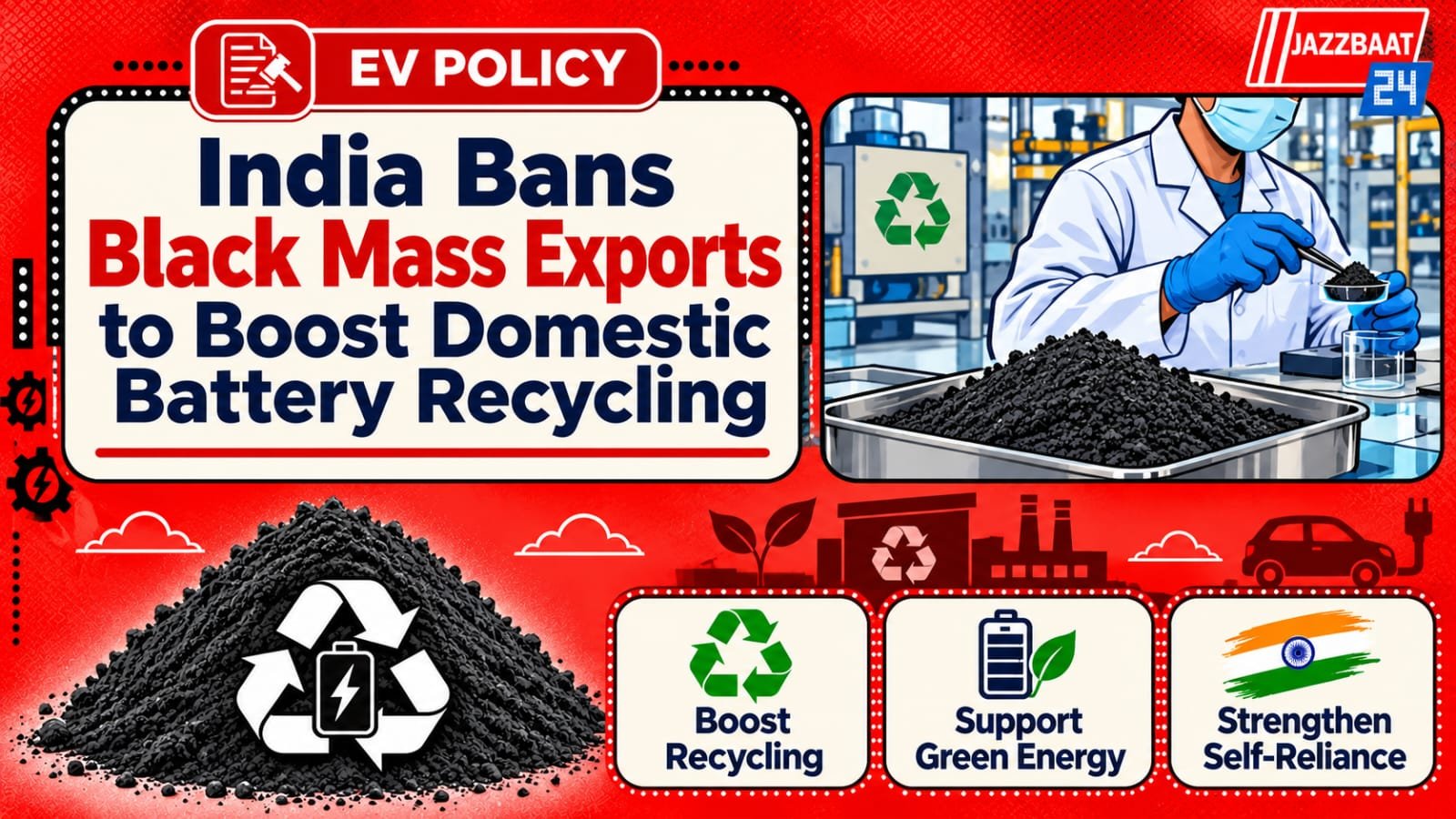
India has prohibited the export of lithium-ion battery black mass, a move aimed at retaining valuable critical minerals within the country and strengthening its domestic battery recycling industry. The decision, announced on November 11, is expected to improve the availability of raw materials for Indian recyclers, reduce dependence on imports and support the country's growing electric vehicle and clean-energy sectors.
But what exactly is black mass, and why has it become so important?
Black mass is a fine, dark powder produced when used lithium-ion batteries and battery manufacturing waste are dismantled, shredded and processed. It may look like ordinary industrial dust, but it contains valuable materials such as lithium, cobalt, nickel and manganese. These minerals are essential for manufacturing batteries used in electric vehicles, smartphones, laptops and energy storage systems.
The recycling process begins with the collection and dismantling of discarded batteries. Their outer casings and other components are separated before the battery cells are shredded. Through mechanical processing, materials such as plastics, copper and aluminium are removed. The remaining concentrated mixture of battery materials is known as black mass.
This powder then undergoes further chemical or thermal treatment to recover individual minerals. Depending on the technology used, lithium, cobalt, nickel and manganese can be extracted, purified and processed into materials suitable for manufacturing new batteries.
Why has India banned its export?
The Directorate General of Foreign Trade (DGFT), under the Commerce Ministry, issued Notification No. 49/2026-27 on November 10, changing the export policy for lithium-ion battery black mass under ITC (HS) Code 85491400 from 'Free' to 'Prohibited'. The restriction has come into immediate effect and will remain until further orders.
The government says Indian recycling and refining capacity has expanded considerably but is not being fully utilised because of insufficient raw material. While domestically generated black mass has been sent overseas, some Indian recyclers have reportedly had to import similar material to meet their requirements.
By retaining this material within the country, the government wants to ensure that more valuable minerals are recovered locally instead of being processed abroad.
A boost for India's EV ambitions
The decision is expected to benefit battery recyclers, mineral processors and manufacturers involved in electric mobility and energy storage. It could also encourage fresh investment, create employment opportunities and reduce the country's foreign exchange expenditure on imported critical minerals.
The move complements the National Critical Mineral Mission and the ₹1,500 crore incentive scheme approved in September 2025 to develop recycling facilities for recovering critical minerals from battery waste and electronic waste.
India's growing electric vehicle market will require a dependable supply of battery materials in the coming years. Recovering minerals from discarded batteries offers an alternative to relying entirely on freshly mined resources.
However, the challenge will be to develop advanced recycling technology, ensure environmentally safe processing and establish efficient collection systems.
The larger objective is to turn battery waste into a valuable domestic resource, allowing India to recover, refine and reuse critical minerals rather than lose them to overseas processing.




Reader Comments 0