
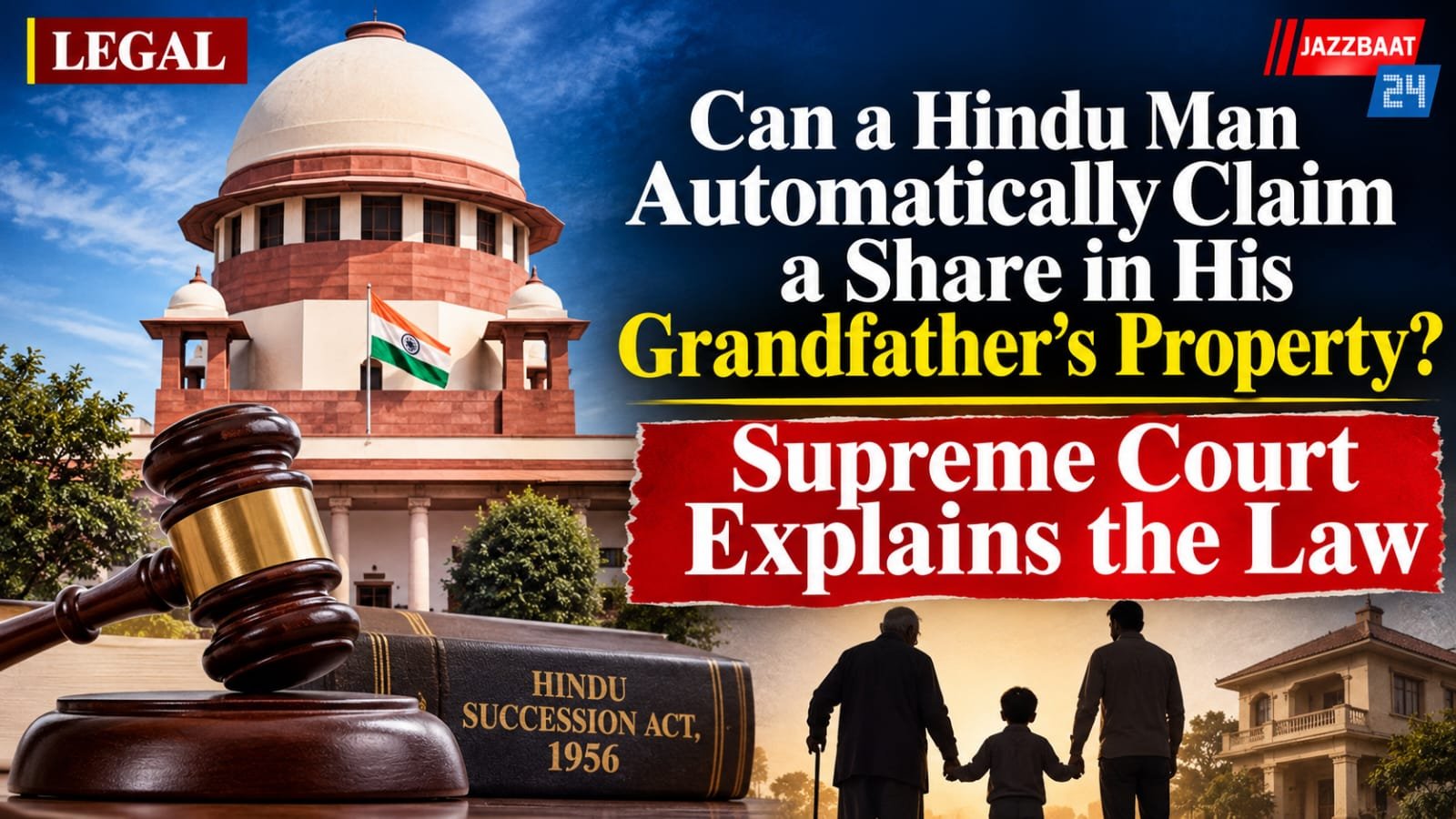
New Delhi: Does a grandson automatically acquire a legal share in his grandfather’s property simply because he is born into the family? The Supreme Court of India has clarified that the answer is not necessarily yes. A person's right to claim a share in a grandfather's property depends on how the property was acquired, inherited and legally held.
In a significant judgment delivered this November, 2026, the Supreme Court dismissed a grandson's claim to a share in a property inherited by his father from his grandfather. The court ruled that a grandson cannot claim an automatic birthright in property that his father inherited as an individual under the Hindu Succession Act, 1956, particularly when the father is still alive.
The judgment was delivered by a bench comprising Justices Augustine George Masih and Sunita Agarwal in *J. Rajesh (Minor) v. M. Kumaran*, Civil Appeal No. 7020 of 2012.
How did the property dispute begin?
The case concerned a property originally owned by N. Ramakrishnan. Following his death, a partition suit was filed by his daughter in 1993 to divide the property among the legal heirs.
Under a compromise decree dated February 3, 1994, Ramakrishnan's son, M. Kumaran, received a plot measuring 1,811 square feet.
Kumaran subsequently sold the property through two sale deeds executed in April 1997.
However, his son, J. Rajesh, challenged the sale, arguing that the property was ancestral and that he had acquired a legal interest in it by birth. He sought a partition and a half share in the disputed property.
Although the trial court initially ruled in Rajesh's favour, the appellate court overturned the decision. The Madras High Court subsequently upheld the appellate court's ruling, prompting the grandson to approach the Supreme Court.
What did the Supreme Court say?
The Supreme Court examined Section 8 of the Hindu Succession Act, 1956, which governs the inheritance of property when a Hindu man dies without leaving a valid will.
Under Section 8, the property devolves upon the deceased person's Class I legal heirs. These include his son, daughter, widow and mother, among others.
Importantly, the son of a living son is not independently listed as a Class I heir. Therefore, when the grandson's father is alive and inherits the property, the grandson cannot claim a direct share in his grandfather's estate under Section 8.
The bench observed that a grandson does not automatically acquire rights in property inherited by his father under the provisions of the Hindu Succession Act.
The court further clarified that once the grandfather's property was distributed among his legal heirs through partition, each heir became the exclusive owner of the respective share. The property allotted to Kumaran therefore became his individual property, which he was legally entitled to sell.
Does every grandson have no right to ancestral property?
The judgment does not mean that grandchildren can never claim a share in ancestral property.
Under the Mitakshara school of Hindu law, a coparcener can acquire an interest by birth in genuine ancestral coparcenary property. Daughters also have equal coparcenary rights under the 2005 amendment to the Hindu Succession Act.
However, property inherited by a father under Section 8 of the Hindu Succession Act generally becomes his individual property rather than automatically becoming ancestral property in relation to his children.
There is also an important distinction in the application of Hindu personal law. The Dayabhaga school, traditionally followed in West Bengal and Assam, does not recognise a son's birthright in family property in the same manner as Mitakshara law.
A grandson may also inherit through the branch of a predeceased son, subject to the applicable succession provisions. Property received through a valid will or gift can involve different legal considerations.
What is the final legal position?
By dismissing the appeal, the Supreme Court upheld the father's right to deal with the property allotted to him after the partition. It made clear that merely being born into a family does not automatically create a right to every property that once belonged to a grandfather.
The ruling highlights an important principle of Hindu succession law: the legal character and history of a property matter more than simply describing it as ancestral.
For families involved in inheritance disputes, the judgment serves as a reminder that property rights must be determined by examining ownership records, succession documents, partition decrees and the applicable school of Hindu law.
The bottom line:A grandson does not automatically become a co-owner of his grandfather's property merely by birth. Whether he can claim a share depends on the nature of the property, the manner in which it devolved and the applicable inheritance law.


Reader Comments 0