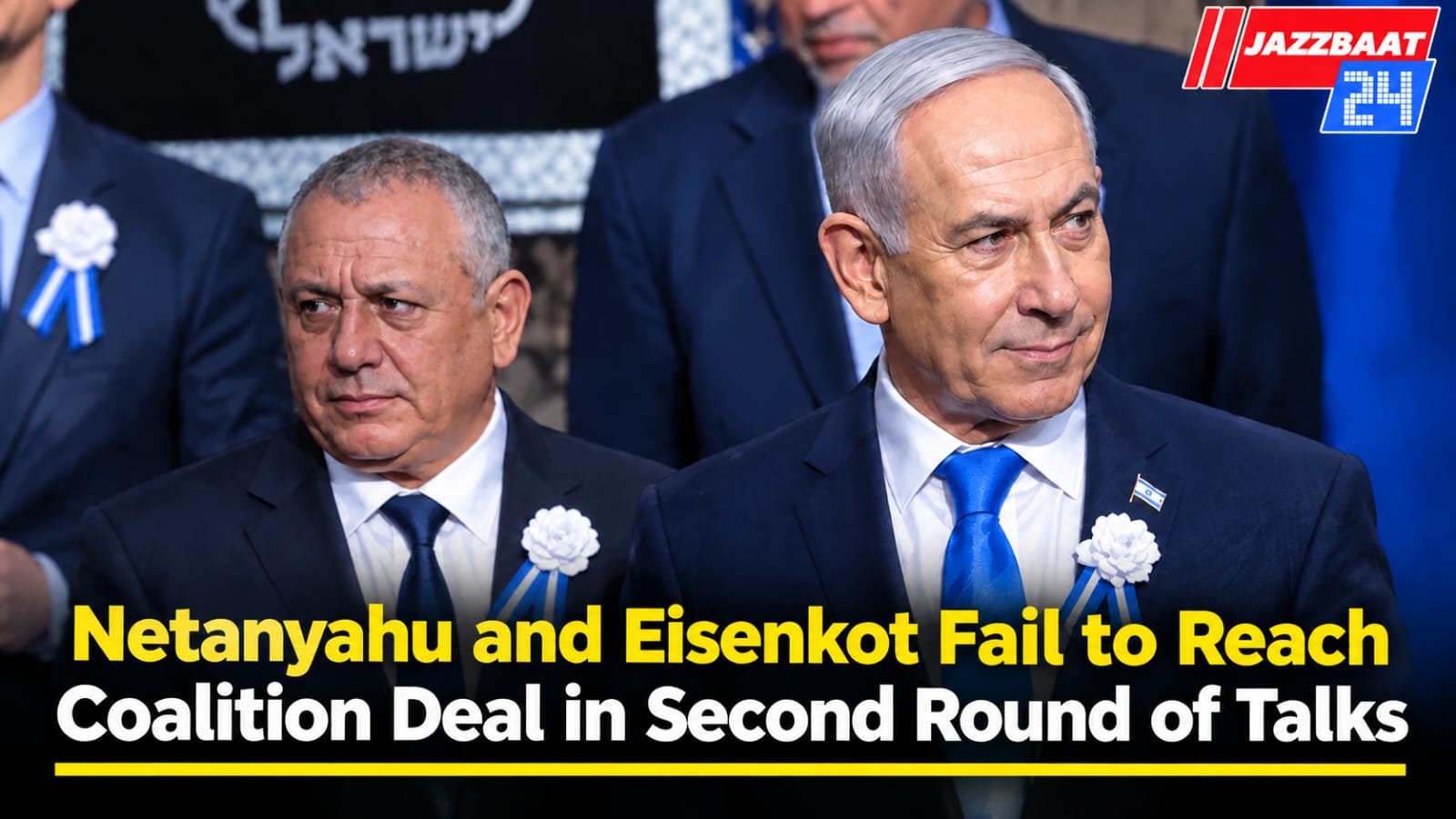
Israel's efforts to form a new government have encountered another setback after caretaker Prime Minister Benjamin Netanyahu's Likud Party and opposition leader Gadi Eisenkot's Yashar Party failed to reach an agreement during their second round of coalition negotiations on Sunday, November 22.
The two parties held a four-hour meeting at a hotel in Herzliya, near Tel Aviv, to discuss the possibility of forming a national unity government. However, significant disagreements over political leadership, security policies and potential coalition partners prevented any breakthrough.
In a joint statement after the meeting, both sides said they had presented their positions on several important issues and discussed them in detail. They also confirmed that another meeting would take place, although no date was announced.
One of the biggest obstacles remains the question of who would serve as prime minister. Netanyahu is pushing for a unity arrangement that could involve sharing the premiership with Eisenkot through a rotation agreement. However, Eisenkot has resisted serving in a government initially led by Netanyahu.
Another major disagreement concerns the possible inclusion of far-right National Security Minister Itamar Ben-Gvir. Likud reportedly wants Ben-Gvir's party, Otzma Yehudit, included in the government, while Eisenkot's Yashar Party has made clear its opposition to such an arrangement.
The parties also discussed several sensitive policy issues, including military conscription for ultra-Orthodox Jewish communities, judicial reforms and the establishment of an independent commission of inquiry into the October 7, 2023, Hamas-led attacks.
The October 2026 elections left Israel without a clear parliamentary majority. Eisenkot's political bloc secured 48 seats in the 120-member Knesset, falling 13 seats short of the 61 required for a majority.
Eisenkot has until December 6 to form a government, although he can request an additional 14 days. He is also considering the possibility of forming a minority government with support from Arab political parties if negotiations with Likud and other potential partners fail.
Meanwhile, former Prime Minister Naftali Bennett has expressed support for a unity government led by Eisenkot but ruled out joining an administration headed by Netanyahu.
The continuing deadlock has left Israel's political future uncertain. With the deadline approaching, the coming days will be crucial in determining whether the rival political camps can reach a compromise or whether the country faces another round of political uncertainty.

Reader Comments 0