
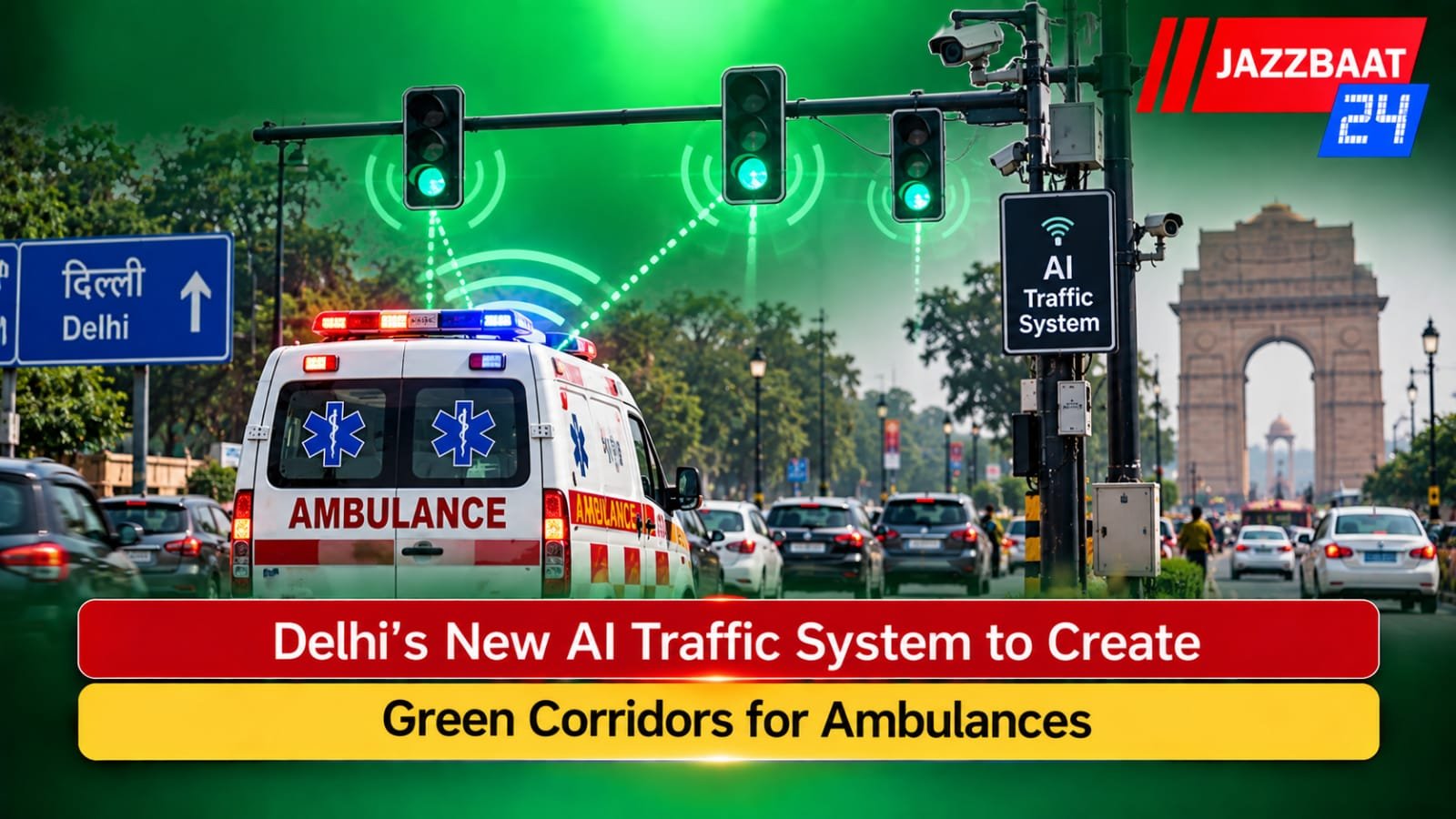
Delhi is set to introduce an artificial intelligence-enabled traffic management system that will allow ambulances and other emergency vehicles to move through busy intersections with fewer delays.
The Union Cabinet on Wednesday approved the Intelligent Traffic Management System (ITMS) for Delhi at an estimated cost of ₹1,789.52 crore. The project is aimed at modernising the capital’s traffic network by combining adaptive traffic signals, automated enforcement and real-time traffic management.
One of the key features of the new system will be the creation of automatic “green corridors” for emergency vehicles. Under the proposed system, ambulances and other emergency vehicles will be equipped with sensors capable of communicating with traffic signals.
According to S Velmurugan, senior adviser at the National Council of Applied Economic Research and former chief scientist of the Central Road Research Institute, the system will detect an approaching emergency vehicle and automatically change the traffic signal to green. The signal would remain green until the vehicle crosses the junction.
The technology could potentially detect an emergency vehicle several hundred metres before it reaches an intersection. Velmurugan said the detection range could, depending on the technology used, be around 200 to 500 metres.
This could allow the system to prepare the next traffic signal before an ambulance reaches it. If the technology works across successive intersections, emergency vehicles could effectively receive a continuous green passage along their route, reducing the time spent waiting at traffic signals.
However, some operational details are yet to be finalised. Officials and experts will have to determine how the system responds when an emergency vehicle is outside the specified detection range and how traffic should be managed around the vehicle.
The ITMS will be implemented across 42 important traffic corridors in Delhi in three phases over 24 months. This will be followed by five years of operation and maintenance.
Under the first phase, five traffic corridors are scheduled to be covered within 12 months. The plan includes 250 adaptive signal junctions and 271 enforcement points. The second phase will cover seven additional corridors and include 222 signalised junctions and 236 enforcement points.
Unlike conventional traffic signals that operate according to fixed timings, adaptive signals will analyse real-time traffic conditions and automatically adjust signal cycles according to the volume of vehicles on the road.
The system will also integrate technology-based enforcement measures. These include cameras and systems capable of detecting speeding, red-light violations, stop-line violations and other traffic offences.
The idea of introducing an integrated traffic management system in Delhi is not new. Officials said the concept was first proposed in 2008, when authorities considered using traffic sensors, CCTV cameras, automatic number plate recognition systems and automated violation detection.
Several of these technologies have since been introduced separately across the city. The latest ITMS proposal seeks to bring them together under a single, AI-based traffic management framework.
Delhi Police submitted the latest proposal to the Ministry of Home Affairs in February this year. Once implemented, the system is expected to give authorities greater control over traffic flows while providing emergency vehicles with technology-assisted priority on congested roads.




Reader Comments 0